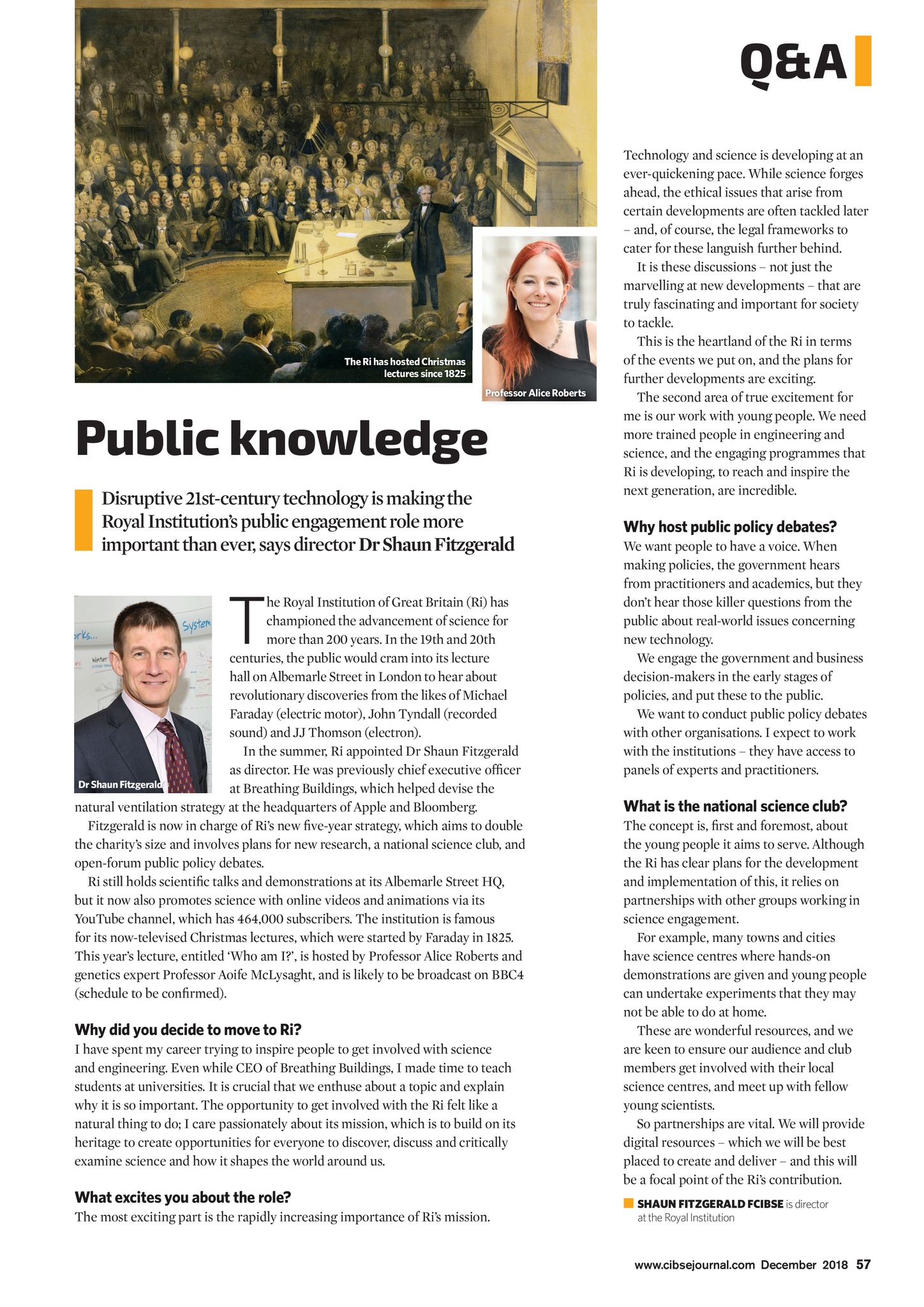
Q&A The Ri has hosted Christmas lectures since 1825 Professor Alice Roberts Public knowledge Disruptive 21st-century technology is making the Royal Institutions public engagement role more important than ever, says director Dr Shaun Fitzgerald T he Royal Institution of Great Britain (Ri) has championed the advancement of science for more than 200 years. In the 19th and 20th centuries, the public would cram into its lecture hall on Albemarle Street in London to hear about revolutionary discoveries from the likes of Michael Faraday (electric motor), John Tyndall (recorded sound) and JJ Thomson (electron). In the summer, Ri appointed Dr Shaun Fitzgerald as director. He was previously chief executive officer Dr Shaun Fitzgerald at Breathing Buildings, which helped devise the natural ventilation strategy at the headquarters of Apple and Bloomberg. Fitzgerald is now in charge of Ris new five-year strategy, which aims to double the charitys size and involves plans for new research, a national science club, and open-forum public policy debates. Ri still holds scientific talks and demonstrations at its Albemarle Street HQ, but it now also promotes science with online videos and animations via its YouTube channel, which has 464,000 subscribers. The institution is famous for its now-televised Christmas lectures, which were started by Faraday in 1825. This years lecture, entitled Who am I?, is hosted by Professor Alice Roberts and genetics expert Professor Aoife McLysaght, and is likely to be broadcast on BBC4 (schedule to be confirmed). Why did you decide to move to Ri? I have spent my career trying to inspire people to get involved with science and engineering. Even while CEO of Breathing Buildings, I made time to teach students at universities. It is crucial that we enthuse about a topic and explain why it is so important. The opportunity to get involved with the Ri felt like a natural thing to do; I care passionately about its mission, which is to build on its heritage to create opportunities for everyone to discover, discuss and critically examine science and how it shapes the world around us. What excites you about the role? The most exciting part is the rapidly increasing importance of Ris mission. Technology and science is developing at an ever-quickening pace. While science forges ahead, the ethical issues that arise from certain developments are often tackled later and, of course, the legal frameworks to cater for these languish further behind. It is these discussions not just the marvelling at new developments that are truly fascinating and important for society to tackle. This is the heartland of the Ri in terms of the events we put on, and the plans for further developments are exciting. The second area of true excitement for me is our work with young people. We need more trained people in engineering and science, and the engaging programmes that Ri is developing, to reach and inspire the next generation, are incredible. Why host public policy debates? We want people to have a voice. When making policies, the government hears from practitioners and academics, but they dont hear those killer questions from the public about real-world issues concerning new technology. We engage the government and business decision-makers in the early stages of policies, and put these to the public. We want to conduct public policy debates with other organisations. I expect to work with the institutions they have access to panels of experts and practitioners. What is the national science club? The concept is, first and foremost, about the young people it aims to serve. Although the Ri has clear plans for the development and implementation of this, it relies on partnerships with other groups working in science engagement. For example, many towns and cities have science centres where hands-on demonstrations are given and young people can undertake experiments that they may not be able to do at home. These are wonderful resources, and we are keen to ensure our audience and club members get involved with their local science centres, and meet up with fellow young scientists. So partnerships are vital. We will provide digital resources which we will be best placed to create and deliver and this will be a focal point of the Ris contribution. SHAUN FITZGERALD FCIBSE is director at the Royal Institution www.cibsejournal.com December 2018 57 CIBSE Dec18 pp57 Q&A.indd 57 23/11/2018 16:18