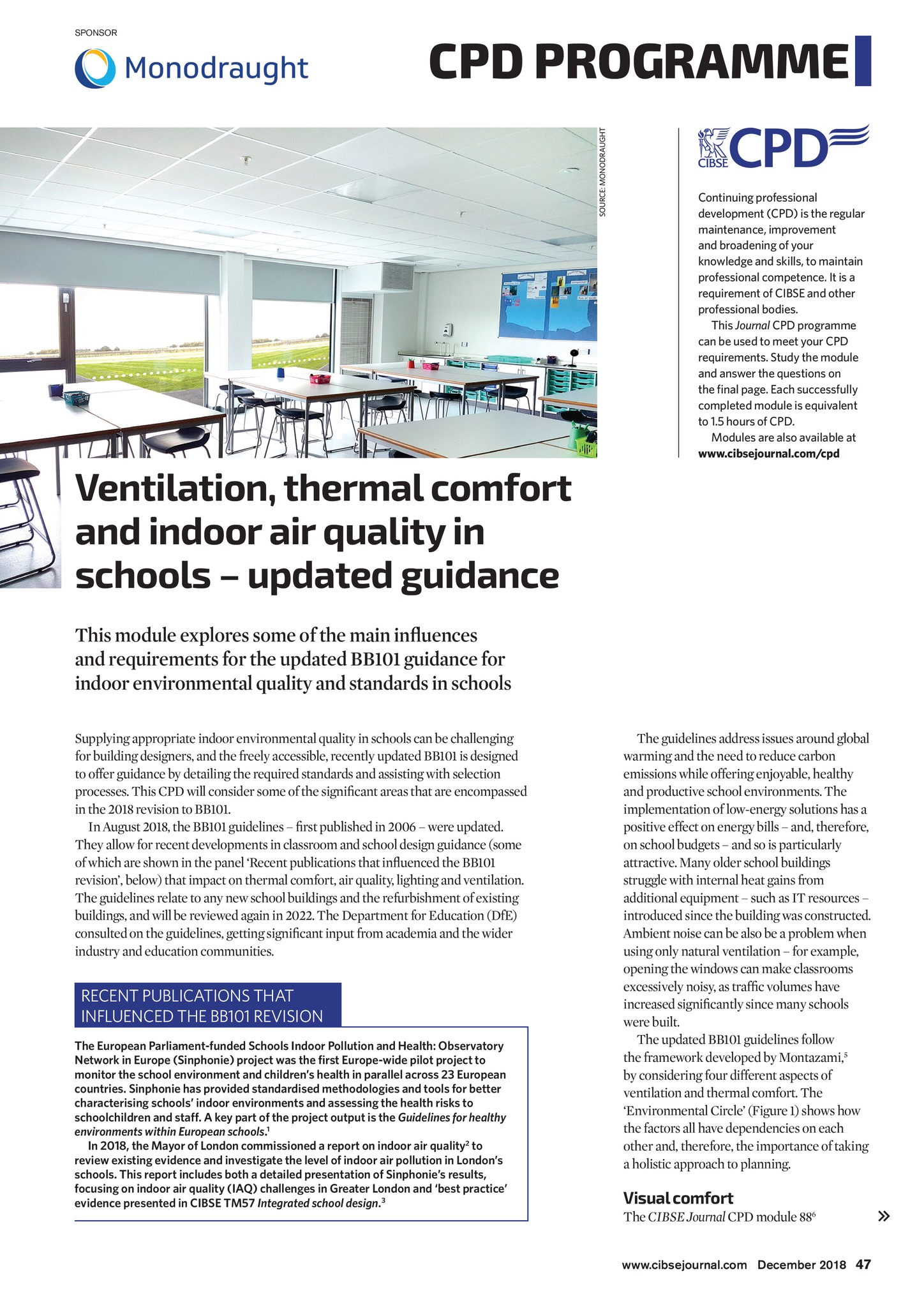
CPD PROGRAMME Source: Monodraught SPONSOR Continuing professional development (CPD) is the regular maintenance, improvement and broadening of your knowledge and skills, to maintain professional competence. It is a requirement of CIBSE and other professional bodies. This Journal CPD programme can be used to meet your CPD requirements. Study the module and answer the questions on the final page. Each successfully completed module is equivalent to 1.5 hours of CPD. Modules are also available at www.cibsejournal.com/cpd Ventilation, thermal comfort and indoor air quality in schools updated guidance This module explores some of the main influences and requirements for the updated BB101 guidance for indoor environmental quality and standards in schools Supplying appropriate indoor environmental quality in schools can be challenging for building designers, and the freely accessible, recently updated BB101 is designed to offer guidance by detailing the required standards and assisting with selection processes. This CPD will consider some of the significant areas that are encompassed in the 2018 revision to BB101. In August 2018, the BB101 guidelines first published in 2006 were updated. They allow for recent developments in classroom and school design guidance (some of which are shown in the panel Recent publications that influenced the BB101 revision, below) that impact on thermal comfort, air quality, lighting and ventilation. The guidelines relate to any new school buildings and the refurbishment of existing buildings, and will be reviewed again in 2022. The Department for Education (DfE) consulted on the guidelines, getting significant input from academia and the wider industry and education communities. Recent publications that influenced the BB101 revision The European Parliament-funded Schools Indoor Pollution and Health: Observatory Network in Europe (Sinphonie) project was the first Europe-wide pilot project to monitor the school environment and childrens health in parallel across 23 European countries. Sinphonie has provided standardised methodologies and tools for better characterising schools indoor environments and assessing the health risks to schoolchildren and staff. A key part of the project output is the Guidelines for healthy environments within European schools.1 In 2018, the Mayor of London commissioned a report on indoor air quality2 to review existing evidence and investigate the level of indoor air pollution in Londons schools. This report includes both a detailed presentation of Sinphonies results, focusing on indoor air quality (IAQ) challenges in Greater London and best practice evidence presented in CIBSE TM57 Integrated school design.3 The guidelines address issues around global warming and the need to reduce carbon emissions while offering enjoyable, healthy and productive school environments. The implementation of low-energy solutions has a positive effect on energy bills and, therefore, on school budgets and so is particularly attractive. Many older school buildings struggle with internal heat gains from additional equipment such as IT resources introduced since the building was constructed. Ambient noise can be also be a problem when using only natural ventilation for example, opening the windows can make classrooms excessively noisy, as traffic volumes have increased significantly since many schools were built. The updated BB101 guidelines follow the framework developed by Montazami,5 by considering four different aspects of ventilation and thermal comfort. The Environmental Circle (Figure 1) shows how the factors all have dependencies on each other and, therefore, the importance of taking a holistic approach to planning. Visual comfort The CIBSE Journal CPD module 886 www.cibsejournal.com December 2018 47 CIBSE Dec18 pp47-50 CPD138 v2.indd 47 23/11/2018 16:15