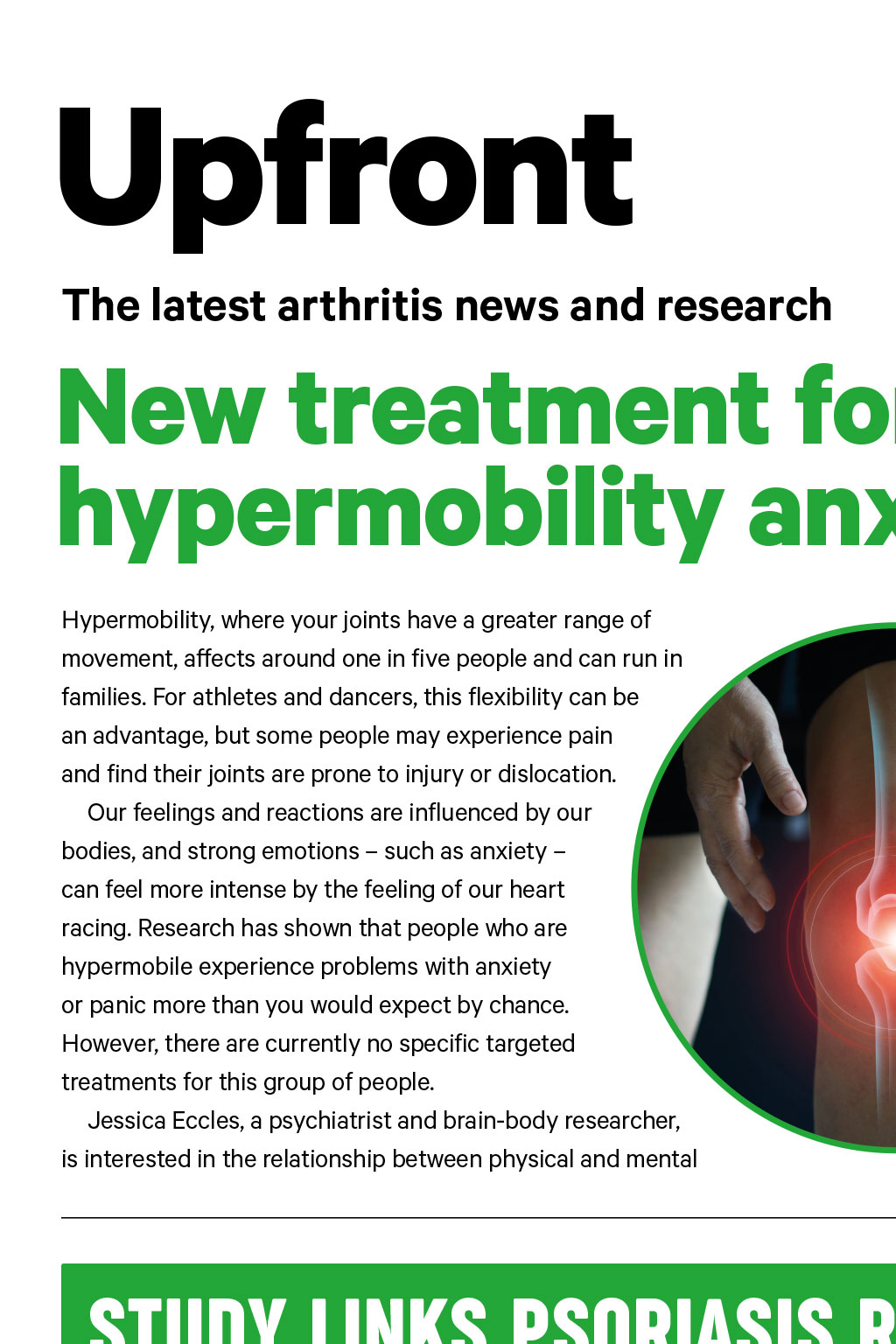
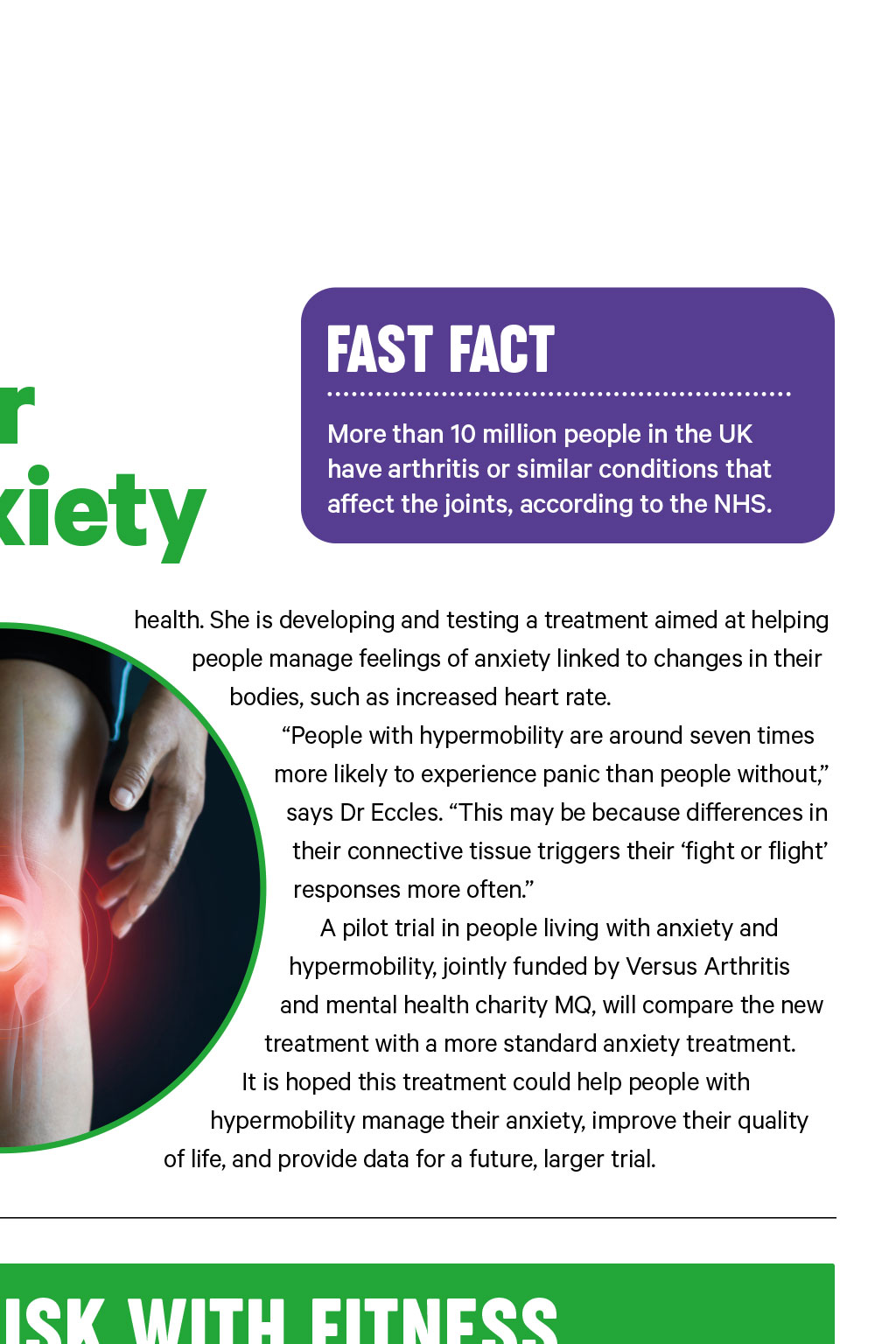


Upfront Hypermobility, where your joints have a greater range of movement, affects around one in five people and can run in families. For athletes and dancers, this flexibility can be an advantage, but some people may experience pain and find their joints are prone to injury or dislocation. Our feelings and reactions are influenced by our bodies, and strong emotions such as anxiety can feel more intense by the feeling of our heart racing. Research has shown that people who are hypermobile experience problems with anxiety or panic more than you would expect by chance. However, there are currently no specific targeted treatments for this group of people. Jessica Eccles, a psychiatrist and brain-body researcher, is interested in the relationship between physical and mental FAST FACT More than 10 million people in the UK have arthritis or similar conditions that affect the joints, according to the NHS. health. She is developing and testing a treatment aimed at helping people manage feelings of anxiety linked to changes in their bodies, such as increased heart rate. People with hypermobility are around seven times more likely to experience panic than people without, says Dr Eccles. This may be because differences in their connective tissue triggers their fight or flight responses more often. A pilot trial in people living with anxiety and hypermobility, jointly funded by Versus Arthritis and mental health charity MQ, will compare the new treatment with a more standard anxiety treatment. It is hoped this treatment could help people with hypermobility manage their anxiety, improve their quality of life, and provide data for a future, larger trial. Study links psoriasis risk with fitness A low level of fitness in young adults has been linked to a higher risk of psoriasis later in life. Scientists at the University of Gothenburg, Sweden, studied data on more than 1.2 million men conscripted, aged 18, into the Swedish Armed Forces between 1968 and 2005. All took a fitness test, and researchers divided the data into three levels (low, medium, high), according to how fit the men were. Later in life, between the ages of 37 and 51, more than 23,000 of the men developed psoriasis or psoriatic arthritis. In the low-fitness group, the risk of developing psoriasis was 35 per cent higher, and that of developing psoriatic arthritis 44 per cent higher, than in the high-fitness group. We show that theres an association between lower fitness and raised risk of developing psoriasis and psoriatic arthritis, but we dont show a causal connection. So we cant say that these health conditions can be prevented by exercising, says the studys first author, Marta Laskowski, a doctoral student in dermatology at the University of Gothenburg and resident physician at Sahlgrenska University Hospital.