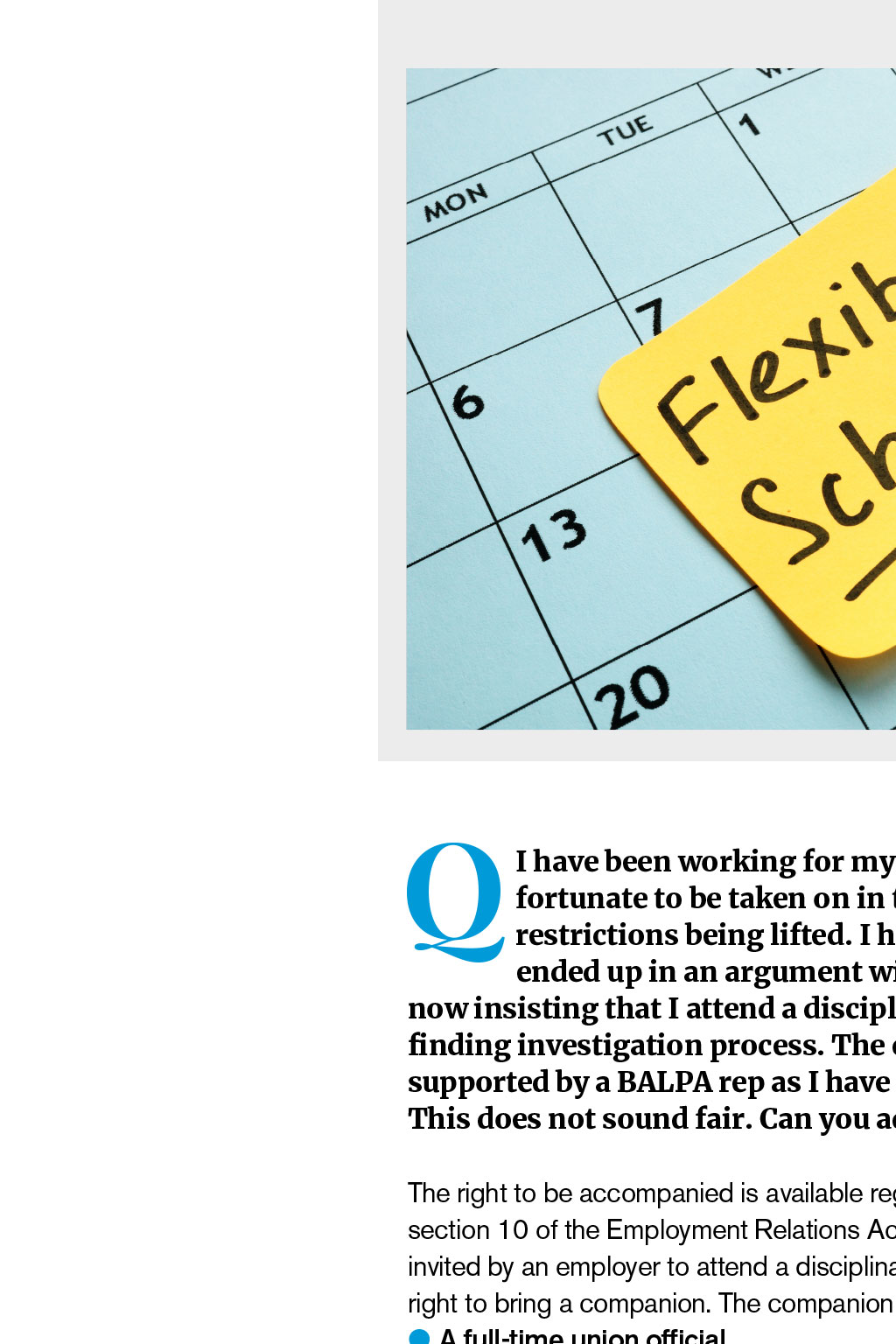
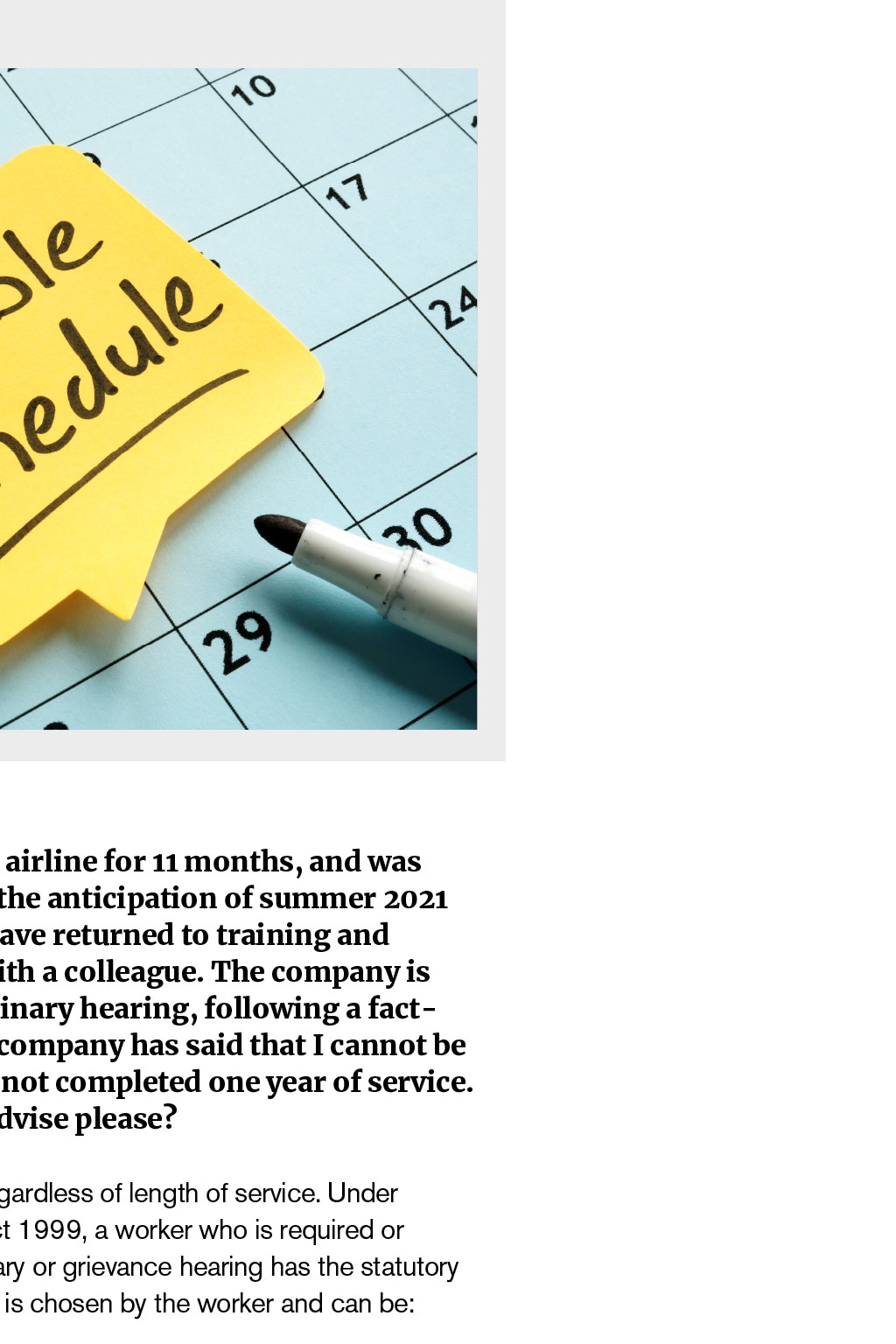

We look at flexible working, and the right to be accompanied By Terry Brandon, BALPA National Officer Q My airline is in the process of changing some of its policies and procedures. I am about to submit a flexible working request, but I am not certain of the current position concerning flexible working. Many airlines have taken the opportunity to review policies and procedures during the lockdown, and some have made significant changes. It is worth noting that a company can only improve upon the statutory and legal minimums. At present these are: All employees with at least 26 weeks continuous service and who have not already made a statutory request within the last 12 months have a statutory right to make a request to change their hours of work, times of work and/or place of work. An employer must consider the request in a reasonable manner and is able to refuse the request for one or more of a specified list of business reasons which includes, for example, the burden of additional costs or an inability to reorganise work among existing staff. All requests, including any appeals, must be considered, and decided upon within a period of three months from first receipt of the employees application, unless the employee agrees to an extension. An employee whose request is refused may complain to an employment tribunal on several grounds, for example that the decision wasnt reached within the relevant decision period or that the application was rejected for a reason other than one of the statutory grounds. Unfortunately, the employment tribunal cannot compel an employer to accommodate the request, but compensation may be awarded. Half of working mums dont get the flexibility they request at work, according to a new survey published by the TUC and campaigner Mother Pukka released in October 2021. Almost 13,000 working mums responded to a new TUC and Mother Pukka survey on flexible work 50% said their boss had rejected their flexible working request or only accepted part of it Most (86%) mums working flexibly said that they have faced discrimination and disadvantage at work as a result TUC calls for a legal right to flexible work to be advertised with every job, as government consults on new rights. The legal right to request flexible working has been in place for around 20 years. But the survey shows the current system is broken, says the TUC. Too many workers have their requests turned down and those who get flexible working face discrimination and disadvantage as a result. Many women told the TUC they are put off asking for flexible working. Flexible working isnt just home working for office workers it also includes options such as job sharing, fixed early or late starts, agreed predictable hours, term-time working, and condensed hours. The TUC notes that some form of flexible working would be suitable for every job there are no jobs where all forms of flexible working should be ruled out. Working mums who completed the survey said that: The government should make employers advertise flexible working in job ads with the successful candidate having the right to take up this flexibility from their first day at work (99% of respondents). They would be more likely to apply for a job if it included the specific types of flexible working available in the advert (99%). The government should give all workers the right to flexible working from day one in the job (96%) Q I have been working for my airline for 11 months, and was fortunate to be taken on in the anticipation of summer 2021 restrictions being lifted. I have returned to training and ended up in an argument with a colleague. The company is now insisting that I attend a disciplinary hearing, following a factfinding investigation process. The company has said that I cannot be supported by a BALPA rep as I have not completed one year of service. This does not sound fair. Can you advise please? The right to be accompanied is available regardless of length of service. Under section 10 of the Employment Relations Act 1999, a worker who is required or invited by an employer to attend a disciplinary or grievance hearing has the statutory right to bring a companion. The companion is chosen by the worker and can be: A full-time union official A certified lay official someone who has been trained in representing and accompanying individuals at hearings A co-worker sharing the same employer Footnote The employer has since changed its position to comply with the legislation following intervention from BALPA, and the member received representation from us. If you have a question youd like to put to Terry or any of our other BALPA experts, email TheLog@balpa.org INDUSTRIAL ISSUES Know your rights