
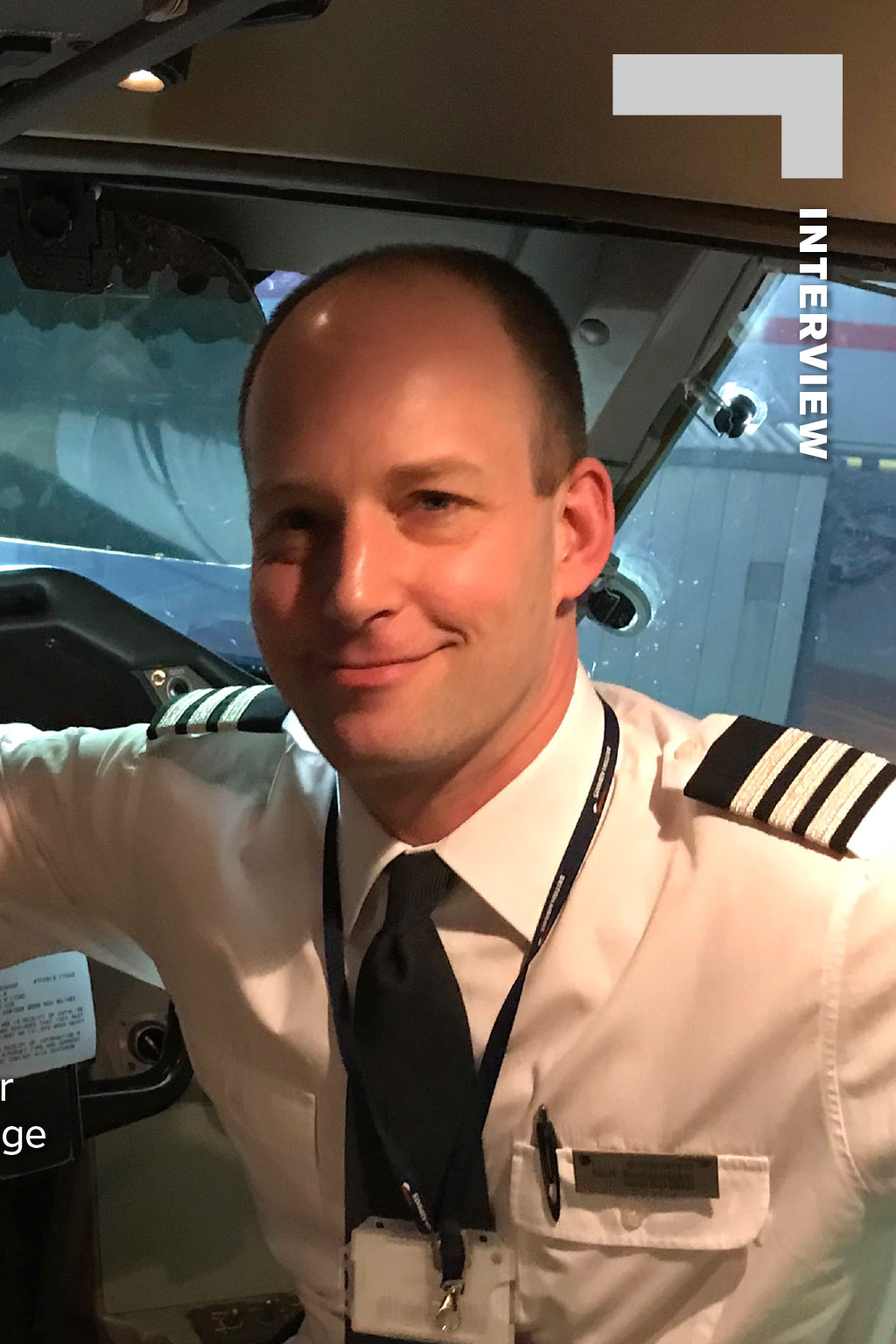






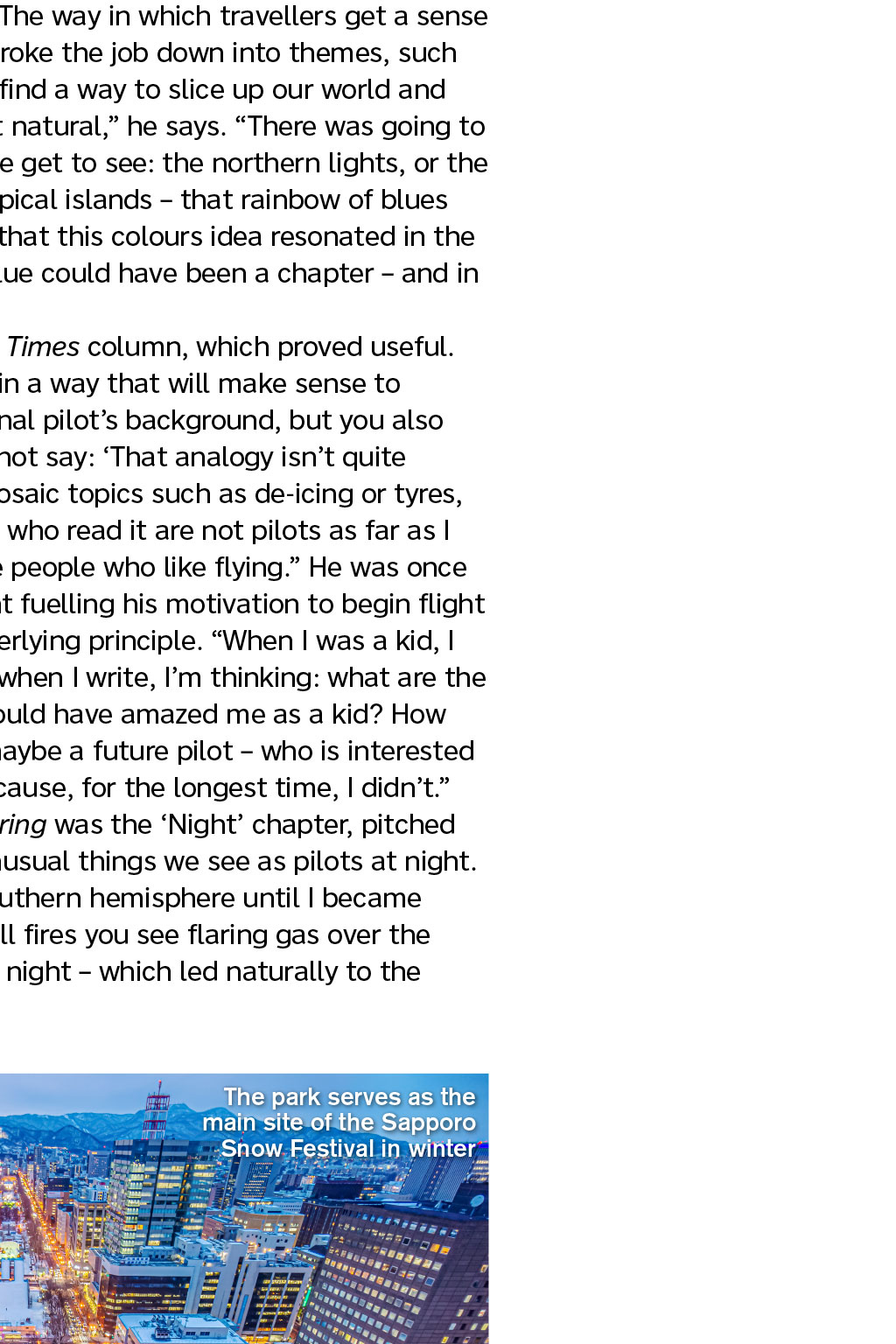

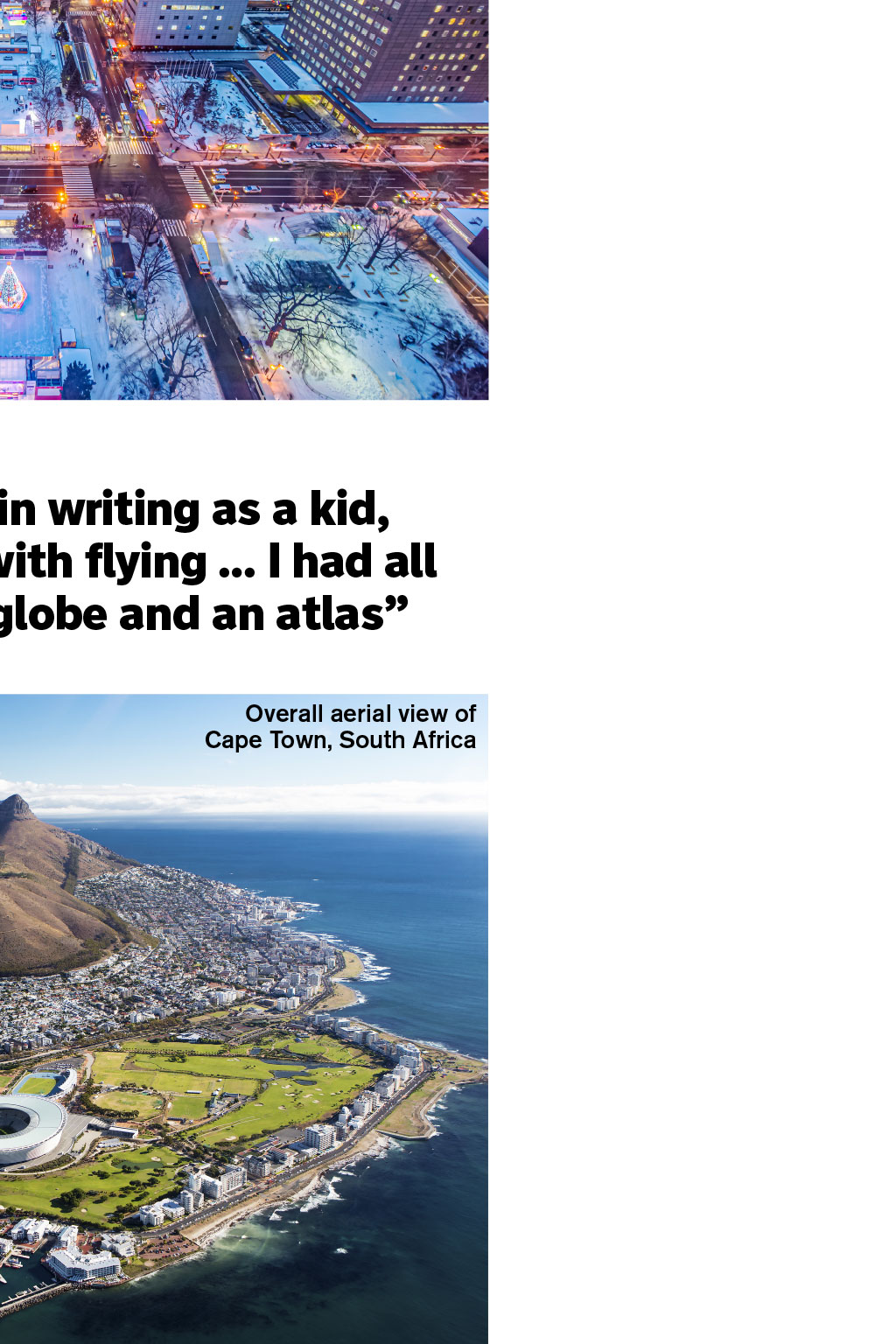




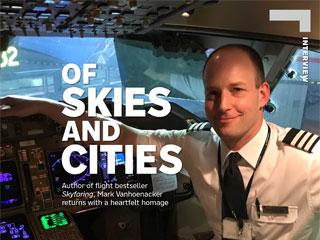
INTERVIEW OF SKIES AND CITIES Author of flight bestseller Skyfaring, Mark Vanhoenacker returns with a heartfelt homage By Captain Robin Evans, Senior Log Contributor magine the view, around dusk, from the camera of a low-orbit satellite moving above a densely settled part of the world, and how this perspective allows us to watch a web of glowing cities, each flat, and etched as finely as circuitry, turn towards us with the silent inevitability of the planet itself. If this sounds familiar, a moment we have probably all experienced but never tried to articulate, it comes from an accurate source. I think a lot of pilots have that combination of highly technical and a romantic interest in flying, those are the two sides of the job, says 787 pilot Mark Vanhoenacker of his latest book, Imagine a City, the follow-up to 2015s Skyfaring: A Journey with a Pilot. If his debut surprised that a pilot could deliver such a readable discussion of the jobs technicalities, the payoff came in his unexpectedly poetic filter. He recalls skimming overcast at high speed. It seems its always sunset in winter in Helsinki either dark or sunset. One evening, the skipper and I were totally amazed at the crimson clouds whipping past at 230 knots. We looked at each other and didnt really say anything, but were clearly both just very moved by it. He went on to write a bestseller about such things. I was always really interested in writing when I was a kid, he says, but I was also obsessed with flying. Im sure you can imagine I had all the model aeroplanes, a globe and an atlas. Once I went long haul [in 2007], I found myself with additional time off down route and between flights. I have a few friends who work in journalism, and they suggested I write about flying, as its so interesting to people. Vanhoenacker explains how he began with travel pieces general, fun articles. A 2013 effort about globes put him on the map. That article was about why I liked having a globe as a kid, why I still have one; an agent in London saw it and sent me a note: Did you ever want to write a book about globes? He laughs: I said, Well, maybe not globes! What about flying? Vanhoenacker reveals the Skyfaring that never was: At first, I thought it would be a viewers guide to the world: If you look out over Colorado youll see these geological formations and, if you fly over the east coast of China, youll see all these new port facilities. The way in which travellers get a sense of the world from above. Instead, he broke the job down into themes, such as Air or Wayfinding. I was trying to find a way to slice up our world and those kinds of categories seemed most natural, he says. There was going to be a chapter on the amazing colours we get to see: the northern lights, or the way you see shallow waters around tropical islands that rainbow of blues deepening out. Vanhoenacker reveals that this colours idea resonated in the sequel: It always goes back to blue. Blue could have been a chapter and in the new book, it is. Along the way, he began a Financial Times column, which proved useful. You want to be able to explain things in a way that will make sense to someone who doesnt have a professional pilots background, but you also want professional pilots to read it and not say: That analogy isnt quite right. These monthly pieces, about prosaic topics such as de-icing or tyres, are Skyfaring in miniature. The people who read it are not pilots as far as I know, Vanhoenacker says, but theyre people who like flying. He was once one of them: a management consultant fuelling his motivation to begin flight training. He explains this is still an underlying principle. When I was a kid, I didnt know any commercial pilots. So when I write, Im thinking: what are the things they could have told me that would have amazed me as a kid? How can I explain our world to someone maybe a future pilot who is interested but doesnt have that background? Because, for the longest time, I didnt. He reveals the original core of Skyfaring was the Night chapter, pitched to his agent. I was struck by all the unusual things we see as pilots at night. Id never really seen the stars of the southern hemisphere until I became a long-haul pilot. And how many oil-well fires you see flaring gas over the Middle East. Just the way cities look at night which led naturally to the second book, Imagine a City. The park serves as the main site of the Sapporo Snow Festival in winter I was always interested in writing as a kid, but I was also obsessed with flying I had all the model aeroplanes, a globe and an atlas Overall aerial view of Cape Town, South Africa Imagine a City Imagine a City explores the cities that have captured Vanhoenackers imagination. Skyfaring is about flying. Imagine a City is about what we do after flying its not just being on the ground, but being in cities, he explains. The world is more urban than its ever been. The way pilots, especially longhaul pilots, experience cities must be unique in all of history. We see cities from the air, but also from the ground, in a way that really nobody else does. Its a story that begins, like many, in a childhood home, looking from a bedroom window, dreaming of escape. Its also about the reverse: gazing from the tall panes of downroute hotels back to a home town that you may leave, but never leaves you. These bookends define two very distinct, parallel journeys: our historic and cultural tour around the cities that form Vanhoenackers muse, and his own, cathartic, personal one. This introduces his home of Pittsfield, Massachusetts, two and half hours drive west of Boston, which serves as an anchor. A small city also responsible for Herman Melvilles Moby Dick it is very significant to Vanhoenacker. His imaginary city is the one he retreated to as a child. This new book evolved in a more personal way; it has elements of memoir and Im talking about what big cities meant to me in the small city of my childhood, reflects Vanhoenacker. It was hard to write that without talking about why I wanted to leave home why most people want to leave at some point. I struggled with how personal to make it; I couldnt write this without being more personal. He adds: The world is changing, I think were all becoming a little more comfortable with such things and thats probably a good thing, even if it isnt always easy. Vanhoenacker links back to Skyfarings place lag concept. Like jet lag, place lag diminishes as you stay on in a place, but so peripatetic has my adult life been that I suspect my place lag only ever truly lifts when Im in Pittsfield, where its absence, then, is nearly as disconcerting. This unbelonging, as he puts it to look back from the sheltering anonymity of a megacity on the farthest side of the world becomes a recurring motif. Looking down, Im grateful for our instruments, and Im struck once more by how the surface of a desert and the depths of a thick-enough slab of tawny air are all but indistinguishable; and by the sense, far stronger than any science fiction film could evoke, that we are deep in the future and in the final minutes of our approach to the greatest metropolis of a desert planet. Vanhoenacker avoids obvious destinations (scattered according to the routes flown on, in sequence, the A320 and, particularly, the 747 and 787) or addressing them in a typical way. I love swimming and used to have a really good sense of which cities in Europe had the best swimming pools, he shares. Its a very strange way of experiencing cities there could have been a chapter called swimming pools. Helsinki would have been in there; I love its outdoor Olympic pool in summer, of course. As an introduction, he riffs on the etymology of city names: of the town upon a cape (Cape Town) or the city of the river of January (Rio de Janeiro). This leads, in turn, to the many city epithets granted worldwide: the Eternal City or the City of Sails, upon which Vanhoenacker proposes his own. He groups cities with respect to certain features or qualities rivers, skyscrapers, old walls that are appealing or meaningful to me. This reflects his books more expansive scope, also revealing his inner, curious geographer. Whenever I go to Cape Town, Im struck by the sense that, if its not the end of the world, its one end of the world the end of the world from my northern hemisphere perspective. But I wanted to quantify that and see if it was just my impression or not. So I wondered, what percentage of the worlds population exists north of Cape Town? He describes these efforts (involving NASA data and finding a suitable professor to help him query it), the answer suitably conclusive. Thats an entire morning for one line in the book, he laughs. Efforts complete, Vanhoenacker confesses to looking forward to a break from writing, perhaps delivering copies to the extended circle of accomplices who supplied perspectives on their own homes. This book did take a lot longer and, of course, I have a day job or a night job. This one comes seven years after Skyfaring, which, by any full-time writers schedule, would be unusual writing is definitely secondary to flying. But I love them both. Imagine a City by Mark Vanhoenacker was released on 12th May (UK) and 5th July (US)