





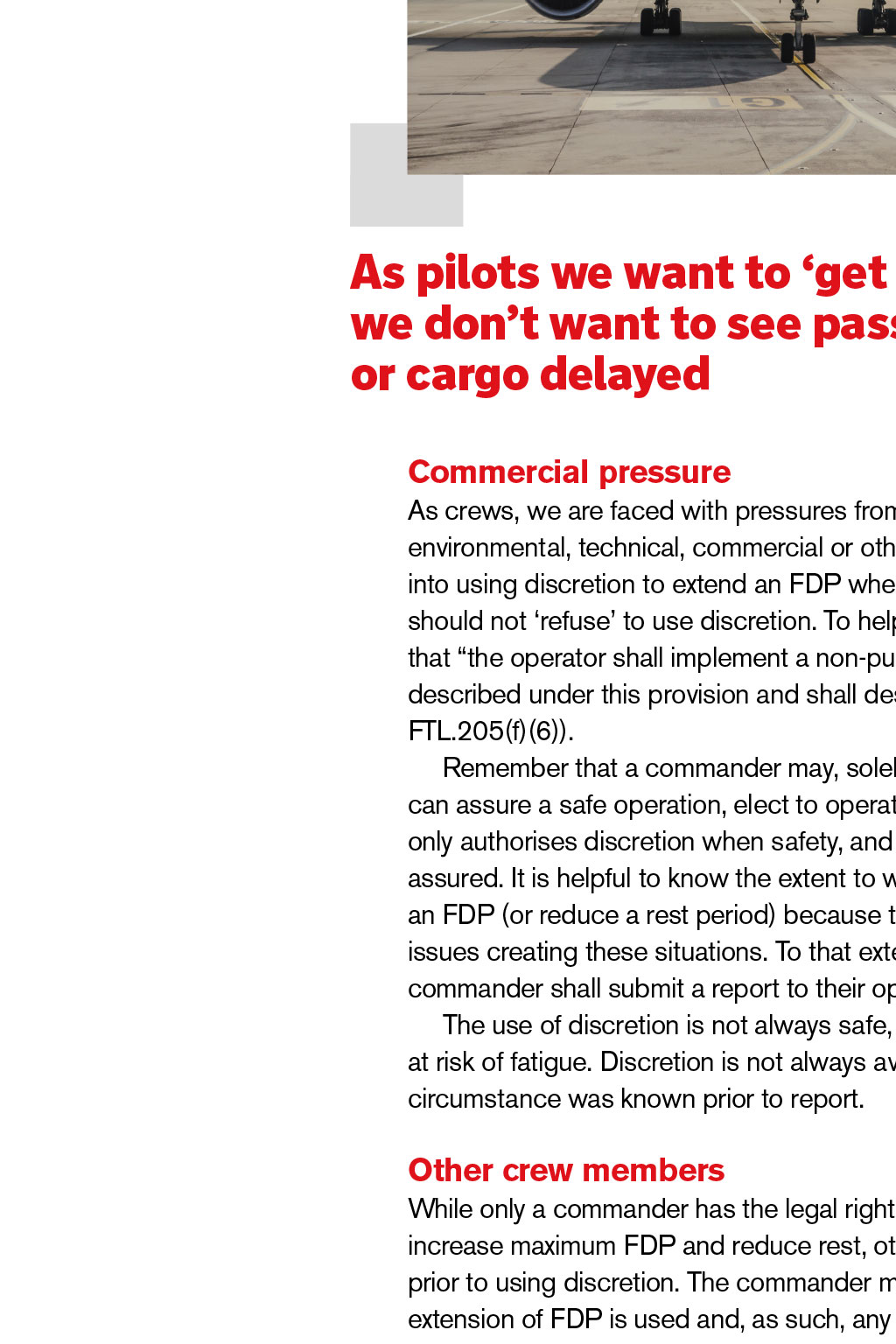
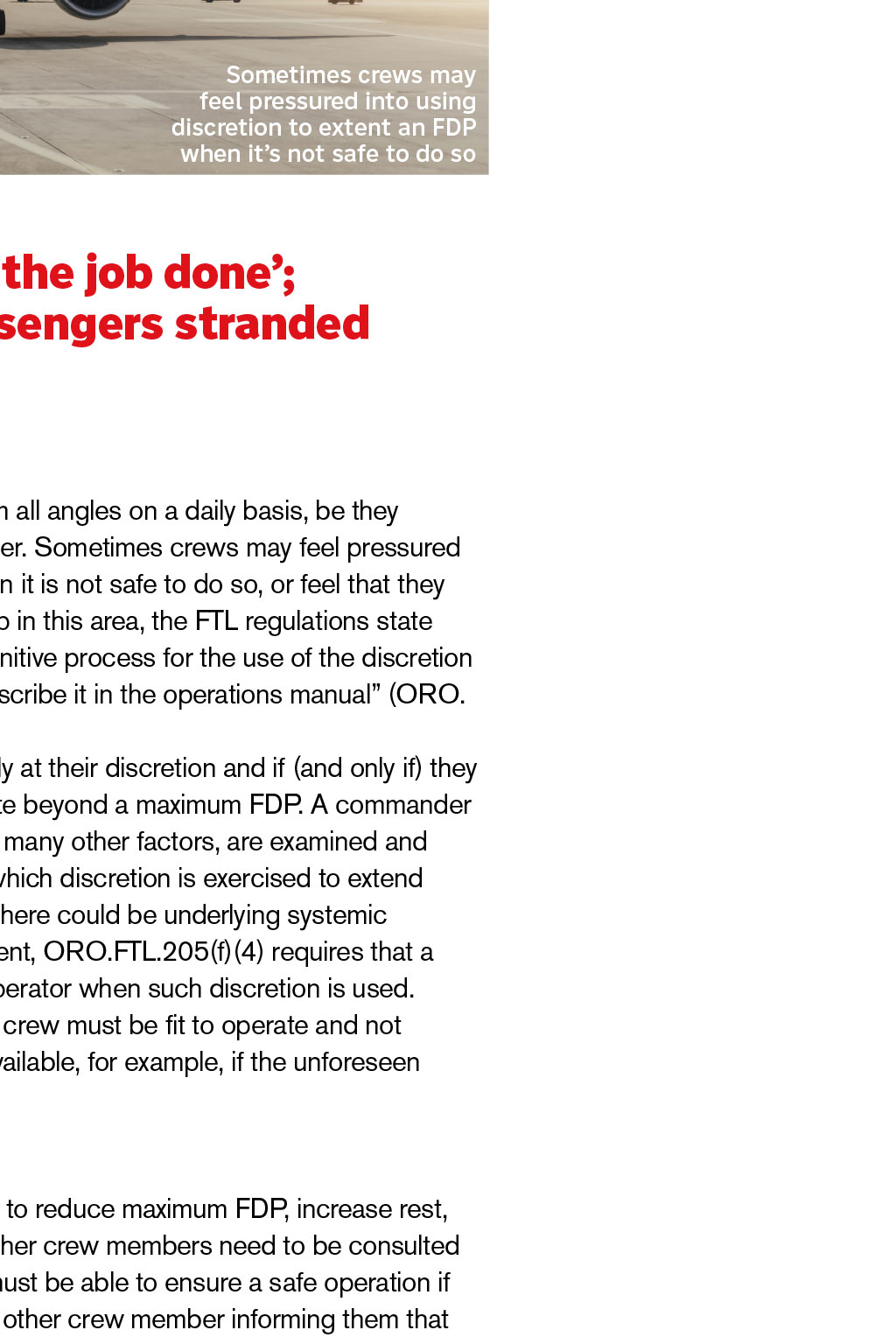
TECH LOG By the BALPA scheduling team ou struggle to concentrate. You feel exhausted, even after a good nights sleep. You are irritable and this spills over into your home life. You are at a higher risk of serious diseases such as skin cancer, diabetes and depression. You are suffering from long-term fatigue and burnout. The effects and risks of long-term fatigue are well documented, and have been regularly shared over the years. While these may be well-known to the pilot community, sometimes the practicalities of protecting yourself from fatigue on a dayto-day basis are less familiar. Commanders Discretion can be used by captains to extend the legally allowed Flight Duty Period (FDP) for that particular duty. This is probably the most common use of Commanders Discretion and, while useful to ensure a duty is completed, it can add to the overall fatigue problem if used on a regular basis by an individual. As pilots we want to get the job done; we dont want to see passengers stranded or cargo delayed. We problem-solve every day, and completing the duty under even the most difficult circumstances is a problem we often try our upmost to solve. Did you know there are other areas of Commanders Discretion, also contained within the same Flight Time Limitations (FTL) legislation, which can help to protect you and your crew from daily fatigue? Decreasing FDP The key to any type of Commanders Discretion is that it can only be used if there are unforeseen circumstances on the day of operation that start at or after the reporting time. This can come in many forms, including, but not limited to: Adverse weather Disruptive passengers Tech issues Slots Where it is considered that such events may introduce a detrimental effect on flight safety and/or induce severe fatigue, then the commander has the ability to reduce the maximum allowed FDP for that particular duty. For example: a four-sector day reporting at 0600 local time would usually allow an FDP of 12 hours, but the commander could decide to reduce the max FDP to something less than that, taking into account the fatigue levels of the crew. It is heartening to know that if the commander assesses that events of the day make fatigue a factor and put flight safety at risk, then they can act to ensure none of the crew is made to operate when they consider it unsafe (ORO. FTL.205(f)(2)). Increasing rest For the same reasons, the commander can extend the required rest after a duty period. This applies even though it may delay the next planned duty. The pandemic has seen the decimation of many scheduling agreements, and minimum rest down route is often rostered. This can be insufficient to recover following a busy and mentally draining day, something we will see more and more of as the summer ramps up. It is worth noting that the FTL regulations allow for the reduction of an FDP and an increase in rest used in combination. For example, in the case of unforeseen circumstances, a commander may reduce the maximum FDP for some or all of the crew, and then use a similar mechanism and justification to increase rest after that duty period with the aim of reducing the risks on flight safety. Commanders Discretion will be laid out in your own companys OMA and/or fatigue manual, and these sections are well worth a read as we push on towards one of the busiest summers in recent memory. It is also worth pointing out that some airlines operate to more restrictive FTLs than generic limits, and are detailed within the relevant ops manuals. These limits should be understood and respected as if they were standard limits unless a regulated mechanism exists to operate outside them. Sometimes crews may feel pressured into using discretion to extent an FDP when its not safe to do so As pilots we want to get the job done; we dont want to see passengers stranded or cargo delayed Commercial pressure As crews, we are faced with pressures from all angles on a daily basis, be they environmental, technical, commercial or other. Sometimes crews may feel pressured into using discretion to extend an FDP when it is not safe to do so, or feel that they should not refuse to use discretion. To help in this area, the FTL regulations state that the operator shall implement a non-punitive process for the use of the discretion described under this provision and shall describe it in the operations manual (ORO. FTL.205(f)(6)). Remember that a commander may, solely at their discretion and if (and only if) they can assure a safe operation, elect to operate beyond a maximum FDP. A commander only authorises discretion when safety, and many other factors, are examined and assured. It is helpful to know the extent to which discretion is exercised to extend an FDP (or reduce a rest period) because there could be underlying systemic issues creating these situations. To that extent, ORO.FTL.205(f)(4) requires that a commander shall submit a report to their operator when such discretion is used. The use of discretion is not always safe, crew must be fit to operate and not at risk of fatigue. Discretion is not always available, for example, if the unforeseen circumstance was known prior to report. Other crew members While only a commander has the legal right to reduce maximum FDP, increase rest, increase maximum FDP and reduce rest, other crew members need to be consulted prior to using discretion. The commander must be able to ensure a safe operation if extension of FDP is used and, as such, any other crew member informing them that they are unable to continue the duty because of fatigue would factor into the decisionmaking process. ORO.FTL.205(f)(3) highlights the fact that the commander shall consult all crew members on their alertness prior to deciding if discretion is available to increase/ reduce max FDP or increase/reduce rest in other words, it is not the decision of individual crew members to accept or renounce an extension of FDP. Every day, we work together as a team to ensure a safe outcome of each and every flight. From the pre-flight briefing to the post-flight paperwork and beyond, we must look after ourselves and each other. Commanders: think carefully about your role in Commanders Discretion. It is yours to use, but yours to protect. Other crew: make sure your commander knows your fatigue state, ensure you know theirs. Work together and ensure any use of discretion is safe and legal.