


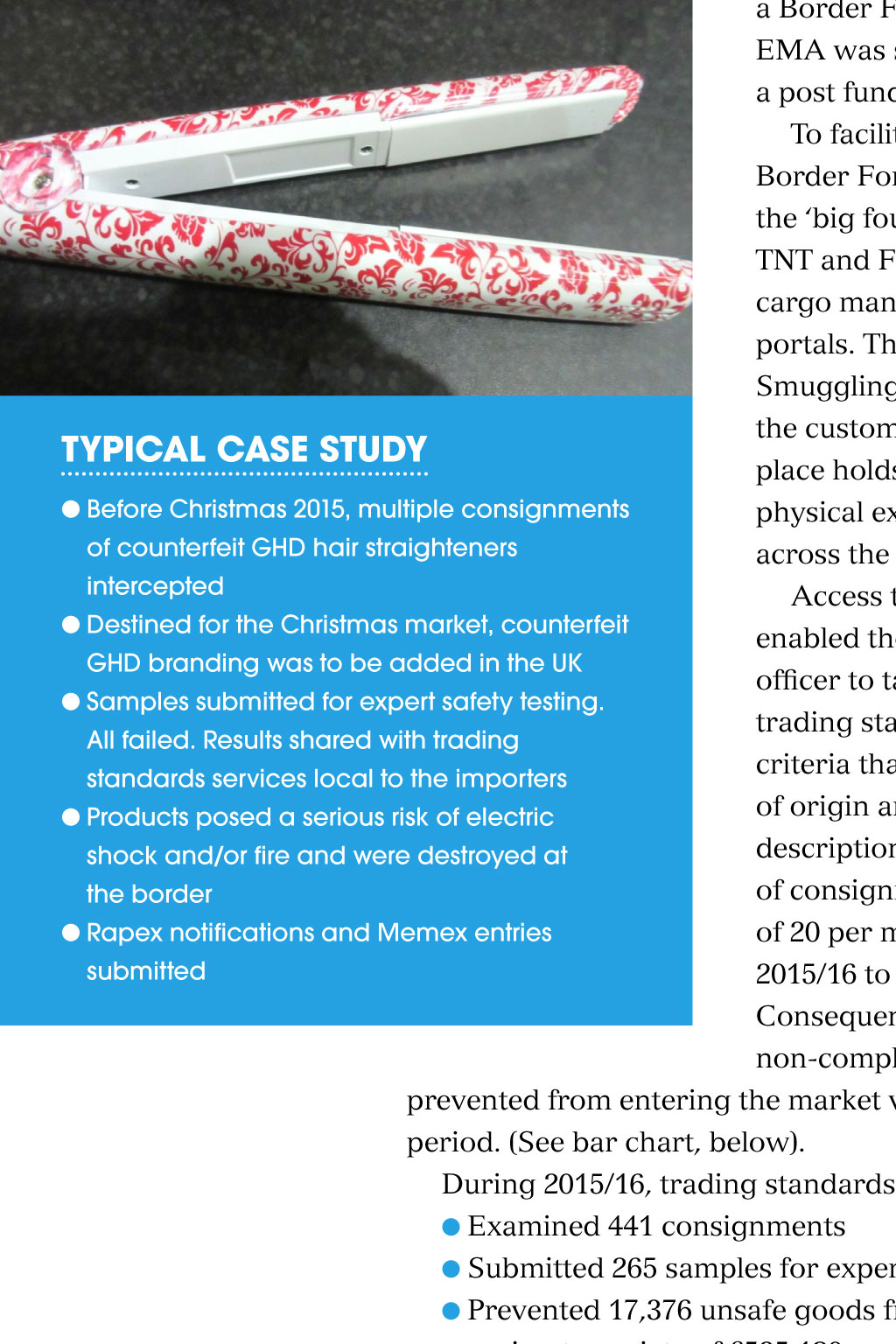
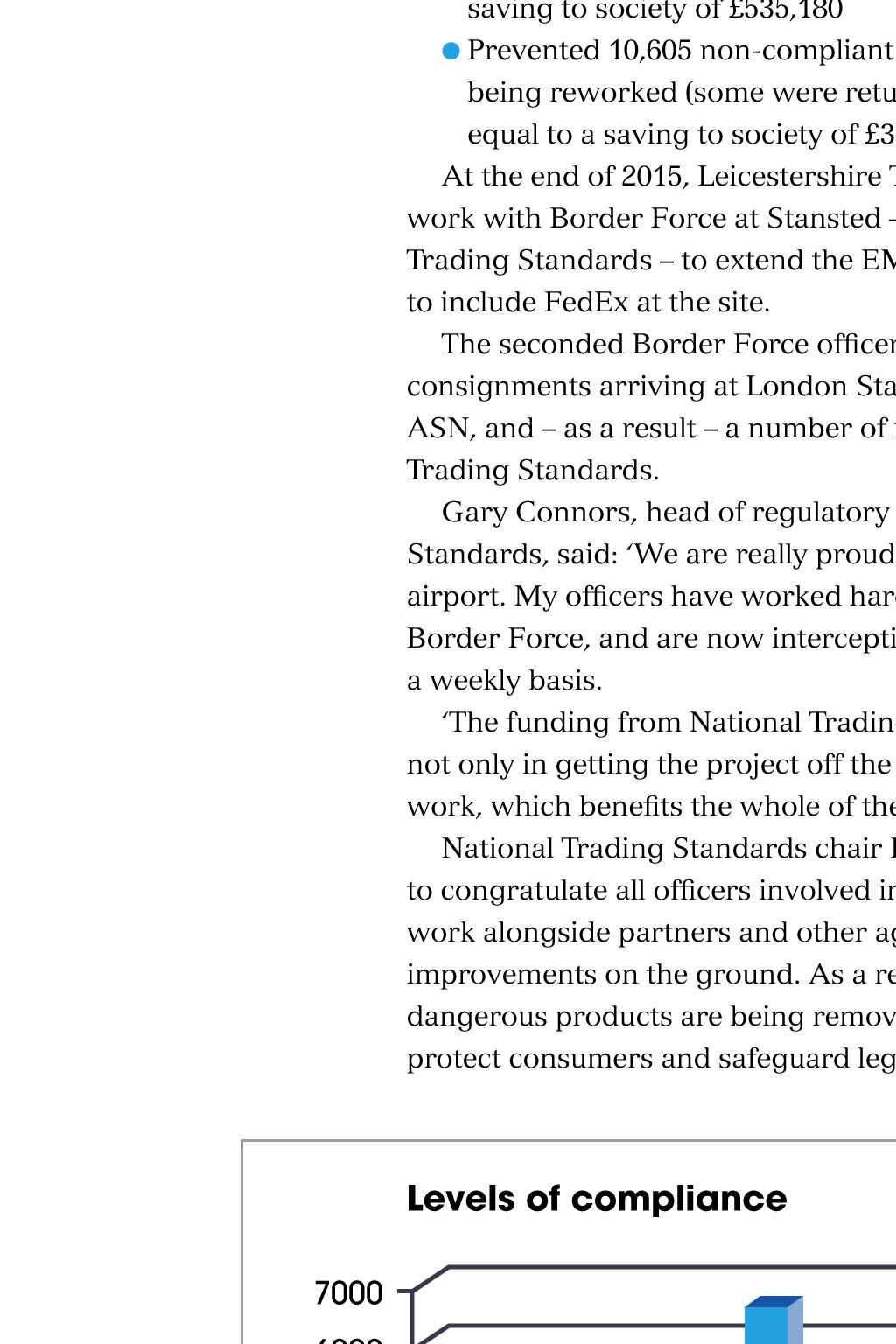
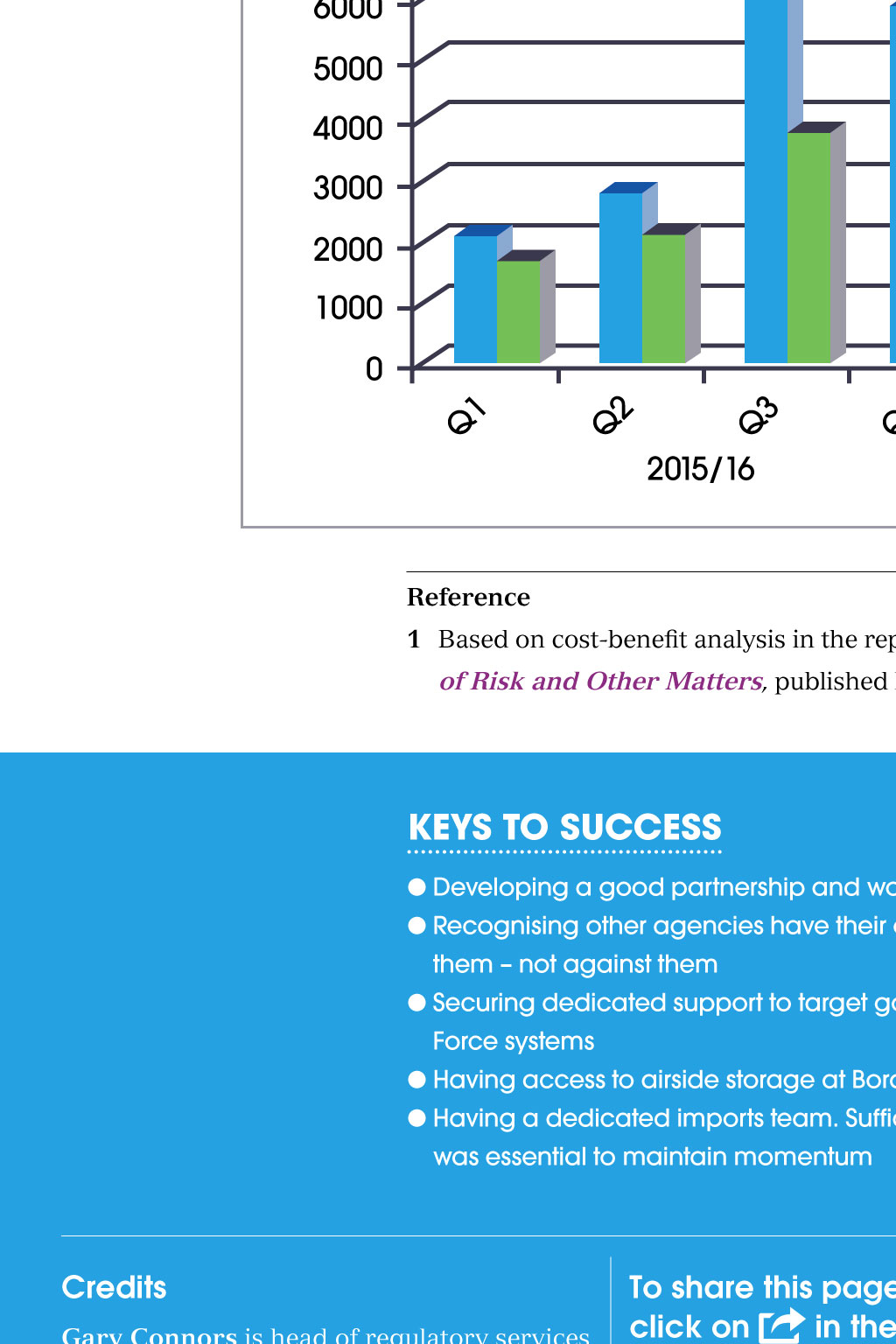
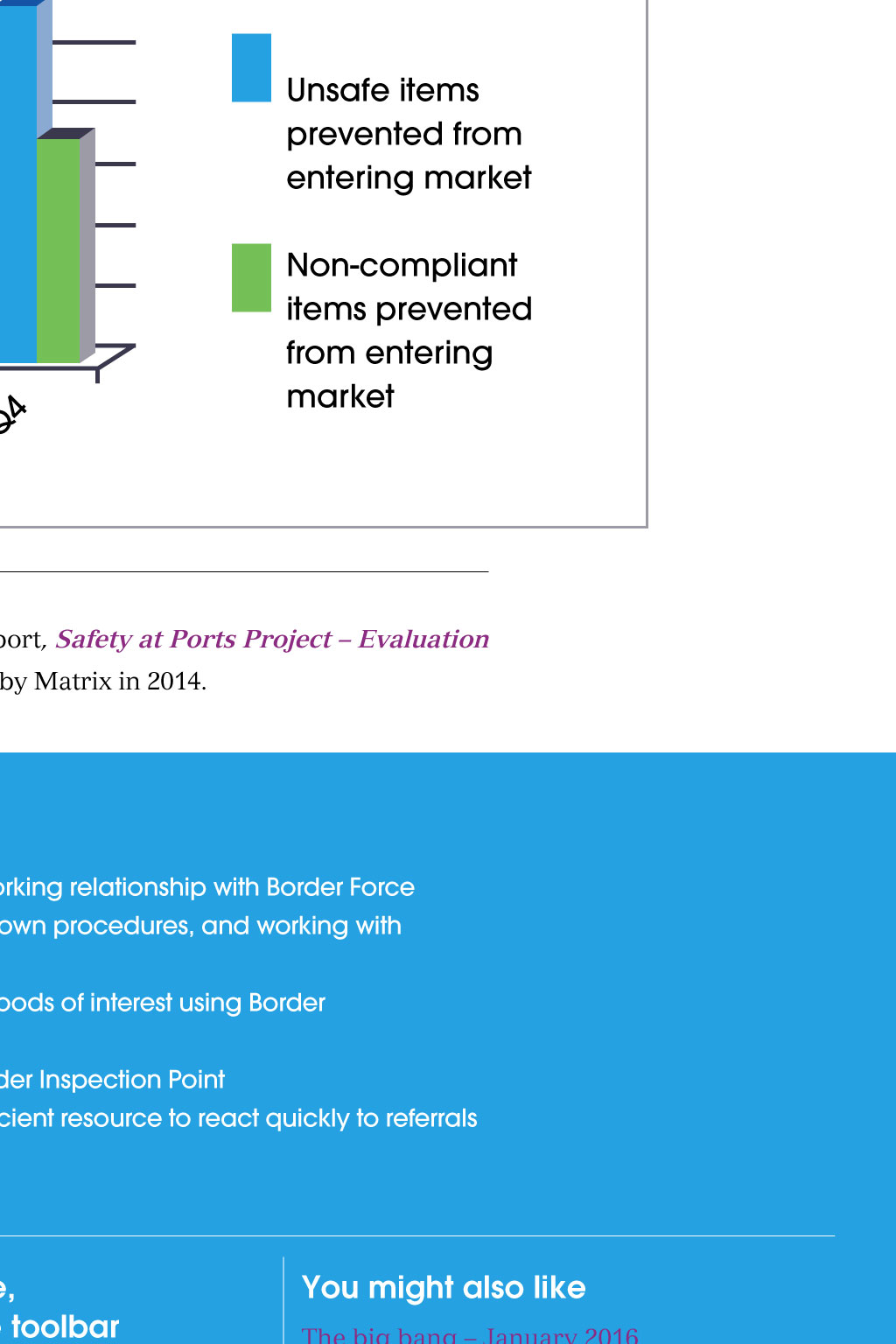



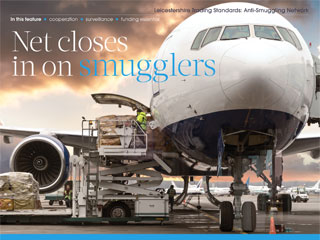
Leicestershire Trading Standards: Anti-Smuggling Network In this feature l cooperation l surveillance l funding essential Net closes in on smugglers An innovative partnership project at East Midlands Airport is helping to protect consumers from unsafe and non-compliant products, says Gary Connors N ineteen serious injuries averted; 16 fires prevented; anda total saving to society of 861,814.1 These werejust some of the first-year achievements of apioneering partnership between Leicestershire Trading Standards and the UKs Border Force, which targets the importation of unsafe and non-compliant goods through East Midlands Airport. The use of so-called Anti-Smuggling Nets and the close cooperation of both organisatons resulted in a three-fold increase in the number of unsafe products being prevented from entering the UK market during 2015/16. There was also a doubling of the number of non-compliant goods being seized. (See bar chart, below). So, how were these impressive figures achieved? East Midlands Airport (EMA) is the UKs busiest cargo airport, second only to London Heathrow. It handles more than 320,000 tonnes of flown cargo every year. Three of the big four fast parcel carriers DHL, UPS and TNT operate through EMA, with DHL and UPS using the airport as their UK hub. EMA also hosts the National Fast Parcel Targeting Team, which forms part of the Border Force Intelligence Directorate Air. Since 2014, officers from Leicestershire Trading Standards have been funded by National Trading Standards (NTS) to be part of the NTS Safety at Ports & Borders teams. They carry out market surveillance at EMA, inspecting consumer products imported from third countries to ensure they are safe. With security at the airport tighter than ever, gaining authorisation and airside passes for officers took a long time. Border Force was notused to having a trading standards presence at EMA, so local agreement protocols and a joint national agreement between NTS andBorder Force had to be put in place before officers could start active market surveillance. Since these teething problems, however, Leicestershire Trading Standards and Border Force have gone on to develop a good workingrelationship. A significant milestone came when trading standards secured much-needed airside storage facilities. Storage is at a premium at EMA particularly airside but, in the time-honoured tradition of its not what you know, but who you know, environmental health colleagues agreed that officers could share their Border Inspection Point facilities. This gave the trading standards team more space to examine goods, as well as a secure storage area. This quickly filled up with unsafe goods from the many mixed consignments destined for fulfilment houses around the UK and Europe that were examined by trading standards. Among the goods seized during the first few months were counterfeit and unsafe Nutribullet foodblenders and Babyliss hairstylers. Trading standards officers at the airport were dealing with an increasing number of consignment referrals, including local ones from Border Force as a result of the new working arrangements and national referrals from the Single Point of Contact based at Suffolk Trading Standards. As a result, a wide range of unsafe products continued to be intercepted, including cosmetics, lasers, hairstraighteners, sunglasses, LED lights and hoverboards. In response to this growing workload, trading standards established adedicated imports team early in 2015. It was quickly recognised in the project that joint-working opportunities existed between Border Forceand trading standards, to mirror thecustoms authoritys operating methodology. As a result, in autumn 2015, aBorder Force intelligence officer based at EMA was seconded to trading standards apost funded by NTS. To facilitate faster parcel movements, BorderForce has permission from each of thebig four parcel carriers DHL, UPS, TNTand FedEx to access their live inventory/ cargo manifest databases via internet portals. These are collectively known as AntiSmuggling Nets (ASNs), which are used by the customs agency actively to target and TYPICAL CASE STuDY place holds on consignments of interest, for l Before Christmas 2015, multiple consignments physical examination by their teams at airports of counterfeit GHD hair straighteners across the country. intercepted Access to the ASNs for UPS and DHL l Destined for the Christmas market, counterfeit enabled the seconded Border Force GHD branding was to be added in the UK officer to target and refer consignments to l Samples submitted for expert safety testing. trading standards, based on agreed profile All failed. Results shared with trading criteria thatfocused on high-risk countries standards services local to the importers of originand high-risk consignment l Products posed a serious risk of electric descriptions.This increased the number shock and/or fire and were destroyed at of consignment referrals from an average the border l Rapex notifications and Memex entries of 20 per month during the first half of submitted 2015/16 to 103 during Q3 and 223 during Q4. Consequently, the number of unsafe and non-compliant products detected and prevented from entering the market via EMA also increased during that period. (See bar chart, below). During 2015/16, trading standards officers at EMA have: l Examined 441 consignments l Submitted 265 samples for expert testing l Prevented 17,376 unsafe goods from entering the market, equal to a saving to society of 535,180 l Prevented 10,605 non-compliant goods from entering the market/ being reworked (some were returned to the country of origin), equalto a saving to society of 326,634 At the end of 2015, Leicestershire Trading Standards also began to work with Border Force at Stansted along with colleagues from Essex Trading Standards to extend the EMA model of targeting and referrals to include FedEx at the site. The seconded Border Force officer began to target FedEx consignments arriving at London Stansted Airport in early 2016, using ASN, and as a result a number of referrals have been made to Essex Trading Standards. Gary Connors, head of regulatory services for Leicestershire Trading Standards, said: We are really proud of what we have achieved at the airport. My officers have worked hard to build good relationships with Border Force, and are now intercepting dangerous consumer goods on aweekly basis. The funding from National Trading Standards has been essential, notonly in getting the project off the ground, but in continuing this great work, which benefits the whole of the UK. National Trading Standards chair Lord Toby Harris said: I would like to congratulate all officers involved in these projects. Their dedicated work alongside partners and other agencies has led directly to improvements on the ground. As a result, increasing numbers of dangerous products are being removed from the supply chain, helping protect consumers and safeguard legitimate businesses. With security at the airport tighter than ever, gaining authorisation and airside passes for officers took a long time. Border Force was not used to having a trading standards presence at EMA Levels of compliance 7000 6000 5000 Unsafe items prevented from entering market 4000 3000 2000 1000 4 Q 3 Q 2 Q Q 1 0 Non-compliant items prevented from entering market 2015/16 Reference 1 Based on cost-benefit analysis in the report, Safety at Ports Project Evaluation of Risk and Other Matters, published by Matrix in 2014. KEYS TO SuCCESS l Developing good partnership working relationship with Border Force l Recognising other agencies have their own procedures, and working with them not against them l Securing dedicated support to target goods of interest using Border Force systems l Having access to airside storage at Border Inspection Point l Having a dedicated imports team. Sufficient resource to react quickly to referrals was essential to maintain momentum Credits Gary Connors is head of regulatory services for Leicestershire County Council. Images: mariakraynova / Shutterstock To share this page, in the toolbar click on You might also like The big bang January 2016