


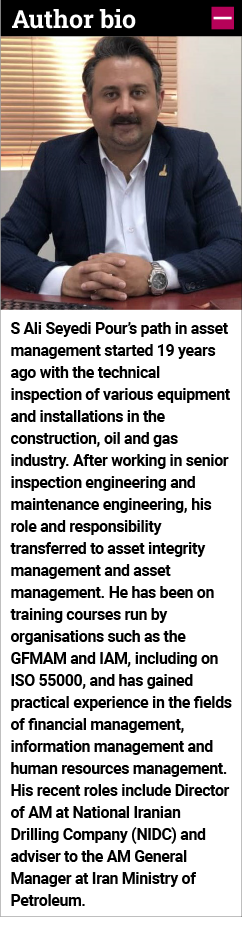
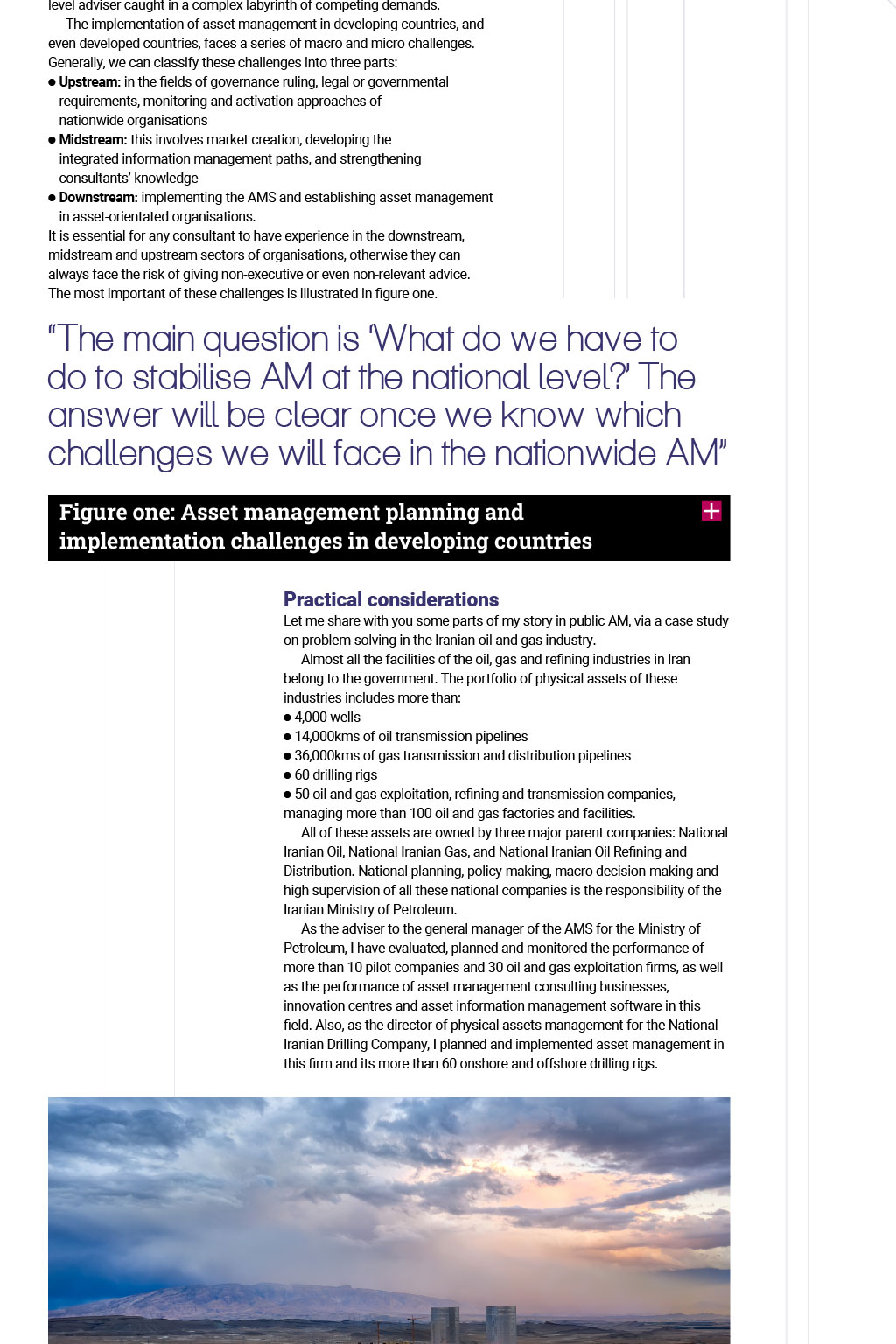
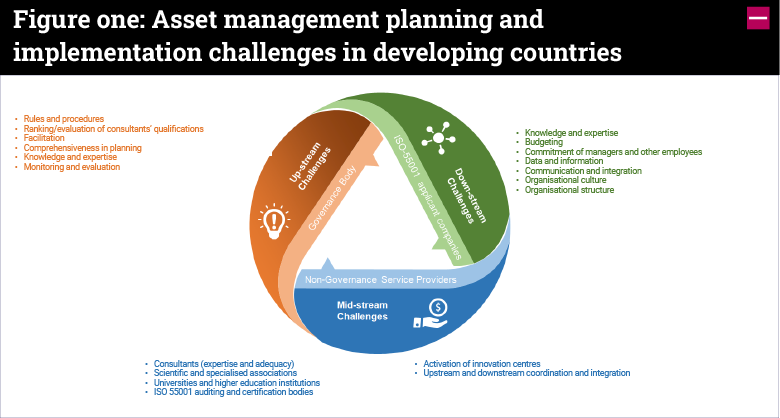
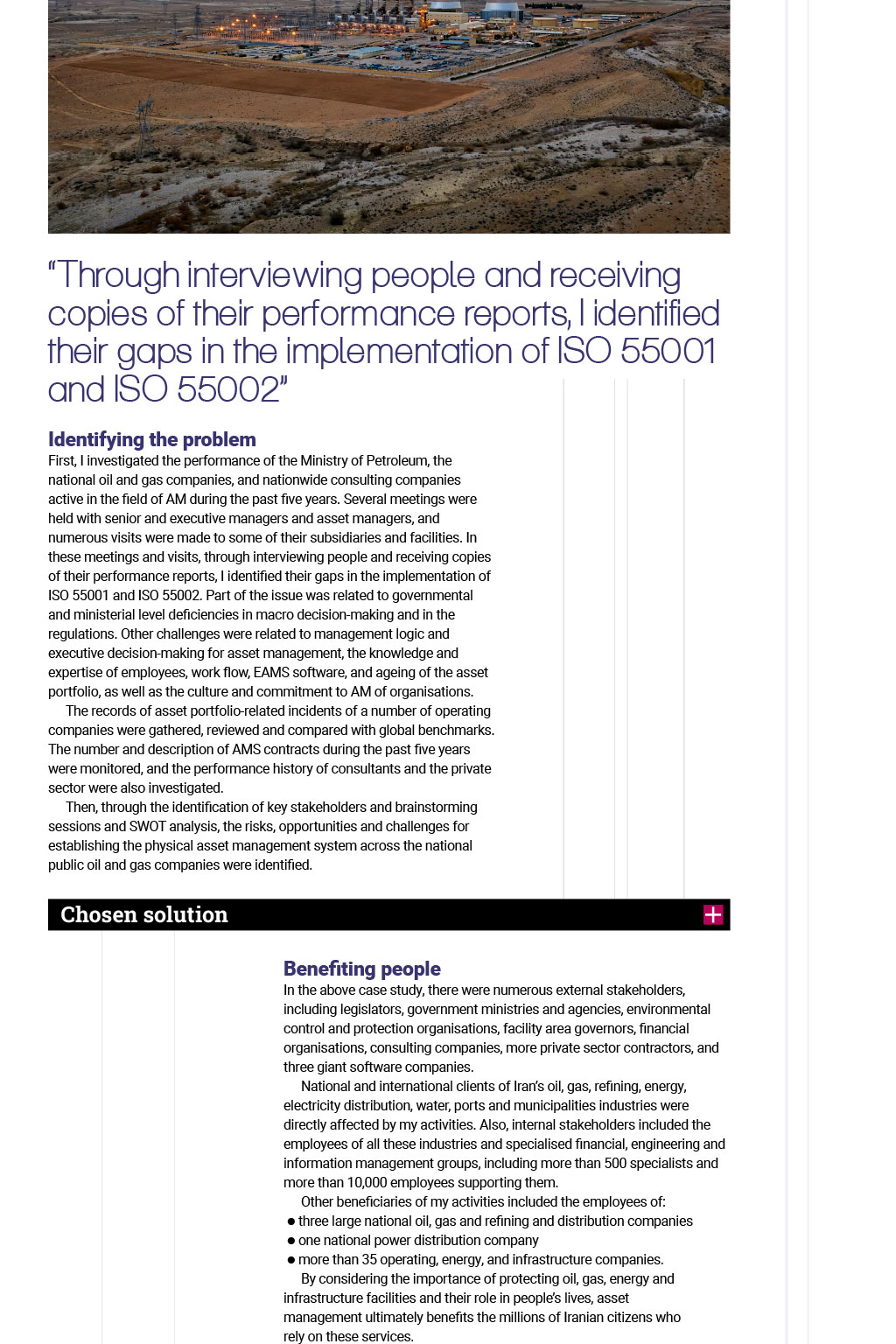
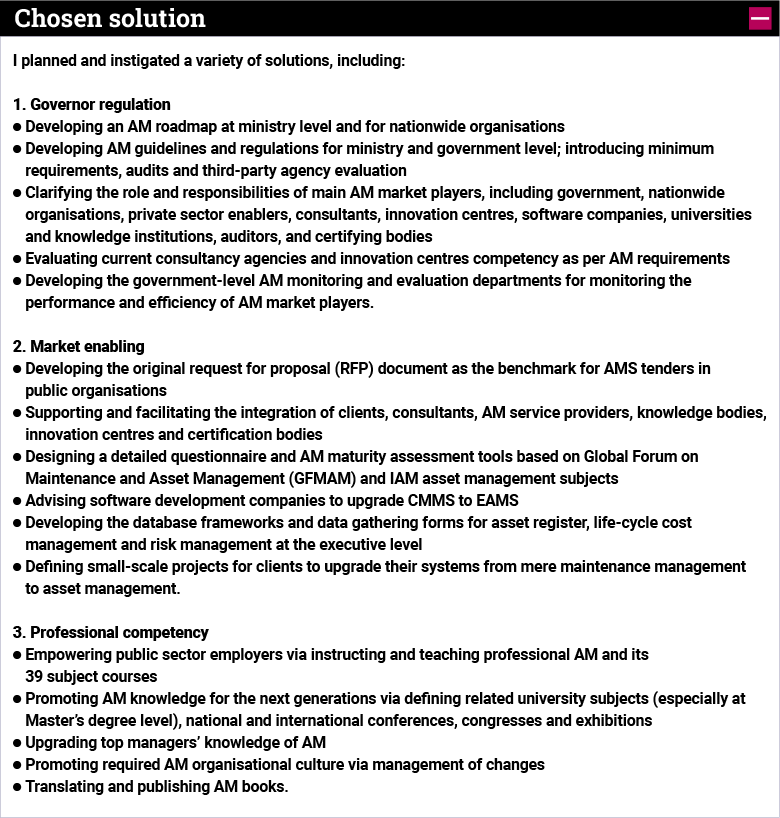


Knowledge base Ali Seyedi Pour, winner of the McKeown Individual Achievement Award in 2022, shares his knowledge and experiences of asset management challenges Author bio Increased safety and business reliability, and more effective financial management (especially in CAPEX and OPEX) are the benefits for a company when it starts using an asset management system (AMS). In some developing countries, the concept of asset management (AM) is still very young, but in time those nations will benefit at government level, in public and private sectors, and even in knowledge management from the opportunities that AM brings. This will be much clearer where many of the strategic industries are publicly owned or under government ownership via national companies. In such circumstances, developing a top-level AMS will be very useful in regulation, integration and supervision of the state of AM in such nationwide organisations. We need to pay special attention to asset management in developing countries on a deeper level than consulting in industrial sectors. The main question is: What do we have to do to stabilise AM at the national level? The answer will be clear once we know which challenges we will face in the nationwide AM. S Ali Seyedi Pours path in asset management started 19 years ago with the technical inspection of various equipment and installations in the construction, oil and gas industry. After working in senior inspection engineering and maintenance engineering, his role and responsibility transferred to asset integrity management and asset management. He has been on training courses run by organisations such as the GFMAM and IAM, including on ISO 55000, and has gained practical experience in the fields of financial management, information management and human resources management. His recent roles include Director of AM at National Iranian Drilling Company (NIDC) and adviser to the AM General Manager at Iran Ministry of Petroleum. Facing challenges In a public company, each AM consulting project includes a challenging portfolio and an asset management principal role, which can get a ministrylevel adviser caught in a complex labyrinth of competing demands. The implementation of asset management in developing countries, and even developed countries, faces a series of macro and micro challenges. Generally, we can classify these challenges into three parts: Upstream: in the fields of governance ruling, legal or governmental requirements, monitoring and activation approaches of nationwide organisations Midstream: this involves market creation, developing the integrated information management paths, and strengthening consultants knowledge Downstream: implementing the AMS and establishing asset management in asset-orientated organisations. It is essential for any consultant to have experience in the downstream, midstream and upstream sectors of organisations, otherwise they can always face the risk of giving non-executive or even non-relevant advice. The most important of these challenges is illustrated in Figure one. The main question is What do we have to do to stabilise AM at the national level? The answer will be clear once we know which challenges we will face in the nationwide AM Practical considerations Let me share with you some parts of my story in public AM, via a case study on problem-solving in the Iranian oil and gas industry. Almost all the facilities of the oil, gas and refining industries in Iran belong to the government. The portfolio of physical assets of these industries includes more than: 4,000 wells 14,000kms of oil transmission pipelines 36,000kms of gas transmission and distribution pipelines 60 drilling rigs 50 oil and gas exploitation, refining and transmission companies, managing more than 100 oil and gas factories and facilities. All of these assets are owned by three major parent companies: National Iranian Oil, National Iranian Gas, and National Iranian Oil Refining and Distribution. National planning, policy-making, macro decision-making and high supervision of all these national companies is the responsibility of the Iranian Ministry of Petroleum. As the adviser to the general manager of the AMS for the Ministry of Petroleum, I have evaluated, planned and monitored the performance of more than 10 pilot companies and 30 oil and gas exploitation firms, as well as the performance of asset management consulting businesses, innovation centres and asset information management software in this field. Also, as the director of physical assets management for the National Iranian Drilling Company, I planned and implemented asset management in this firm and its more than 60 onshore and offshore drilling rigs. Through interviewing people and receiving copies of their performance reports, I identified their gaps in the implementation of ISO 55001 and ISO 55002 Identifying the problem First, I investigated the performance of the Ministry of Petroleum, the national oil and gas companies, and nationwide consulting companies active in the field of AM during the past five years. Several meetings were held with senior and executive managers and asset managers, and numerous visits were made to some of their subsidiaries and facilities. In these meetings and visits, through interviewing people and receiving copies of their performance reports, I identified their gaps in the implementation of ISO 55001 and ISO 55002. Part of the issue was related to governmental and ministerial level deficiencies in macro decision-making and in the regulations. Other challenges were related to management logic and executive decision-making for asset management, the knowledge and expertise of employees, work flow, EAMS software, and ageing of the asset portfolio, as well as the culture and commitment to AM of organisations. The records of asset portfolio-related incidents of a number of operating companies were gathered, reviewed and compared with global benchmarks. The number and description of AMS contracts during the past five years were monitored, and the performance history of consultants and the private sector were also investigated. Then, through the identification of key stakeholders and brainstorming sessions and SWOT analysis, the risks, opportunities and challenges for establishing the physical asset management system across the national public oil and gas companies were identified. Benefiting people In the above case study, there were numerous external stakeholders, including legislators, government ministries and agencies, environmental control and protection organisations, facility area governors, financial organisations, consulting companies, more private sector contractors, and three giant software companies. National and international clients of Irans oil, gas, refining, energy, electricity distribution, water, ports and municipalities industries were directly affected by my activities. Also, internal stakeholders included the employees of all these industries and specialised financial, engineering and information management groups, including more than 500 specialists and more than 10,000 employees supporting them. Other beneficiaries of my activities included the employees of: three large national oil, gas and refining and distribution companies one national power distribution company more than 35 operating, energy, and infrastructure companies. By considering the importance of protecting oil, gas, energy and infrastructure facilities and their role in peoples lives, asset management ultimately benefits the millions of Iranian citizens who rely on these services. Figure one: Asset management planning and implementation challenges in developing countries Rules and procedures Ranking/evaluation of consultants qualifications Facilitation Comprehensiveness in planning Knowledge and expertise Monitoring and evaluation Consultants (expertise and adequacy) Scientific and specialised associations Universities and higher education institutions ISO 55001 auditing and certification bodies Knowledge and expertise Budgeting Commitment of managers and other employees Data and information Communication and integration Organisational culture Organisational structure Activation of innovation centres Upstream and downstream coordination and integration Chosen solution I planned and instigated a variety of solutions, including: 1. Governor regulation Developing an AM roadmap at ministry level and for nationwide organisations Developing AM guidelines and regulations for ministry and government level; introducing minimum requirements, audits and third-party agency evaluation Clarifying the role and responsibilities of main AM market players, including government, nationwide organisations, private sector enablers, consultants, innovation centres, software companies, universities and knowledge institutions, auditors, and certifying bodies Evaluating current consultancy agencies and innovation centres competency as per AM requirements Developing the government-level AM monitoring and evaluation departments for monitoring the performance and efficiency of AM market players. 2. Market enabling Developing the original request for proposal (RFP) document as the benchmark for AMS tenders in public organisations Supporting and facilitating the integration of clients, consultants, AM service providers, knowledge bodies, innovation centres and certification bodies Designing a detailed questionnaire and AM maturity assessment tools based on Global Forum on Maintenance and Asset Management (GFMAM) and IAM asset management subjects Advising software development companies to upgrade CMMS to EAMS Developing the database frameworks and data gathering forms for asset register, life-cycle cost management and risk management at the executive level Defining small-scale projects for clients to upgrade their systems from mere maintenance management to asset management. 3. Professional competency Empowering public sector employers via instructing and teaching professional AM and its 39 subject courses Promoting AM knowledge for the next generations via defining related university subjects (especially at Masters degree level), national and international conferences, congresses and exhibitions Upgrading top managers knowledge of AM Promoting required AM organisational culture via management of changes Translating and publishing AM books.