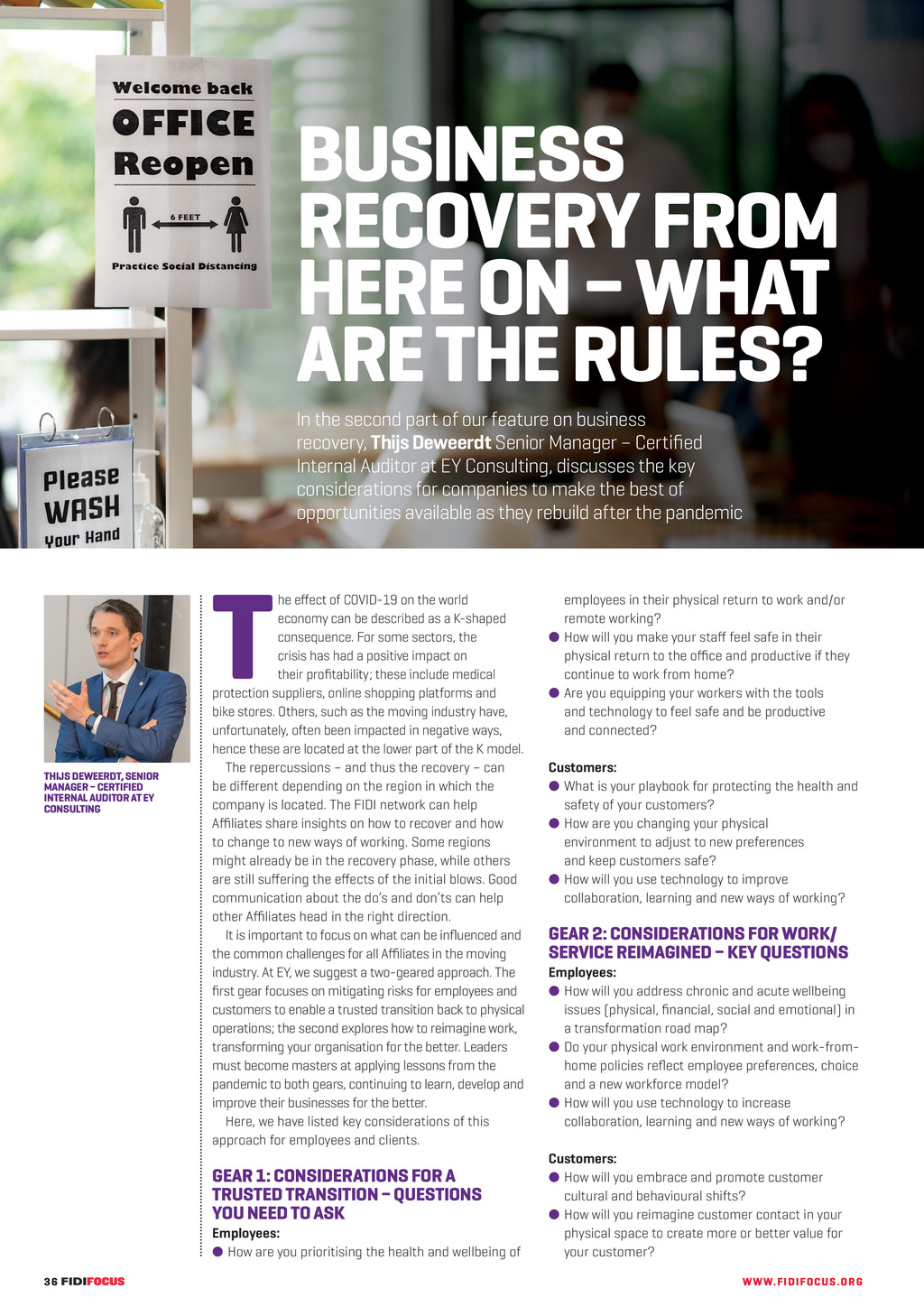


BUSINESS RECOVERY FROM HERE ON WHAT ARE THE RULES? In the second part of our feature on business recovery, Thijs Deweerdt Senior Manager Certified Internal Auditor at EY Consulting, discusses the key considerations for companies to make the best of opportunities available as they rebuild after the pandemic T THIJS DEWEERDT, SENIOR MANAGER CERTIFIED INTERNAL AUDITOR AT EY CONSULTING he eect of COVID-19 on the world economy can be described as a K-shaped consequence. For some sectors, the crisis has had a positive impact on their profitability; these include medical protection suppliers, online shopping platforms and bike stores. Others, such as the moving industry have, unfortunately, often been impacted in negative ways, hence these are located at the lower part of the K model. The repercussions and thus the recovery can be dierent depending on the region in which the company is located. The FIDI network can help Aliates share insights on how to recover and how to change to new ways of working. Some regions might already be in the recovery phase, while others are still suering the eects of the initial blows. Good communication about the dos and donts can help other Aliates head in the right direction. It is important to focus on what can be influenced and the common challenges for all Aliates in the moving industry. At EY, we suggest a two-geared approach. The first gear focuses on mitigating risks for employees and customers to enable a trusted transition back to physical operations; the second explores how to reimagine work, transforming your organisation for the better. Leaders must become masters at applying lessons from the pandemic to both gears, continuing to learn, develop and improve their businesses for the better. Here, we have listed key considerations of this approach for employees and clients. GEAR 1: CONSIDERATIONS FOR A TRUSTED TRANSITION QUESTIONS YOU NEED TO ASK Employees: l How are you prioritising the health and wellbeing of 36 FF300 DecJan21 pp36-37 Business Recovery.indd 36 employees in their physical return to work and/or remote working? l How will you make your sta feel safe in their physical return to the oce and productive if they continue to work from home? l Are you equipping your workers with the tools and technology to feel safe and be productive and connected? Customers: l What is your playbook for protecting the health and safety of your customers? l How are you changing your physical environment to adjust to new preferences and keep customers safe? l How will you use technology to improve collaboration, learning and new ways of working? GEAR 2: CONSIDERATIONS FOR WORK/ SERVICE REIMAGINED KEY QUESTIONS Employees: l How will you address chronic and acute wellbeing issues (physical, financial, social and emotional) in a transformation road map? l Do your physical work environment and work-fromhome policies reflect employee preferences, choice and a new workforce model? l How will you use technology to increase collaboration, learning and new ways of working? Customers: l How will you embrace and promote customer cultural and behavioural shifts? l How will you reimagine customer contact in your physical space to create more or better value for your customer? WW W. F I D I FOC U S . OR G 24/11/2020 15:27