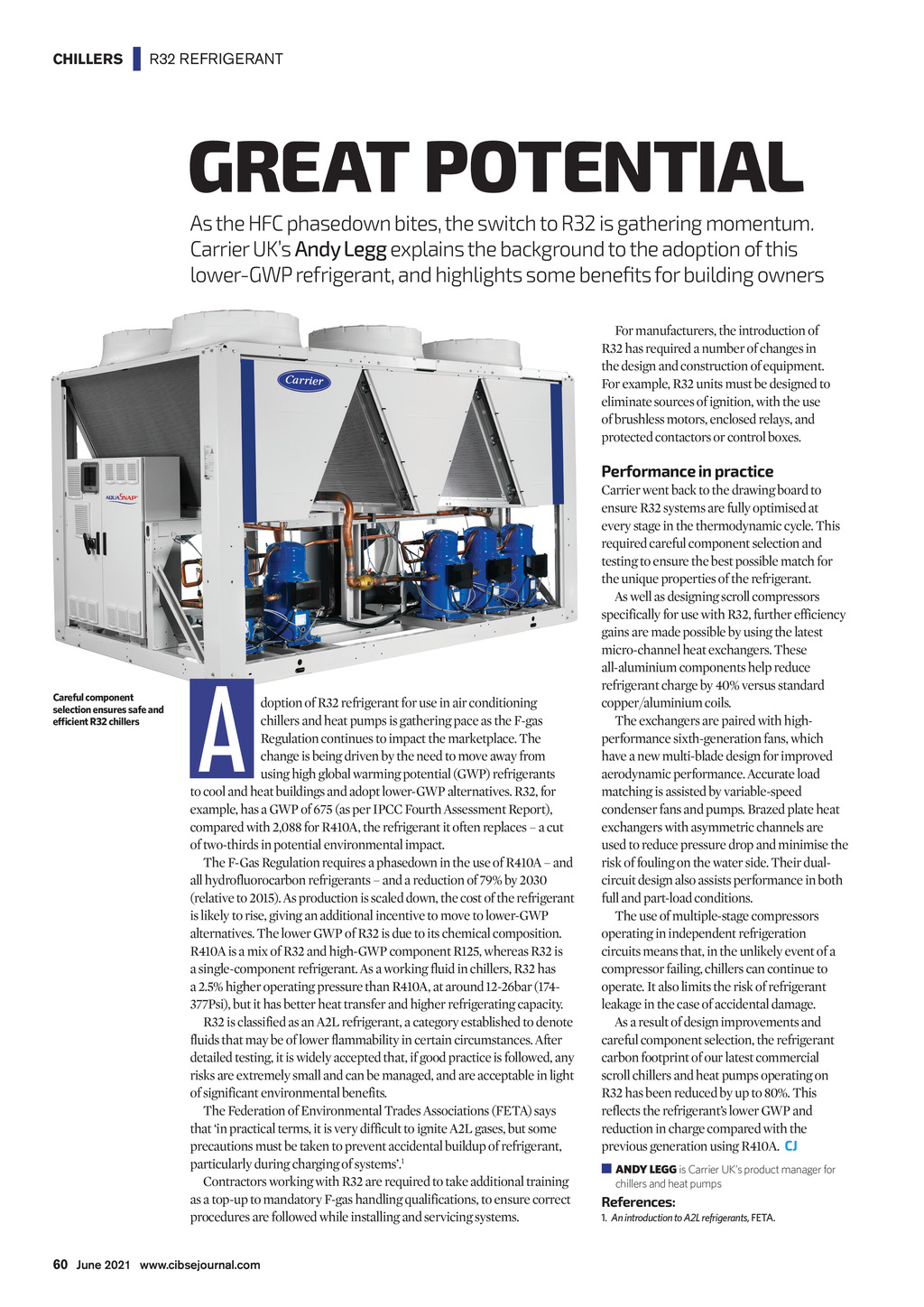


CHILLERS | R32 REFRIGERANT GREAT POTENTIAL As the HFC phasedown bites, the switch to R32 is gathering momentum. Carrier UKs Andy Legg explains the background to the adoption of this lower-GWP refrigerant, and highlights some benefits for building owners For manufacturers, the introduction of R32 has required a number of changes in the design and construction of equipment. For example, R32 units must be designed to eliminate sources of ignition, with the use of brushless motors, enclosed relays, and protected contactors or control boxes. Performance in practice Careful component selection ensures safe and A doption of R32 refrigerant for use in air conditioning chillers and heat pumps is gathering pace as the F-gas Regulation continues to impact the marketplace. The change is being driven by the need to move away from using high global warming potential (GWP) refrigerants to cool and heat buildings and adopt lower-GWP alternatives. R32, for example, has a GWP of 675 (as per IPCC Fourth Assessment Report), compared with 2,088 for R410A, the refrigerant it often replaces a cut of two-thirds in potential environmental impact. The F-Gas Regulation requires a phasedown in the use of R410A and all hydrofluorocarbon refrigerants and a reduction of 79% by 2030 (relative to 2015). As production is scaled down, the cost of the refrigerant is likely to rise, giving an additional incentive to move to lower-GWP alternatives. The lower GWP of R32 is due to its chemical composition. R410A is a mix of R32 and high-GWP component R125, whereas R32 is a single-component refrigerant. As a working fluid in chillers, R32 has a 2.5% higher operating pressure than R410A, at around 12-26bar (174377Psi), but it has better heat transfer and higher refrigerating capacity. R32 is classified as an A2L refrigerant, a category established to denote fluids that may be of lower flammability in certain circumstances. After detailed testing, it is widely accepted that, if good practice is followed, any risks are extremely small and can be managed, and are acceptable in light of significant environmental benefits. The Federation of Environmental Trades Associations (FETA) says that in practical terms, it is very difficult to ignite A2L gases, but some precautions must be taken to prevent accidental buildup of refrigerant, particularly during charging of systems.1 Contractors working with R32 are required to take additional training as a top-up to mandatory F-gas handling qualifications, to ensure correct procedures are followed while installing and servicing systems. Carrier went back to the drawing board to ensure R32 systems are fully optimised at every stage in the thermodynamic cycle. This required careful component selection and testing to ensure the best possible match for the unique properties of the refrigerant. As well as designing scroll compressors specifically for use with R32, further efficiency gains are made possible by using the latest micro-channel heat exchangers. These all-aluminium components help reduce refrigerant charge by 40% versus standard copper/aluminium coils. The exchangers are paired with highperformance sixth-generation fans, which have a new multi-blade design for improved aerodynamic performance. Accurate load matching is assisted by variable-speed condenser fans and pumps. Brazed plate heat exchangers with asymmetric channels are used to reduce pressure drop and minimise the risk of fouling on the water side. Their dualcircuit design also assists performance in both full and part-load conditions. The use of multiple-stage compressors operating in independent refrigeration circuits means that, in the unlikely event of a compressor failing, chillers can continue to operate. It also limits the risk of refrigerant leakage in the case of accidental damage. As a result of design improvements and careful component selection, the refrigerant carbon footprint of our latest commercial scroll chillers and heat pumps operating on R32 has been reduced by up to 80%. This reflects the refrigerants lower GWP and reduction in charge compared with the previous generation using R410A. CJ ANDY LEGG is Carrier UKs product manager for chillers and heat pumps References: 1. An introduction to A2L refrigerants, FETA. 60 June 2021 www.cibsejournal.com CIBSE June 21 pp60 R32 in chillers.indd 60 21/05/2021 16:30