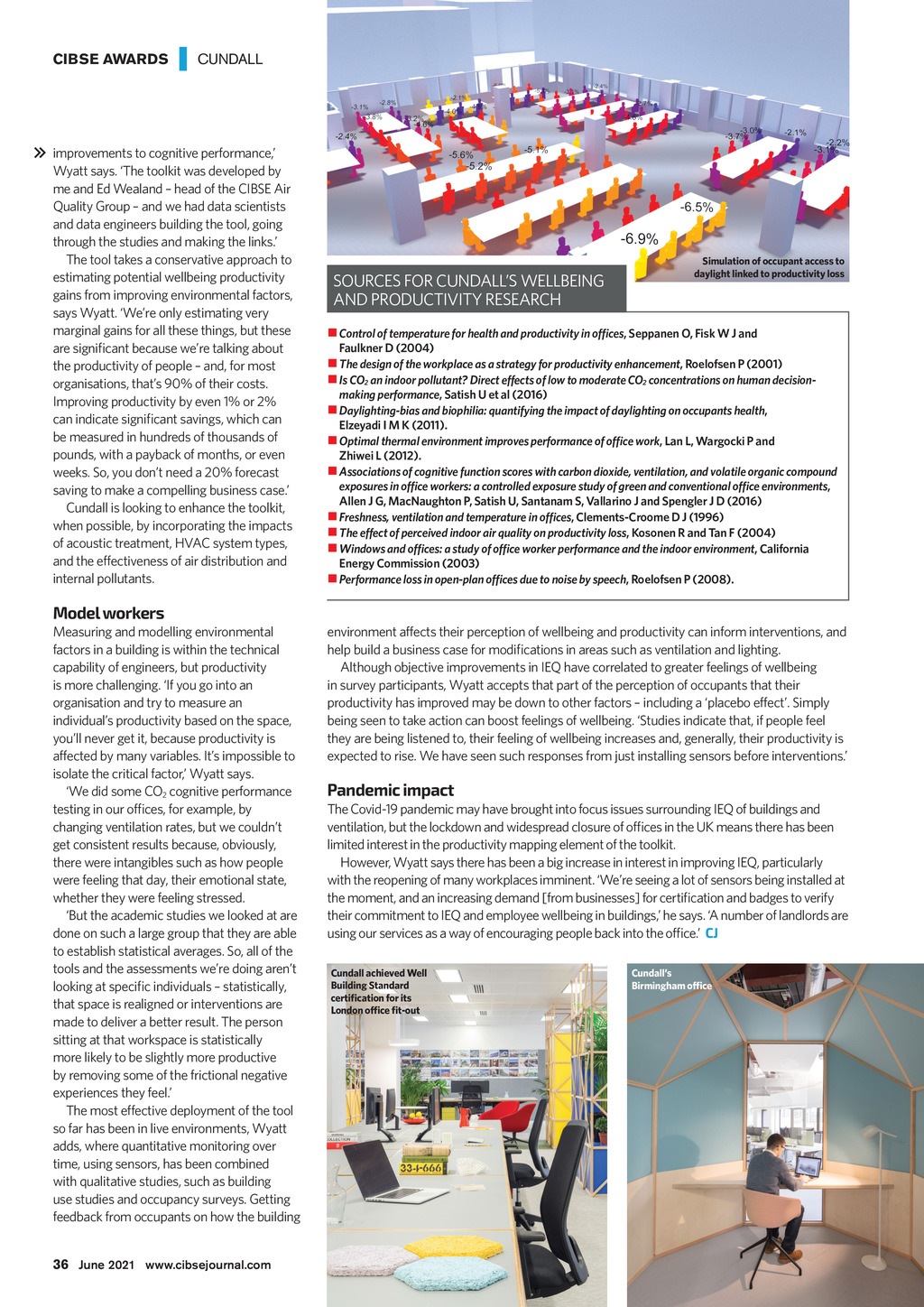


CIBSE AWARDS | CUNDALL improvements to cognitive performance, Wyatt says. The toolkit was developed by me and Ed Wealand head of the CIBSE Air Quality Group and we had data scientists and data engineers building the tool, going through the studies and making the links. The tool takes a conservative approach to estimating potential wellbeing productivity gains from improving environmental factors, says Wyatt. Were only estimating very marginal gains for all these things, but these , Seppanen O, Fisk W J and Faulkner D (2004) the productivity of people and, for most organisations, thats 90% of their costs. Improving productivity by even 1% or 2% be measured in hundreds of thousands of pounds, with a payback of months, or even weeks. So, you dont need a 20% forecast saving to make a compelling business case. Cundall is looking to enhance the toolkit, when possible, by incorporating the impacts of acoustic treatment, HVAC system types, and the effectiveness of air distribution and internal pollutants. Model workers Measuring and modelling environmental factors in a building is within the technical capability of engineers, but productivity is more challenging. If you go into an organisation and try to measure an individuals productivity based on the space, youll never get it, because productivity is affected by many variables. Its impossible to isolate the critical factor, Wyatt says. We did some CO2 cognitive performance changing ventilation rates, but we couldnt get consistent results because, obviously, there were intangibles such as how people were feeling that day, their emotional state, whether they were feeling stressed. But the academic studies we looked at are done on such a large group that they are able to establish statistical averages. So, all of the tools and the assessments were doing arent 2 , Roelofsen P (2001) , Satish U et al (2016) Elzeyadi I M K (2011). Zhiwei L (2012). 2 , , Lan L, Wargocki P and Allen J G, MacNaughton P, Satish U, Santanam S, Vallarino J and Spengler J D (2016) , Clements-Croome D J (1996) , Kosonen R and Tan F (2004) , California Energy Commission (2003) , Roelofsen P (2008). , environment affects their perception of wellbeing and productivity can inform interventions, and Although objective improvements in IEQ have correlated to greater feelings of wellbeing in survey participants, Wyatt accepts that part of the perception of occupants that their productivity has improved may be down to other factors including a placebo effect. Simply being seen to take action can boost feelings of wellbeing. Studies indicate that, if people feel they are being listened to, their feeling of wellbeing increases and, generally, their productivity is Pandemic impact The Covid-19 pandemic may have brought into focus issues surrounding IEQ of buildings and limited interest in the productivity mapping element of the toolkit. However, Wyatt says there has been a big increase in interest in improving IEQ, particularly with the reopening of many workplaces imminent. Were seeing a lot of sensors being installed at their commitment to IEQ and employee wellbeing in buildings, he says. A number of landlords are CJ Cundall achieved Well Building Standard that space is realigned or interventions are made to deliver a better result. The person sitting at that workspace is statistically more likely to be slightly more productive by removing some of the frictional negative The most effective deployment of the tool so far has been in live environments, Wyatt adds, where quantitative monitoring over time, using sensors, has been combined with qualitative studies, such as building use studies and occupancy surveys. Getting feedback from occupants on how the building 36 June 2021 www.cibsejournal.com CIBSE June 21 pp34-36 Cundall award Supp.indd 36 21/05/2021 16:07