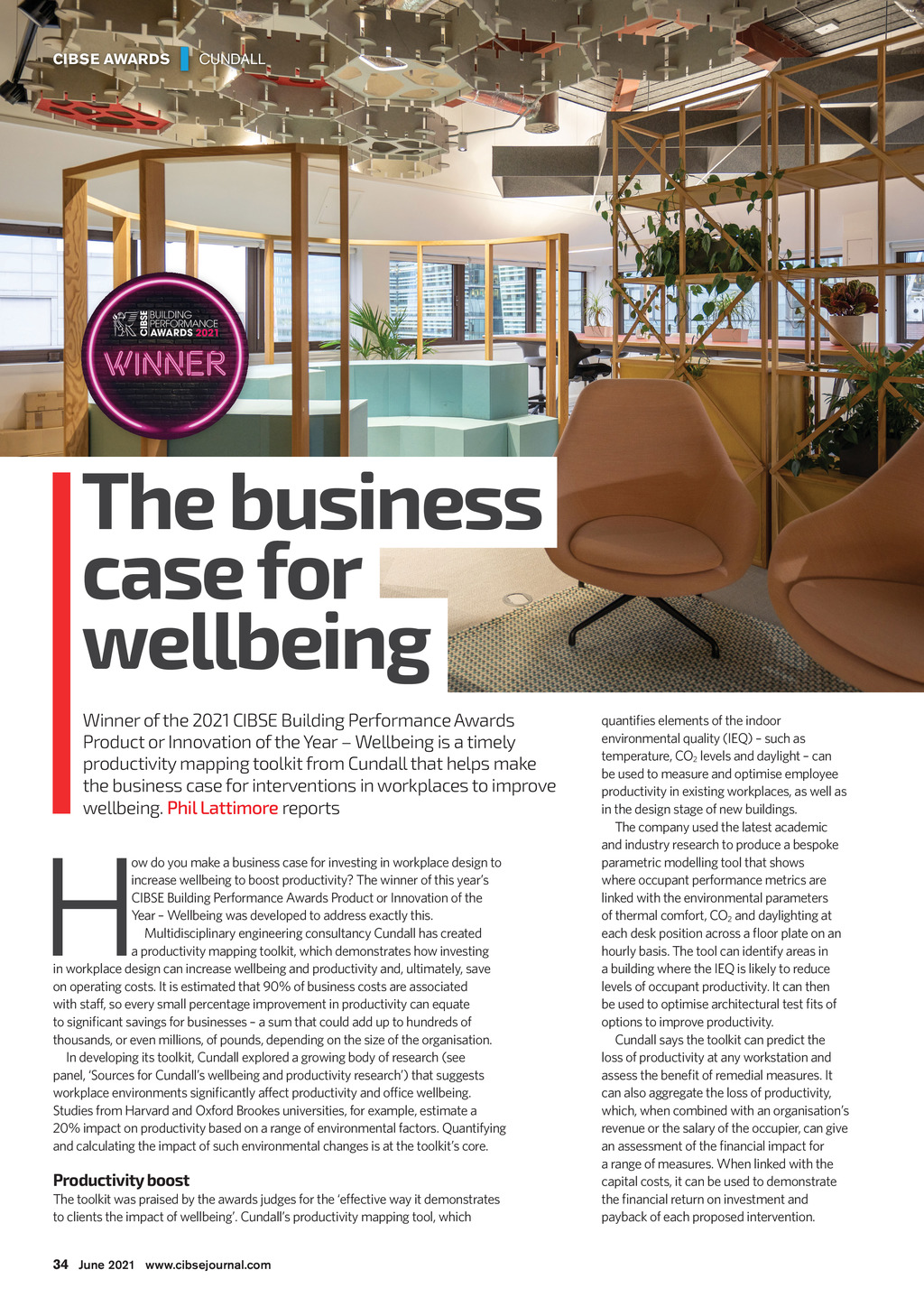


CIBSE AWARDS | CUNDALL The business case for wellbeing Winner of the 2021 CIBSE Building Performance Awards Product or Innovation of the Year Wellbeing is a timely productivity mapping toolkit from Cundall that helps make the business case for interventions in workplaces to improve wellbeing. Phil Lattimore reports H ow do you make a business case for investing in workplace design to increase wellbeing to boost productivity? The winner of this years CIBSE Building Performance Awards Product or Innovation of the Year Wellbeing was developed to address exactly this. Multidisciplinary engineering consultancy Cundall has created a productivity mapping toolkit, which demonstrates how investing in workplace design can increase wellbeing and productivity and, ultimately, save on operating costs. It is estimated that 90% of business costs are associated with staff, so every small percentage improvement in productivity can equate thousands, or even millions, of pounds, depending on the size of the organisation. In developing its toolkit, Cundall explored a growing body of research (see panel, Sources for Cundalls wellbeing and productivity research) that suggests Studies from Harvard and Oxford Brookes universities, for example, estimate a 20% impact on productivity based on a range of environmental factors. Quantifying and calculating the impact of such environmental changes is at the toolkits core. Productivity boost The toolkit was praised by the awards judges for the effective way it demonstrates to clients the impact of wellbeing. Cundalls productivity mapping tool, which environmental quality (IEQ) such as temperature, CO2 levels and daylight can be used to measure and optimise employee productivity in existing workplaces, as well as in the design stage of new buildings. The company used the latest academic and industry research to produce a bespoke parametric modelling tool that shows where occupant performance metrics are linked with the environmental parameters of thermal comfort, CO2 and daylighting at hourly basis. The tool can identify areas in a building where the IEQ is likely to reduce levels of occupant productivity. It can then options to improve productivity. Cundall says the toolkit can predict the loss of productivity at any workstation and can also aggregate the loss of productivity, which, when combined with an organisations revenue or the salary of the occupier, can give a range of measures. When linked with the capital costs, it can be used to demonstrate payback of each proposed intervention. 34 June 2021 www.cibsejournal.com CIBSE June 21 pp34-36 Cundall award Supp.indd 34 21/05/2021 16:06