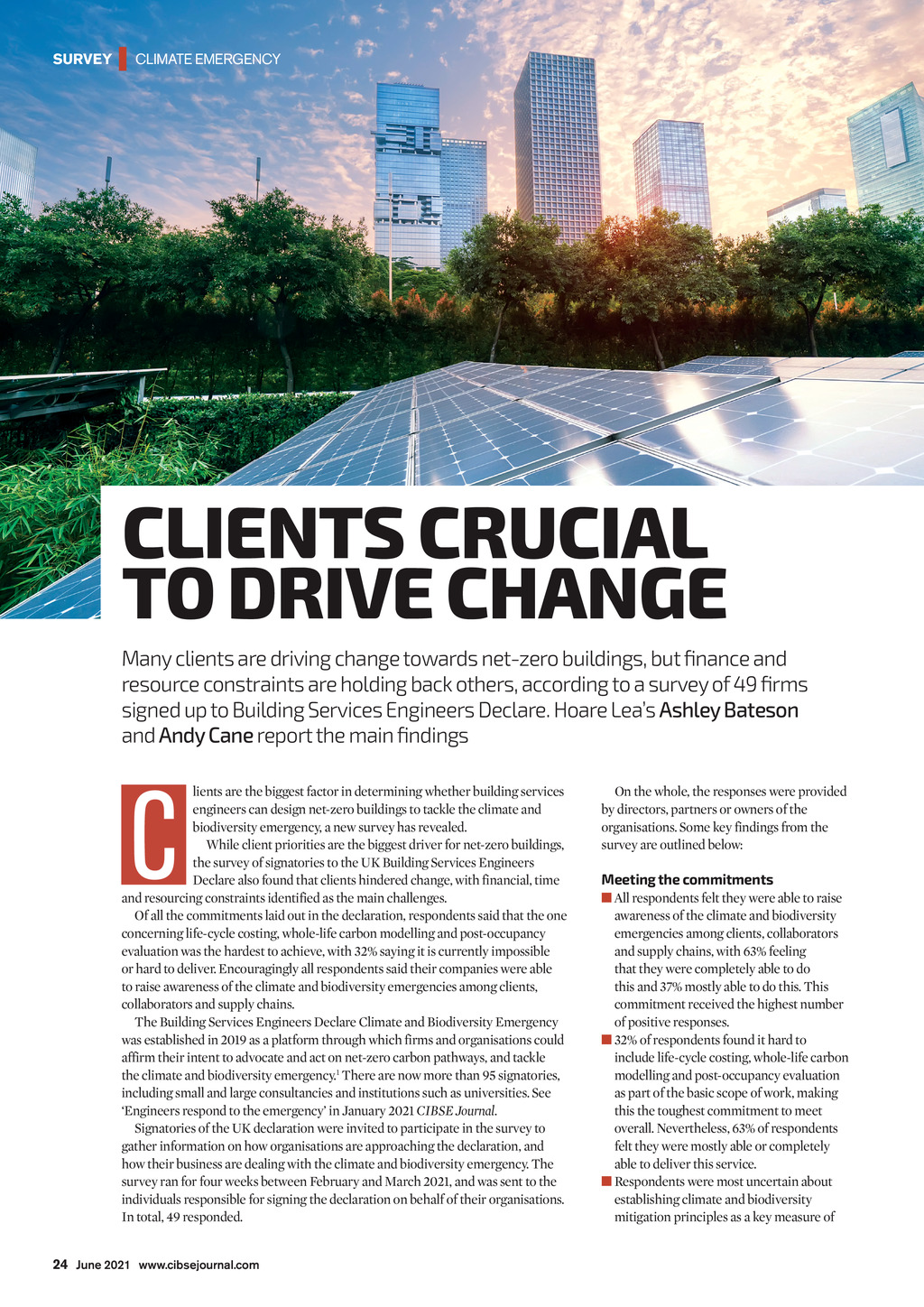


SURVEY | CLIMATE EMERGENCY CLIENTS CRUCIAL TO DRIVE CHANGE Many clients are driving change towards net-zero buildings, but finance and resource constraints are holding back others, according to a survey of 49 firms signed up to Building Services Engineers Declare. Hoare Leas Ashley Bateson and Andy Cane report the main findings C lients are the biggest factor in determining whether building services engineers can design net-zero buildings to tackle the climate and biodiversity emergency, a new survey has revealed. While client priorities are the biggest driver for net-zero buildings, the survey of signatories to the UK Building Services Engineers Declare also found that clients hindered change, with financial, time and resourcing constraints identified as the main challenges. Of all the commitments laid out in the declaration, respondents said that the one concerning life-cycle costing, whole-life carbon modelling and post-occupancy evaluation was the hardest to achieve, with 32% saying it is currently impossible or hard to deliver. Encouragingly all respondents said their companies were able to raise awareness of the climate and biodiversity emergencies among clients, collaborators and supply chains. The Building Services Engineers Declare Climate and Biodiversity Emergency was established in 2019 as a platform through which firms and organisations could affirm their intent to advocate and act on net-zero carbon pathways, and tackle the climate and biodiversity emergency.1 There are now more than 95 signatories, including small and large consultancies and institutions such as universities. See Engineers respond to the emergency in January 2021 CIBSE Journal. Signatories of the UK declaration were invited to participate in the survey to gather information on how organisations are approaching the declaration, and how their business are dealing with the climate and biodiversity emergency. The survey ran for four weeks between February and March 2021, and was sent to the individuals responsible for signing the declaration on behalf of their organisations. In total, 49 responded. On the whole, the responses were provided by directors, partners or owners of the organisations. Some key findings from the survey are outlined below: Meeting the commitments All respondents felt they were able to raise awareness of the climate and biodiversity emergencies among clients, collaborators and supply chains, with 63% feeling that they were completely able to do this and 37% mostly able to do this. This commitment received the highest number of positive responses. 32% of respondents found it hard to include life-cycle costing, whole-life carbon modelling and post-occupancy evaluation as part of the basic scope of work, making this the toughest commitment to meet overall. Nevertheless, 63% of respondents felt they were mostly able or completely able to deliver this service. Respondents were most uncertain about establishing climate and biodiversity mitigation principles as a key measure of 24 June 2021 www.cibsejournal.com CIBSE June 21 pp24-26 Building services declare.indd 24 21/05/2021 15:49