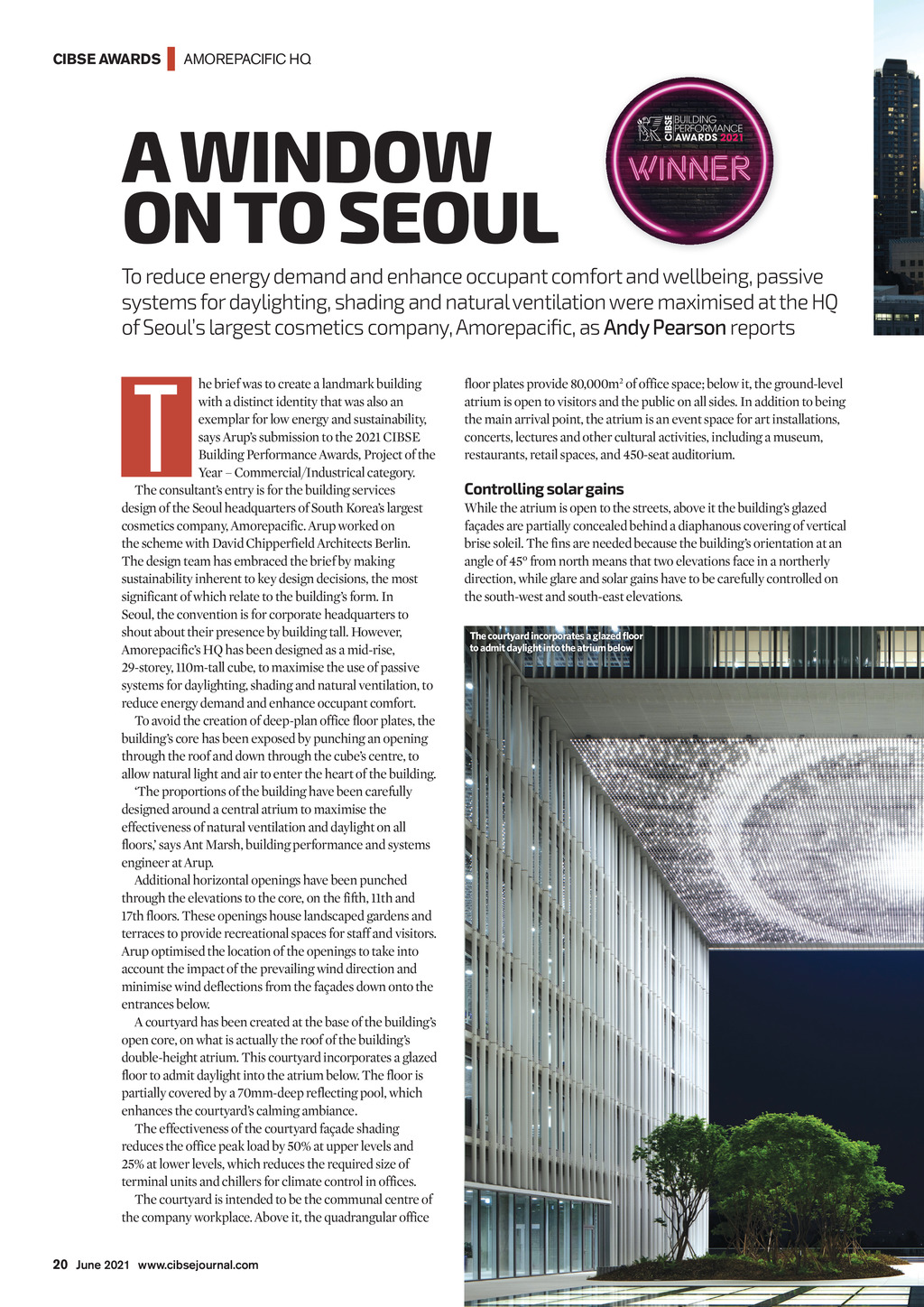


CIBSE AWARDS | AMOREPACIFIC HQ A WINDOW ON TO SEOUL To reduce energy demand and enhance occupant comfort and wellbeing, passive systems for daylighting, shading and natural ventilation were maximised at the HQ of Seouls largest cosmetics company, Amorepacific, as Andy Pearson reports T he brief was to create a landmark building with a distinct identity that was also an exemplar for low energy and sustainability, says Arups submission to the 2021 CIBSE Building Performance Awards, Project of the Year Commercial/Industrical category. The consultants entry is for the building services design of the Seoul headquarters of South Koreas largest cosmetics company, Amorepacific. Arup worked on the scheme with David Chipperfield Architects Berlin. The design team has embraced the brief by making sustainability inherent to key design decisions, the most significant of which relate to the buildings form. In Seoul, the convention is for corporate headquarters to shout about their presence by building tall. However, Amorepacifics HQ has been designed as a mid-rise, 29-storey, 110m-tall cube, to maximise the use of passive systems for daylighting, shading and natural ventilation, to reduce energy demand and enhance occupant comfort. To avoid the creation of deep-plan office floor plates, the buildings core has been exposed by punching an opening through the roof and down through the cubes centre, to allow natural light and air to enter the heart of the building. The proportions of the building have been carefully designed around a central atrium to maximise the effectiveness of natural ventilation and daylight on all floors, says Ant Marsh, building performance and systems engineer at Arup. Additional horizontal openings have been punched through the elevations to the core, on the fifth, 11th and 17th floors. These openings house landscaped gardens and terraces to provide recreational spaces for staff and visitors. Arup optimised the location of the openings to take into account the impact of the prevailing wind direction and minimise wind deflections from the faades down onto the entrances below. A courtyard has been created at the base of the buildings open core, on what is actually the roof of the buildings double-height atrium. This courtyard incorporates a glazed floor to admit daylight into the atrium below. The floor is partially covered by a 70mm-deep reflecting pool, which enhances the courtyards calming ambiance. The effectiveness of the courtyard faade shading reduces the office peak load by 50% at upper levels and 25% at lower levels, which reduces the required size of terminal units and chillers for climate control in offices. The courtyard is intended to be the communal centre of the company workplace. Above it, the quadrangular office floor plates provide 80,000m2 of office space; below it, the ground-level atrium is open to visitors and the public on all sides. In addition to being the main arrival point, the atrium is an event space for art installations, concerts, lectures and other cultural activities, including a museum, restaurants, retail spaces, and 450-seat auditorium. Controlling solar gains While the atrium is open to the streets, above it the buildings glazed faades are partially concealed behind a diaphanous covering of vertical brise soleil. The fins are needed because the buildings orientation at an angle of 45 from north means that two elevations face in a northerly direction, while glare and solar gains have to be carefully controlled on the south-west and south-east elevations. to admit daylight into the atrium below 20 June 2021 www.cibsejournal.com CIBSE June 21 pp20-23 Amorepacific.indd 20 21/05/2021 15:59