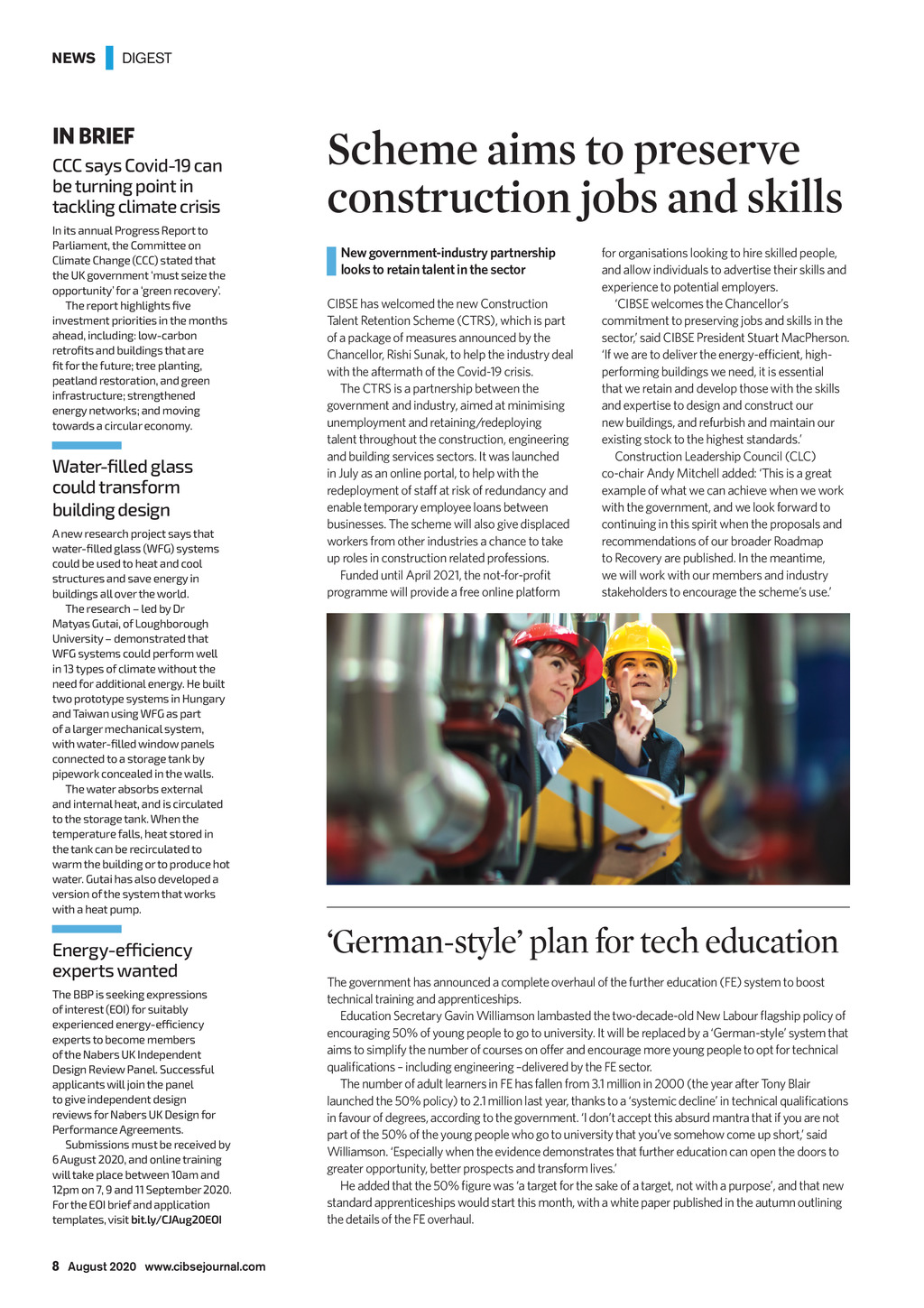


EWS | DIGEST IN BRIEF CCC says Covid-19 can be turning point in tackling climate crisis In its annual Progress Report to Parliament, the Committee on Climate Change (CCC) stated that the UK government must seize the opportunity for a green recovery. The report highlights five investment priorities in the months ahead, including: low-carbon retrofits and buildings that are fit for the future; tree planting, peatland restoration, and green infrastructure; strengthened energy networks; and moving towards a circular economy. Water-filled glass could transform building design A new research project says that water-filled glass (WFG) systems could be used to heat and cool structures and save energy in buildings all over the world. The research led by Dr Matyas Gutai, of Loughborough University demonstrated that WFG systems could perform well in 13 types of climate without the need for additional energy. He built two prototype systems in Hungary and Taiwan using WFG as part of a larger mechanical system, with water-filled window panels connected to a storage tank by pipework concealed in the walls. The water absorbs external and internal heat, and is circulated to the storage tank. When the temperature falls, heat stored in the tank can be recirculated to warm the building or to produce hot water. Gutai has also developed a version of the system that works with a heat pump. Energy-efficiency experts wanted The BBP is seeking expressions of interest (EOI) for suitably experienced energy-efficiency experts to become members of the Nabers UK Independent Design Review Panel. Successful applicants will join the panel to give independent design reviews for Nabers UK Design for Performance Agreements. Submissions must be received by 6 August 2020, and online training will take place between 10am and 12pm on 7, 9 and 11 September 2020. For the EOI brief and application templates, visit bit.ly/CJAug20EOI Scheme aims to preserve construction jobs and skills New government-industry partnership looks to retain talent in the sector CIBSE has welcomed the new Construction Talent Retention Scheme (CTRS), which is part of a package of measures announced by the Chancellor, Rishi Sunak, to help the industry deal with the aftermath of the Covid-19 crisis. The CTRS is a partnership between the government and industry, aimed at minimising unemployment and retaining/redeploying talent throughout the construction, engineering and building services sectors. It was launched in July as an online portal, to help with the redeployment of staff at risk of redundancy and enable temporary employee loans between businesses. The scheme will also give displaced workers from other industries a chance to take up roles in construction related professions. Funded until April 2021, the not-for-profit programme will provide a free online platform for organisations looking to hire skilled people, and allow individuals to advertise their skills and experience to potential employers. CIBSE welcomes the Chancellors commitment to preserving jobs and skills in the sector, said CIBSE President Stuart MacPherson. If we are to deliver the energy-efficient, highperforming buildings we need, it is essential that we retain and develop those with the skills and expertise to design and construct our new buildings, and refurbish and maintain our existing stock to the highest standards. Construction Leadership Council (CLC) co-chair Andy Mitchell added: This is a great example of what we can achieve when we work with the government, and we look forward to continuing in this spirit when the proposals and recommendations of our broader Roadmap to Recovery are published. In the meantime, we will work with our members and industry stakeholders to encourage the schemes use. German-style plan for tech education The government has announced a complete overhaul of the further education (FE) system to boost technical training and apprenticeships. Education Secretary Gavin Williamson lambasted the two-decade-old New Labour flagship policy of encouraging 50% of young people to go to university. It will be replaced by a German-style system that aims to simplify the number of courses on offer and encourage more young people to opt for technical qualifications including engineering delivered by the FE sector. The number of adult learners in FE has fallen from 3.1 million in 2000 (the year after Tony Blair launched the 50% policy) to 2.1 million last year, thanks to a systemic decline in technical qualifications in favour of degrees, according to the government. I dont accept this absurd mantra that if you are not part of the 50% of the young people who go to university that youve somehow come up short, said Williamson. Especially when the evidence demonstrates that further education can open the doors to greater opportunity, better prospects and transform lives. He added that the 50% figure was a target for the sake of a target, not with a purpose, and that new standard apprenticeships would start this month, with a white paper published in the autumn outlining the details of the FE overhaul. 8 August 2020 www.cibsejournal.com CIBSE Aug2020 p08-09 News.indd 8 24/07/2020 17:32