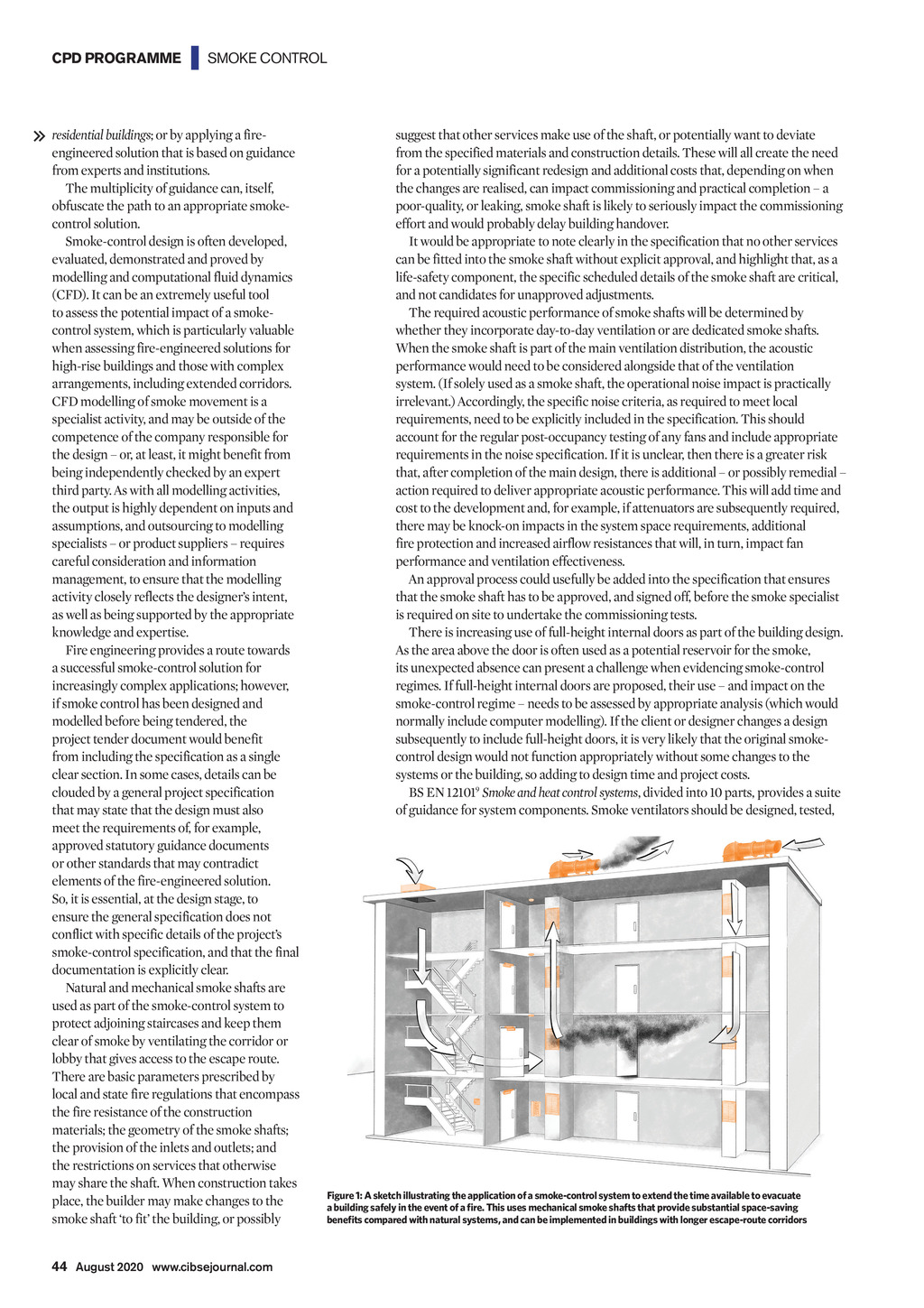


CPD PROGRAMME | SMOKE CONTROL residential buildings; or by applying a fireengineered solution that is based on guidance from experts and institutions. The multiplicity of guidance can, itself, obfuscate the path to an appropriate smokecontrol solution. Smoke-control design is often developed, evaluated, demonstrated and proved by modelling and computational fluid dynamics (CFD). It can be an extremely useful tool to assess the potential impact of a smokecontrol system, which is particularly valuable when assessing fire-engineered solutions for high-rise buildings and those with complex arrangements, including extended corridors. CFD modelling of smoke movement is a specialist activity, and may be outside of the competence of the company responsible for the design or, at least, it might benefit from being independently checked by an expert third party. As with all modelling activities, the output is highly dependent on inputs and assumptions, and outsourcing to modelling specialists or product suppliers requires careful consideration and information management, to ensure that the modelling activity closely reflects the designers intent, as well as being supported by the appropriate knowledge and expertise. Fire engineering provides a route towards a successful smoke-control solution for increasingly complex applications; however, if smoke control has been designed and modelled before being tendered, the project tender document would benefit from including the specification as a single clear section. In some cases, details can be clouded by a general project specification that may state that the design must also meet the requirements of, for example, approved statutory guidance documents or other standards that may contradict elements of the fire-engineered solution. So, it is essential, at the design stage, to ensure the general specification does not conflict with specific details of the projects smoke-control specification, and that the final documentation is explicitly clear. Natural and mechanical smoke shafts are used as part of the smoke-control system to protect adjoining staircases and keep them clear of smoke by ventilating the corridor or lobby that gives access to the escape route. There are basic parameters prescribed by local and state fire regulations that encompass the fire resistance of the construction materials; the geometry of the smoke shafts; the provision of the inlets and outlets; and the restrictions on services that otherwise may share the shaft. When construction takes place, the builder may make changes to the smoke shaft to fit the building, or possibly suggest that other services make use of the shaft, or potentially want to deviate from the specified materials and construction details. These will all create the need for a potentially significant redesign and additional costs that, depending on when the changes are realised, can impact commissioning and practical completion a poor-quality, or leaking, smoke shaft is likely to seriously impact the commissioning effort and would probably delay building handover. It would be appropriate to note clearly in the specification that no other services can be fitted into the smoke shaft without explicit approval, and highlight that, as a life-safety component, the specific scheduled details of the smoke shaft are critical, and not candidates for unapproved adjustments. The required acoustic performance of smoke shafts will be determined by whether they incorporate day-to-day ventilation or are dedicated smoke shafts. When the smoke shaft is part of the main ventilation distribution, the acoustic performance would need to be considered alongside that of the ventilation system. (If solely used as a smoke shaft, the operational noise impact is practically irrelevant.) Accordingly, the specific noise criteria, as required to meet local requirements, need to be explicitly included in the specification. This should account for the regular post-occupancy testing of any fans and include appropriate requirements in the noise specification. If it is unclear, then there is a greater risk that, after completion of the main design, there is additional or possibly remedial action required to deliver appropriate acoustic performance. This will add time and cost to the development and, for example, if attenuators are subsequently required, there may be knock-on impacts in the system space requirements, additional fire protection and increased airflow resistances that will, in turn, impact fan performance and ventilation effectiveness. An approval process could usefully be added into the specification that ensures that the smoke shaft has to be approved, and signed off, before the smoke specialist is required on site to undertake the commissioning tests. There is increasing use of full-height internal doors as part of the building design. As the area above the door is often used as a potential reservoir for the smoke, its unexpected absence can present a challenge when evidencing smoke-control regimes. If full-height internal doors are proposed, their use and impact on the smoke-control regime needs to be assessed by appropriate analysis (which would normally include computer modelling). If the client or designer changes a design subsequently to include full-height doors, it is very likely that the original smokecontrol design would not function appropriately without some changes to the systems or the building, so adding to design time and project costs. BS EN 121019 Smoke and heat control systems, divided into 10 parts, provides a suite of guidance for system components. Smoke ventilators should be designed, tested, Figure 1: A sketch illustrating the application of a smoke-control system to extend the time available to evacuate a building safely in the event of a fire. This uses mechanical smoke shafts that provide substantial space-saving benefits compared with natural systems, and can be implemented in buildings with longer escape-route corridors 44 August 2020 www.cibsejournal.com CIBSE Aug 2020 p43-46 CPD Exyte 166 v2.indd 44 24/07/2020 16:02