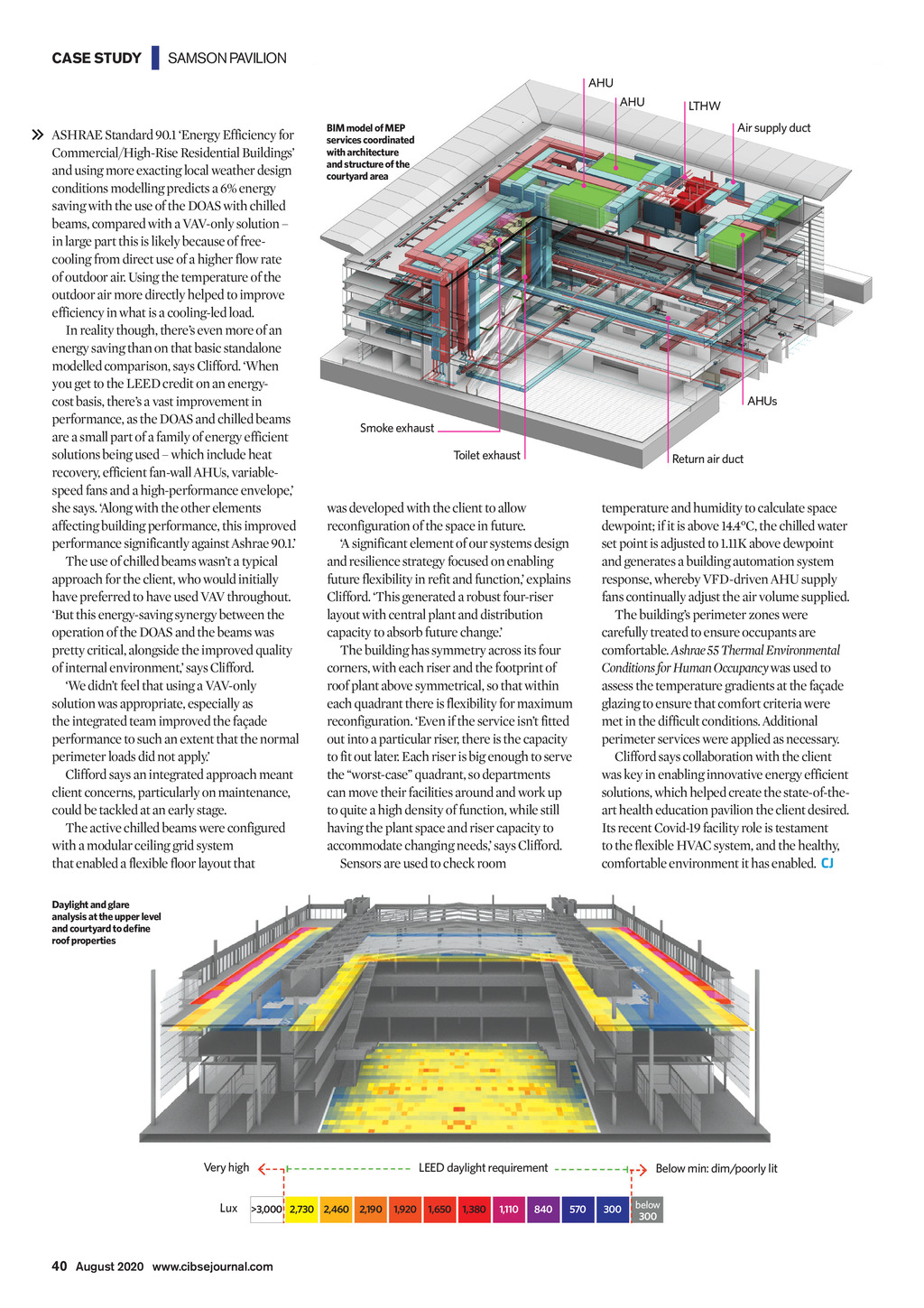


CASE STUDY | SAMSON PAVILION AHU AHU ASHRAE Standard 90.1 Energy Efficiency for Commercial/High-Rise Residential Buildings and using more exacting local weather design conditions modelling predicts a 6% energy saving with the use of the DOAS with chilled beams, compared with a VAV-only solution in large part this is likely because of freecooling from direct use of a higher flow rate of outdoor air. Using the temperature of the outdoor air more directly helped to improve efficiency in what is a cooling-led load. In reality though, theres even more of an energy saving than on that basic standalone modelled comparison, says Clifford. When you get to the LEED credit on an energycost basis, theres a vast improvement in performance, as the DOAS and chilled beams are a small part of a family of energy efficient solutions being used which include heat recovery, efficient fan-wall AHUs, variablespeed fans and a high-performance envelope, she says. Along with the other elements affecting building performance, this improved performance significantly against Ashrae 90.1. The use of chilled beams wasnt a typical approach for the client, who would initially have preferred to have used VAV throughout. But this energy-saving synergy between the operation of the DOAS and the beams was pretty critical, alongside the improved quality of internal environment, says Clifford. We didnt feel that using a VAV-only solution was appropriate, especially as the integrated team improved the faade performance to such an extent that the normal perimeter loads did not apply. Clifford says an integrated approach meant client concerns, particularly on maintenance, could be tackled at an early stage. The active chilled beams were configured with a modular ceiling grid system that enabled a flexible floor layout that LTHW Air supply duct BIM model of MEP services coordinated with architecture and structure of the courtyard area AHUs Smoke exhaust Toilet exhaust Return air duct was developed with the client to allow reconfiguration of the space in future. A significant element of our systems design and resilience strategy focused on enabling future flexibility in refit and function, explains Clifford. This generated a robust four-riser layout with central plant and distribution capacity to absorb future change. The building has symmetry across its four corners, with each riser and the footprint of roof plant above symmetrical, so that within each quadrant there is flexibility for maximum reconfiguration. Even if the service isnt fitted out into a particular riser, there is the capacity to fit out later. Each riser is big enough to serve the worst-case quadrant, so departments can move their facilities around and work up to quite a high density of function, while still having the plant space and riser capacity to accommodate changing needs, says Clifford. Sensors are used to check room temperature and humidity to calculate space dewpoint; if it is above 14.4C, the chilled water set point is adjusted to 1.11K above dewpoint and generates a building automation system response, whereby VFD-driven AHU supply fans continually adjust the air volume supplied. The buildings perimeter zones were carefully treated to ensure occupants are comfortable. Ashrae 55 Thermal Environmental Conditions for Human Occupancy was used to assess the temperature gradients at the faade glazing to ensure that comfort criteria were met in the difficult conditions. Additional perimeter services were applied as necessary. Clifford says collaboration with the client was key in enabling innovative energy efficient solutions, which helped create the state-of-theart health education pavilion the client desired. Its recent Covid-19 facility role is testament to the flexible HVAC system, and the healthy, comfortable environment it has enabled. CJ Daylight and glare analysis at the upper level and courtyard to define roof properties Very high Lux LEED daylight requirement >3,000 2,730 2,460 2,190 1,920 1,650 1,380 1,110 840 Below min: dim/poorly lit 570 300 below 300 40 August 2020 www.cibsejournal.com CIBSE Aug 2020 p38-40 Cleveland clinic v2.indd 40 24/07/2020 17:35