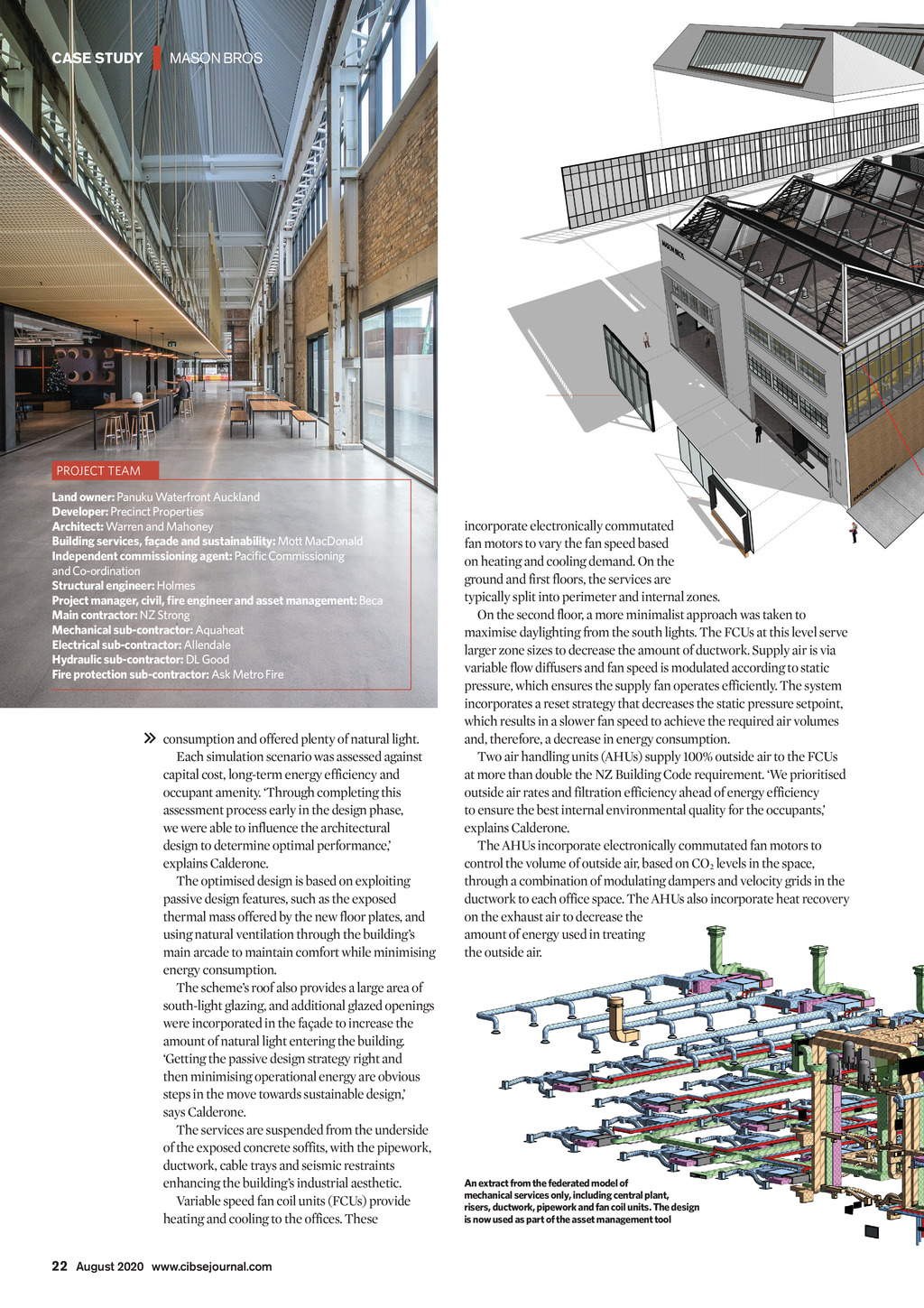


CASE STUDY | MASON BROS PROJECT TEAM Land owner: Panuku Waterfront Auckland Developer: Precinct Properties Architect: Warren and Mahoney Building services, faade and sustainability: Mott MacDonald Independent commissioning agent: Pacific Commissioning and Co-ordination Structural engineer: Holmes Project manager, civil, fire engineer and asset management: Beca Main contractor: NZ Strong Mechanical sub-contractor: Aquaheat Electrical sub-contractor: Allendale Hydraulic sub-contractor: DL Good Fire protection sub-contractor: Ask Metro Fire consumption and offered plenty of natural light. Each simulation scenario was assessed against capital cost, long-term energy efficiency and occupant amenity. Through completing this assessment process early in the design phase, we were able to influence the architectural design to determine optimal performance, explains Calderone. The optimised design is based on exploiting passive design features, such as the exposed thermal mass offered by the new floor plates, and using natural ventilation through the buildings main arcade to maintain comfort while minimising energy consumption. The schemes roof also provides a large area of south-light glazing, and additional glazed openings were incorporated in the faade to increase the amount of natural light entering the building. Getting the passive design strategy right and then minimising operational energy are obvious steps in the move towards sustainable design, says Calderone. The services are suspended from the underside of the exposed concrete soffits, with the pipework, ductwork, cable trays and seismic restraints enhancing the buildings industrial aesthetic. Variable speed fan coil units (FCUs) provide heating and cooling to the offices. These incorporate electronically commutated fan motors to vary the fan speed based on heating and cooling demand. On the ground and first floors, the services are typically split into perimeter and internal zones. On the second floor, a more minimalist approach was taken to maximise daylighting from the south lights. The FCUs at this level serve larger zone sizes to decrease the amount of ductwork. Supply air is via variable flow diffusers and fan speed is modulated according to static pressure, which ensures the supply fan operates efficiently. The system incorporates a reset strategy that decreases the static pressure setpoint, which results in a slower fan speed to achieve the required air volumes and, therefore, a decrease in energy consumption. Two air handling units (AHUs) supply 100% outside air to the FCUs at more than double the NZ Building Code requirement. We prioritised outside air rates and filtration efficiency ahead of energy efficiency to ensure the best internal environmental quality for the occupants, explains Calderone. The AHUs incorporate electronically commutated fan motors to control the volume of outside air, based on CO2 levels in the space, through a combination of modulating dampers and velocity grids in the ductwork to each office space. The AHUs also incorporate heat recovery on the exhaust air to decrease the amount of energy used in treating the outside air. An extract from the federated model of mechanical services only, including central plant, risers, ductwork, pipework and fan coil units. The design is now used as part of the asset management tool 22 August 2020 www.cibsejournal.com CIBSE Aug 2020 p20-24 Mason Bros.indd 22 24/07/2020 16:18