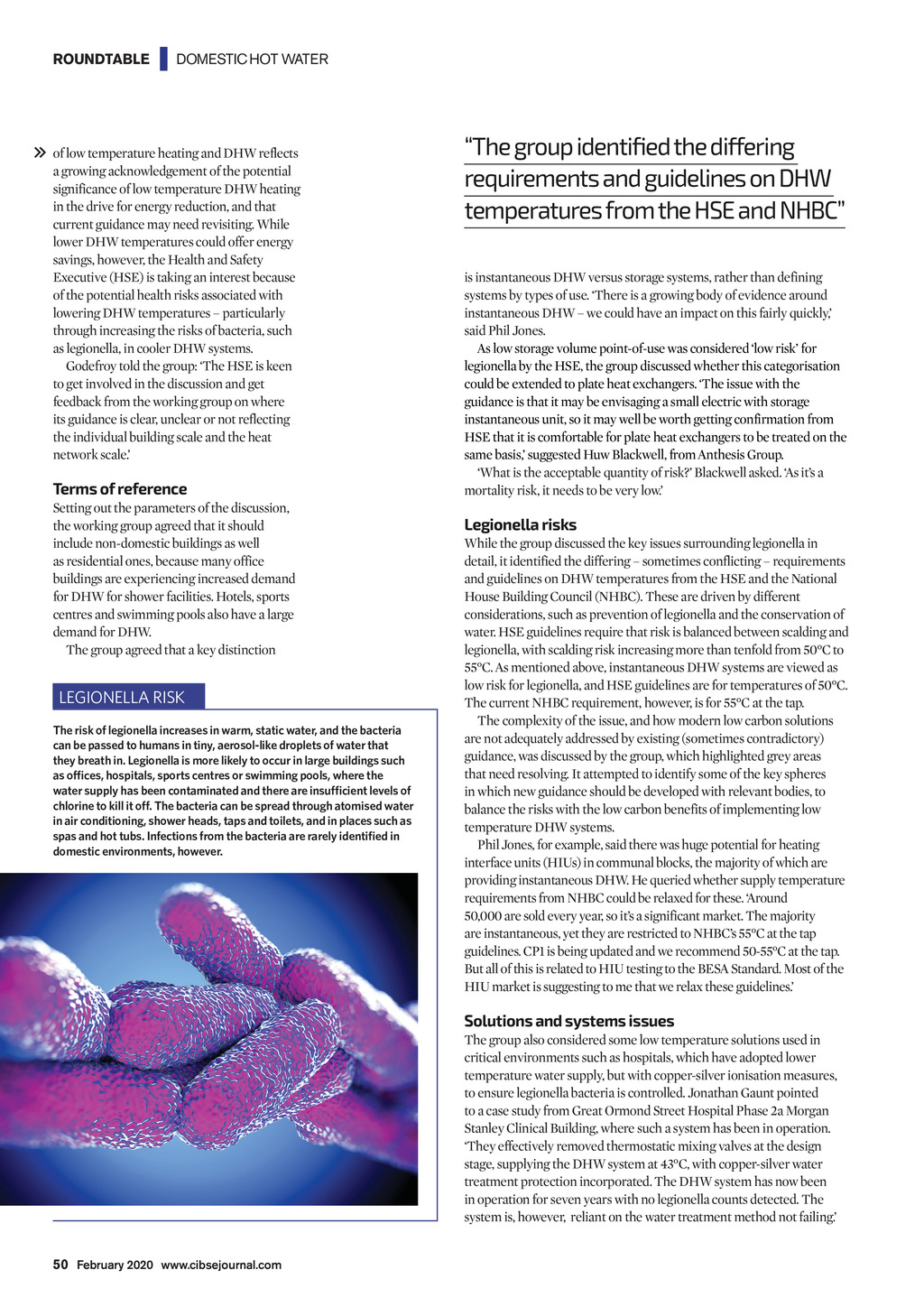


ROUNDTABLE | DOMESTIC HOT WATER of low temperature heating and DHW reflects a growing acknowledgement of the potential significance of low temperature DHW heating in the drive for energy reduction, and that current guidance may need revisiting. While lower DHW temperatures could offer energy savings, however, the Health and Safety Executive (HSE) is taking an interest because of the potential health risks associated with lowering DHW temperatures particularly through increasing the risks of bacteria, such as legionella, in cooler DHW systems. Godefroy told the group: The HSE is keen to get involved in the discussion and get feedback from the working group on where its guidance is clear, unclear or not reflecting the individual building scale and the heat network scale. Terms of reference Setting out the parameters of the discussion, the working group agreed that it should include non-domestic buildings as well as residential ones, because many office buildings are experiencing increased demand for DHW for shower facilities. Hotels, sports centres and swimming pools also have a large demand for DHW. The group agreed that a key distinction LEGIONELLA RISK The risk of legionella increases in warm, static water, and the bacteria can be passed to humans in tiny, aerosol-like droplets of water that they breath in. Legionella is more likely to occur in large buildings such as offices, hospitals, sports centres or swimming pools, where the water supply has been contaminated and there are insufficient levels of chlorine to kill it off. The bacteria can be spread through atomised water in air conditioning, shower heads, taps and toilets, and in places such as spas and hot tubs. Infections from the bacteria are rarely identified in domestic environments, however. The group identified the differing requirements and guidelines on DHW temperatures from the HSE and NHBC is instantaneous DHW versus storage systems, rather than defining systems by types of use. There is a growing body of evidence around instantaneous DHW we could have an impact on this fairly quickly, said Phil Jones. As low storage volume point-of-use was considered low risk for legionella by the HSE, the group discussed whether this categorisation could be extended to plate heat exchangers. The issue with the guidance is that it may be envisaging a small electric with storage instantaneous unit, so it may well be worth getting confirmation from HSE that it is comfortable for plate heat exchangers to be treated on the same basis, suggested Huw Blackwell, from Anthesis Group. What is the acceptable quantity of risk? Blackwell asked. As its a mortality risk, it needs to be very low. Legionella risks While the group discussed the key issues surrounding legionella in detail, it identified the differing sometimes conflicting requirements and guidelines on DHW temperatures from the HSE and the National House Building Council (NHBC). These are driven by different considerations, such as prevention of legionella and the conservation of water. HSE guidelines require that risk is balanced between scalding and legionella, with scalding risk increasing more than tenfold from 50C to 55C. As mentioned above, instantaneous DHW systems are viewed as low risk for legionella, and HSE guidelines are for temperatures of 50C. The current NHBC requirement, however, is for 55C at the tap. The complexity of the issue, and how modern low carbon solutions are not adequately addressed by existing (sometimes contradictory) guidance, was discussed by the group, which highlighted grey areas that need resolving. It attempted to identify some of the key spheres in which new guidance should be developed with relevant bodies, to balance the risks with the low carbon benefits of implementing low temperature DHW systems. Phil Jones, for example, said there was huge potential for heating interface units (HIUs) in communal blocks, the majority of which are providing instantaneous DHW. He queried whether supply temperature requirements from NHBC could be relaxed for these. Around 50,000 are sold every year, so its a significant market. The majority are instantaneous, yet they are restricted to NHBCs 55C at the tap guidelines. CP1 is being updated and we recommend 50-55C at the tap. But all of this is related to HIU testing to the BESA Standard. Most of the HIU market is suggesting to me that we relax these guidelines. Solutions and systems issues The group also considered some low temperature solutions used in critical environments such as hospitals, which have adopted lower temperature water supply, but with copper-silver ionisation measures, to ensure legionella bacteria is controlled. Jonathan Gaunt pointed to a case study from Great Ormond Street Hospital Phase 2a Morgan Stanley Clinical Building, where such a system has been in operation. They effectively removed thermostatic mixing valves at the design stage, supplying the DHW system at 43C, with copper-silver water treatment protection incorporated. The DHW system has now been in operation for seven years with no legionella counts detected. The system is, however, reliant on the water treatment method not failing. 50 February 2020 www.cibsejournal.com CIBSE Feb20 pp49-51 DHW roundtable.indd 50 24/01/2020 15:45