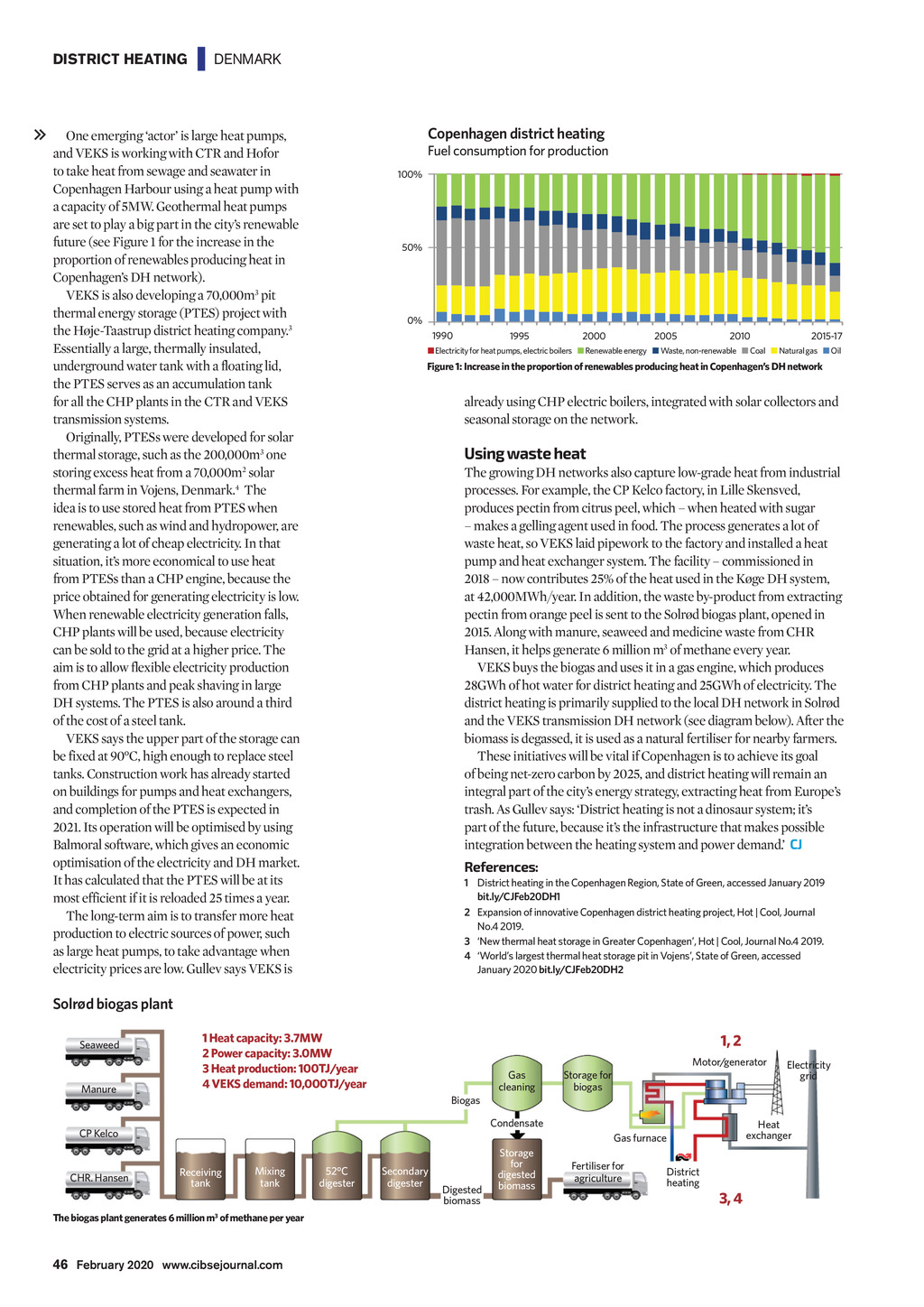

DISTRICT HEATING | DENMARK Copenhagen district heating One emerging actor is large heat pumps, and VEKS is working with CTR and Hofor to take heat from sewage and seawater in Copenhagen Harbour using a heat pump with a capacity of 5MW. Geothermal heat pumps are set to play a big part in the citys renewable future (see Figure 1 for the increase in the proportion of renewables producing heat in Copenhagens DH network). VEKS is also developing a 70,000m3 pit thermal energy storage (PTES) project with the Hje-Taastrup district heating company.3 Essentially a large, thermally insulated, underground water tank with a floating lid, the PTES serves as an accumulation tank for all the CHP plants in the CTR and VEKS transmission systems. Originally, PTESs were developed for solar thermal storage, such as the 200,000m3 one storing excess heat from a 70,000m2 solar thermal farm in Vojens, Denmark.4 The idea is to use stored heat from PTES when renewables, such as wind and hydropower, are generating a lot of cheap electricity. In that situation, its more economical to use heat from PTESs than a CHP engine, because the price obtained for generating electricity is low. When renewable electricity generation falls, CHP plants will be used, because electricity can be sold to the grid at a higher price. The aim is to allow flexible electricity production from CHP plants and peak shaving in large DH systems. The PTES is also around a third of the cost of a steel tank. VEKS says the upper part of the storage can be fixed at 90C, high enough to replace steel tanks. Construction work has already started on buildings for pumps and heat exchangers, and completion of the PTES is expected in 2021. Its operation will be optimised by using Balmoral software, which gives an economic optimisation of the electricity and DH market. It has calculated that the PTES will be at its most efficient if it is reloaded 25 times a year. The long-term aim is to transfer more heat production to electric sources of power, such as large heat pumps, to take advantage when electricity prices are low. Gullev says VEKS is Fuel consumption for production 100% 50% 0% 1990 1995 2005 2000 2015-17 2010 Electricity for heat pumps, electric boilers Renewable energy Waste, non-renewable Coal Natural gas Oil Figure 1: Increase in the proportion of renewables producing heat in Copenhagens DH network already using CHP electric boilers, integrated with solar collectors and seasonal storage on the network. Using waste heat The growing DH networks also capture low-grade heat from industrial processes. For example, the CP Kelco factory, in Lille Skensved, produces pectin from citrus peel, which when heated with sugar makes a gelling agent used in food. The process generates a lot of waste heat, so VEKS laid pipework to the factory and installed a heat pump and heat exchanger system. The facility commissioned in 2018 now contributes 25% of the heat used in the Kge DH system, at 42,000MWh/year. In addition, the waste by-product from extracting pectin from orange peel is sent to the Solrd biogas plant, opened in 2015. Along with manure, seaweed and medicine waste from CHR Hansen, it helps generate 6 million m3 of methane every year. VEKS buys the biogas and uses it in a gas engine, which produces 28GWh of hot water for district heating and 25GWh of electricity. The district heating is primarily supplied to the local DH network in Solrd and the VEKS transmission DH network (see diagram below). After the biomass is degassed, it is used as a natural fertiliser for nearby farmers. These initiatives will be vital if Copenhagen is to achieve its goal of being net-zero carbon by 2025, and district heating will remain an integral part of the citys energy strategy, extracting heat from Europes trash. As Gullev says: District heating is not a dinosaur system; its part of the future, because its the infrastructure that makes possible integration between the heating system and power demand. CJ References: 1 District heating in the Copenhagen Region, State of Green, accessed January 2019 bit.ly/CJFeb20DH1 2 Expansion of innovative Copenhagen district heating project, Hot | Cool, Journal No.4 2019. 3 New thermal heat storage in Greater Copenhagen, Hot | Cool, Journal No.4 2019. 4 Worlds largest thermal heat storage pit in Vojens, State of Green, accessed January 2020 bit.ly/CJFeb20DH2 Solrd biogas plant Seaweed Manure 1 Heat capacity: 3.7MW 2 Power capacity: 3.0MW 3 Heat production: 100TJ/year 4 VEKS demand: 10,000TJ/year 1, 2 Motor/generator Gas cleaning Electricity grid Biogas Condensate CP Kelco CHR. Hansen Storage for biogas Heat exchanger Gas furnace Receiving tank Mixing tank 52C digester Secondary digester Digested biomass Storage for digested biomass Fertiliser for agriculture District heating 3, 4 The biogas plant generates 6 million m3 of methane per year 46 February 2020 www.cibsejournal.com CIBSE Feb20 pp43-44, 46 Danish district heating.indd 46 24/01/2020 17:10