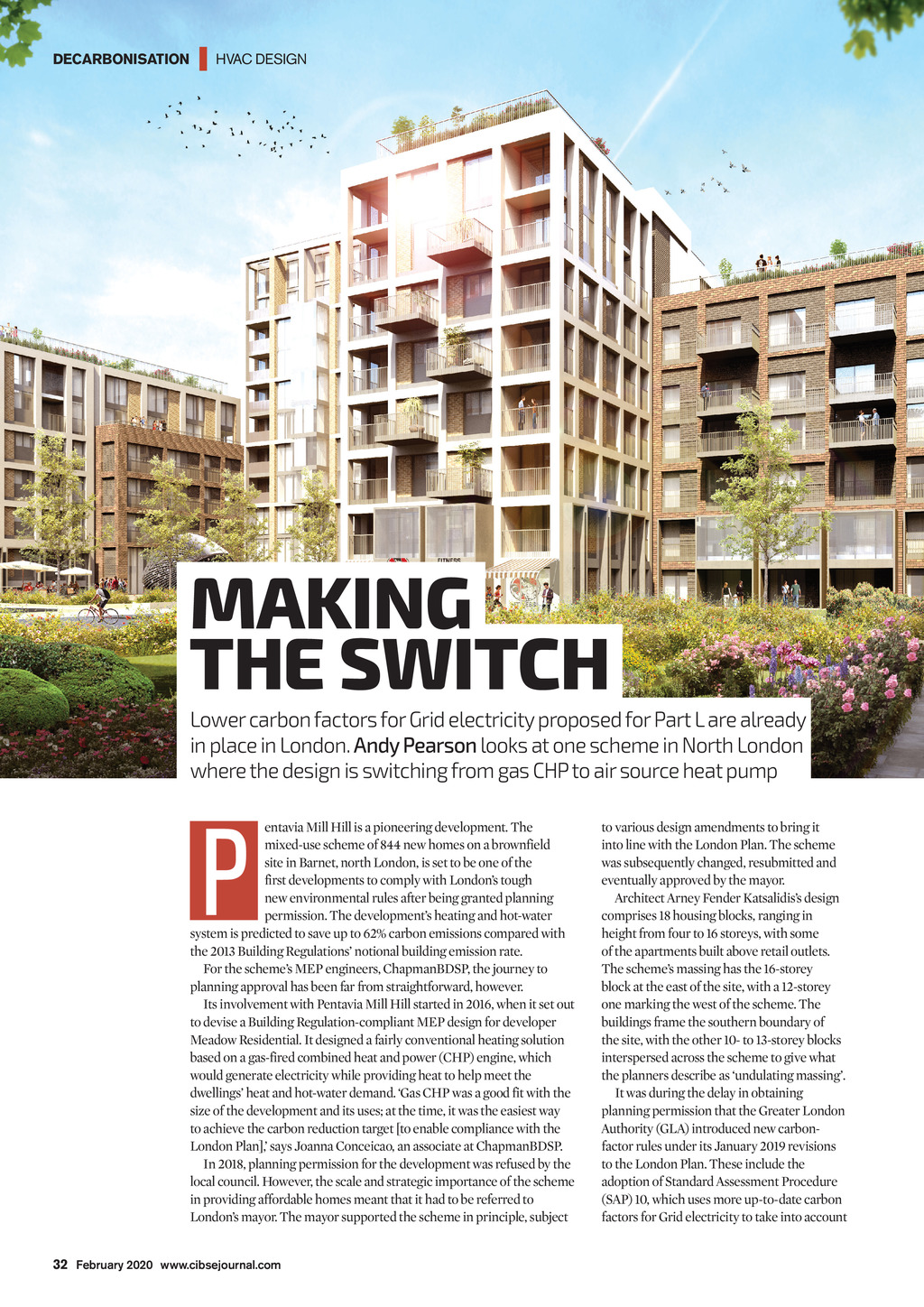


DECARBONISATION | HVAC DESIGN MAKING THE SWITCH Lower carbon factors for Grid electricity proposed for Part L are already in place in London. Andy Pearson looks at one scheme in North London where the design is switching from gas CHP to air source heat pump P entavia Mill Hill is a pioneering development. The mixed-use scheme of 844 new homes on a brownfield site in Barnet, north London, is set to be one of the first developments to comply with Londons tough new environmental rules after being granted planning permission. The developments heating and hot-water system is predicted to save up to 62% carbon emissions compared with the 2013 Building Regulations notional building emission rate. For the schemes MEP engineers, ChapmanBDSP, the journey to planning approval has been far from straightforward, however. Its involvement with Pentavia Mill Hill started in 2016, when it set out to devise a Building Regulation-compliant MEP design for developer Meadow Residential. It designed a fairly conventional heating solution based on a gas-fired combined heat and power (CHP) engine, which would generate electricity while providing heat to help meet the dwellings heat and hot-water demand. Gas CHP was a good fit with the size of the development and its uses; at the time, it was the easiest way to achieve the carbon reduction target [to enable compliance with the London Plan], says Joanna Conceicao, an associate at ChapmanBDSP. In 2018, planning permission for the development was refused by the local council. However, the scale and strategic importance of the scheme in providing affordable homes meant that it had to be referred to Londons mayor. The mayor supported the scheme in principle, subject to various design amendments to bring it into line with the London Plan. The scheme was subsequently changed, resubmitted and eventually approved by the mayor. Architect Arney Fender Katsalidiss design comprises 18 housing blocks, ranging in height from four to 16 storeys, with some of the apartments built above retail outlets. The schemes massing has the 16-storey block at the east of the site, with a 12-storey one marking the west of the scheme. The buildings frame the southern boundary of the site, with the other 10- to 13-storey blocks interspersed across the scheme to give what the planners describe as undulating massing. It was during the delay in obtaining planning permission that the Greater London Authority (GLA) introduced new carbonfactor rules under its January 2019 revisions to the London Plan. These include the adoption of Standard Assessment Procedure (SAP) 10, which uses more up-to-date carbon factors for Grid electricity to take into account 32 February 2020 www.cibsejournal.com CIBSE Feb20 pp32-34 Mill Hill heat pump v2.indd 32 24/01/2020 15:01