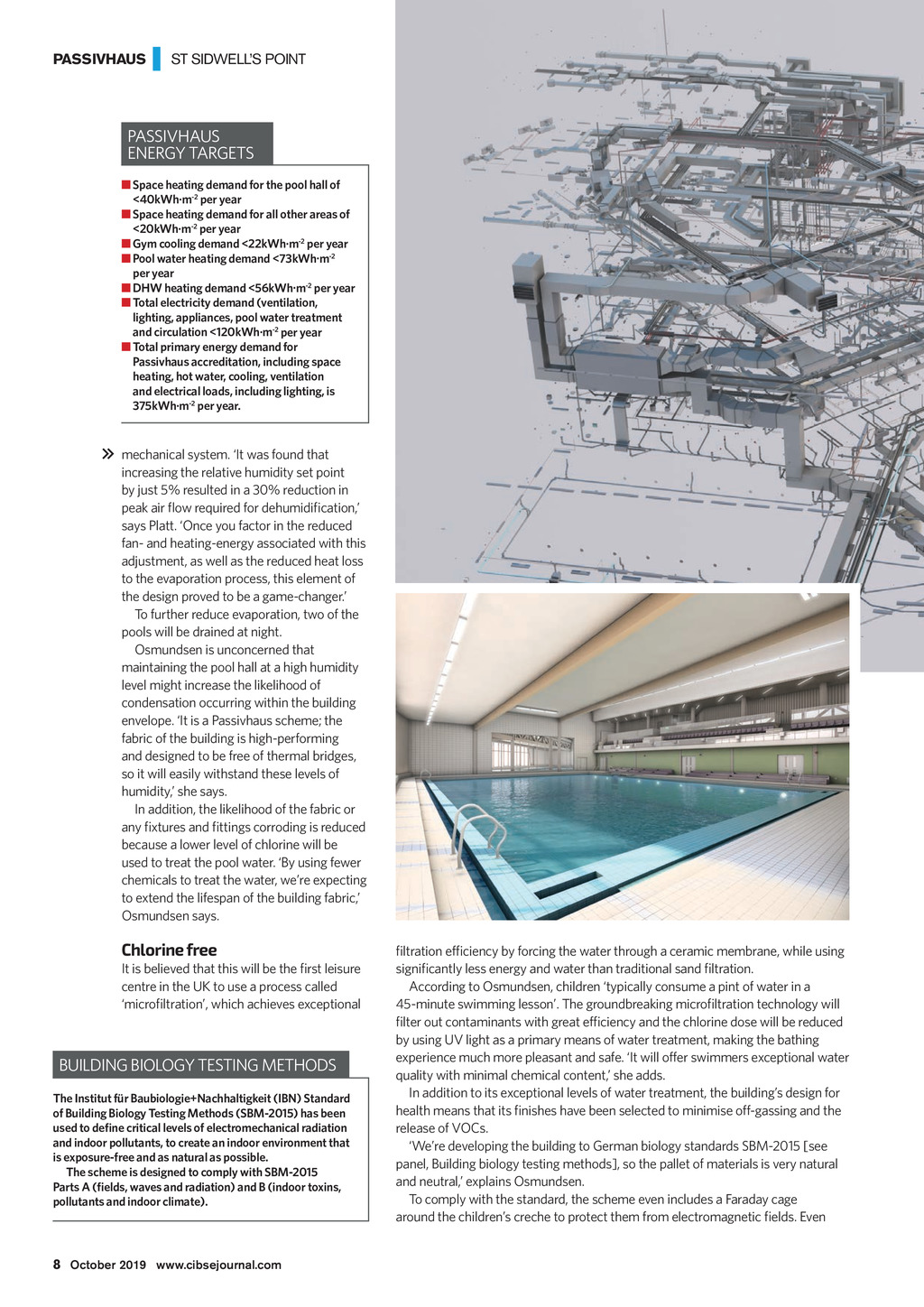
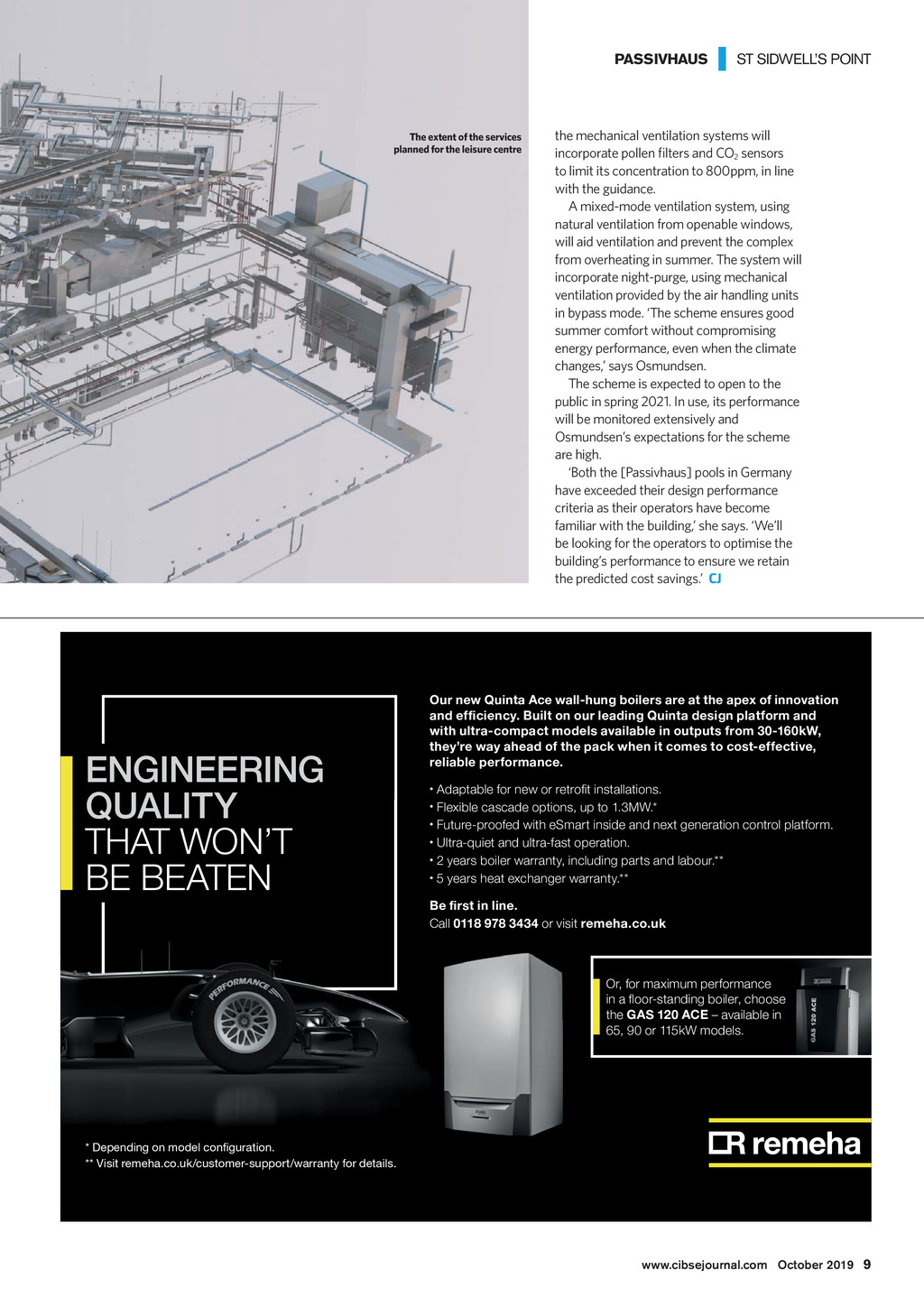

ASSIVHAUS | ST SIDWELLS POINT PASSIVHAUS ENERGY TARGETS pace heating demand for the pool hall of <40kWh.m-2 per year pace heating demand for all other areas of <20kWh.m-2 per year ym cooling demand h.m-2 per year ool water heating demand h.m-2 per year heating demand h.m-2 per year otal electricity demand ventilation, lighting, appliances, pool water treatment and circulation <120kWh.m-2 per year otal primary energy demand for assivhaus accreditation, including space heating, hot water, cooling, ventilation and electrical loads, including lighting, is h.m-2 per year. mechanical system. It was found that increasing the relative humidity set point by just 5% resulted in a 30% reduction in peak air ow required for dehumidication, says Platt. Once you factor in the reduced fan- and heating-energy associated with this ad ustment, as well as the reduced heat loss to the evaporation process, this element of the design proved to be a game-changer. To further reduce evaporation, two of the pools will be drained at night. Osmundsen is unconcerned that maintaining the pool hall at a high humidity level might increase the likelihood of condensation occurring within the building envelope. It is a Passivhaus scheme; the fabric of the building is high-performing and designed to be free of thermal bridges, so it will easily withstand these levels of humidity, she says. In addition, the likelihood of the fabric or any xtures and ttings corroding is reduced because a lower level of chlorine will be used to treat the pool water. By using fewer chemicals to treat the water, were expecting to extend the lifespan of the building fabric, Osmundsen says. Chlorine free It is believed that this will be the rst leisure centre in the UK to use a process called microltration, which achieves exceptional BUILDING BIOLOGY TESTING METHODS The Institut fr Baubiologie+Nachhaltigkeit (IBN) Standard of Building Biology Testing Methods (SBM-2015) has been used to define critical levels of electromechanical radiation and indoor pollutants, to create an indoor environment that is exposure-free and as natural as possible. he scheme is designed to comply with arts fields, waves and radiation and indoor to ins, pollutants and indoor climate . ltration efciency by forcing the water through a ceramic membrane, while using signicantly less energy and water than traditional sand ltration. According to smundsen, children typically consume a pint of water in a 45-minute swimming lesson. The groundbreaking microltration technology will lter out contaminants with great efciency and the chlorine dose will be reduced by using light as a primary means of water treatment, making the bathing experience much more pleasant and safe. It will offer swimmers exceptional water quality with minimal chemical content, she adds. In addition to its exceptional levels of water treatment, the buildings design for health means that its nishes have been selected to minimise off-gassing and the release of VOCs. Were developing the building to erman biology standards SBM-2015 see panel, Building biology testing methods , so the pallet of materials is very natural and neutral, explains smundsen. To comply with the standard, the scheme even includes a Faraday cage around the childrens creche to protect them from electromagnetic elds. Even 8 October 2019 www.cibsejournal.com CIBSE Oct19 pp06-09 Passivhaus pool Supp.indd 8 20/09/2019 13:47