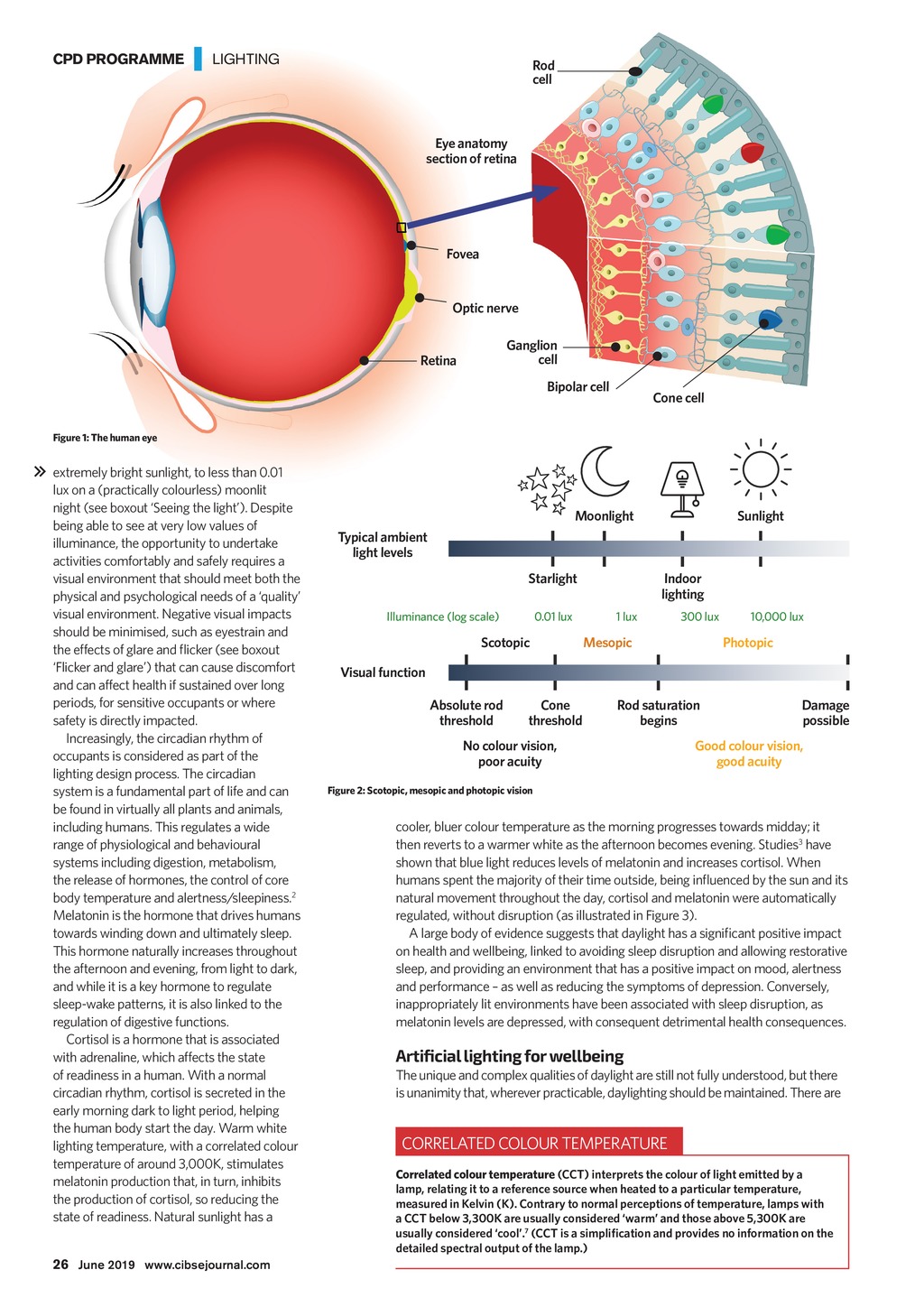


CPD PROGRAMME | LIGHTING Rod cell Eye anatomy section of retina Fovea Optic nerve Ganglion cell Retina Bipolar cell Cone cell Figure 1: The human eye extremely bright sunlight, to less than 0.01 lux on a (practically colourless) moonlit night (see boxout Seeing the light). Despite being able to see at very low values of illuminance, the opportunity to undertake activities comfortably and safely requires a visual environment that should meet both the physical and psychological needs of a quality visual environment. Negative visual impacts should be minimised, such as eyestrain and the effects of glare and icker (see boxout Flicker and glare) that can cause discomfort and can affect health if sustained over long periods, for sensitive occupants or where safety is directly impacted. Increasingly, the circadian rhythm of occupants is considered as part of the lighting design process. The circadian system is a fundamental part of life and can be found in virtually all plants and animals, including humans. This regulates a wide range of physiological and behavioural systems including digestion, metabolism, the release of hormones, the control of core body temperature and alertness/sleepiness.2 Melatonin is the hormone that drives humans towards winding down and ultimately sleep. This hormone naturally increases throughout the afternoon and evening, from light to dark, and while it is a key hormone to regulate sleep-wake patterns, it is also linked to the regulation of digestive functions. Cortisol is a hormone that is associated with adrenaline, which affects the state of readiness in a human. With a normal circadian rhythm, cortisol is secreted in the early morning dark to light period, helping the human body start the day. Warm white lighting temperature, with a correlated colour temperature of around 3,000K, stimulates melatonin production that, in turn, inhibits the production of cortisol, so reducing the state of readiness. Natural sunlight has a Moonlight Sunlight Typical ambient light levels Starlight Illuminance (log scale) 0.01 lux Scotopic Indoor lighting 1 lux 300 lux 10,000 lux Photopic Mesopic Visual function Absolute rod threshold Cone threshold Rod saturation begins No colour vision, poor acuity Damage possible Good colour vision, good acuity Figure 2: Scotopic, mesopic and photopic vision cooler, bluer colour temperature as the morning progresses towards midday; it then reverts to a warmer white as the afternoon becomes evening. Studies3 have shown that blue light reduces levels of melatonin and increases cortisol. When humans spent the majority of their time outside, being inuenced by the sun and its natural movement throughout the day, cortisol and melatonin were automatically regulated, without disruption (as illustrated in Figure 3). A large body of evidence suggests that daylight has a signicant positive impact on health and wellbeing, linked to avoiding sleep disruption and allowing restorative sleep, and providing an environment that has a positive impact on mood, alertness and performance as well as reducing the symptoms of depression. Conversely, inappropriately lit environments have been associated with sleep disruption, as melatonin levels are depressed, with consequent detrimental health consequences. Artificial lighting for wellbeing The unique and complex qualities of daylight are still not fully understood, but there is unanimity that, wherever practicable, daylighting should be maintained. There are CORRELATED COLOUR TEMPERATURE Correlated colour temperature (CCT) interprets the colour of light emitted by a lamp, relating it to a reference source when heated to a particular temperature, measured in Kelvin (K). Contrary to normal perceptions of temperature, lamps with a CCT below 3,300K are usually considered warm and those above 5,300K are usually considered cool.7 (CCT is a simplication and provides no information on the detailed spectral output of the lamp.) 26 June 2019 www.cibsejournal.com CIBSE Jun19 pp25-28 CPD 147 Supp v4.indd 26 24/05/2019 14:53