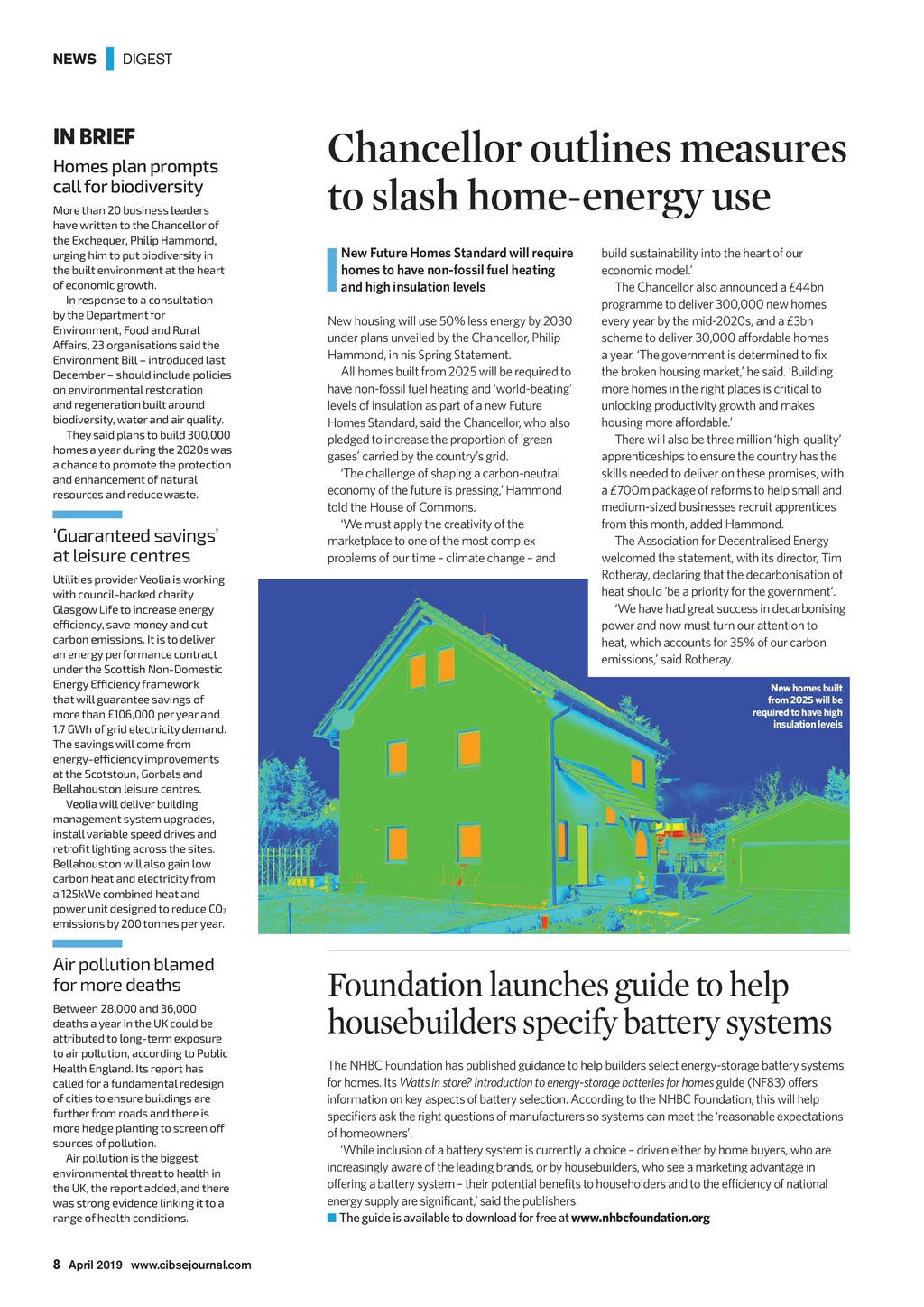


EWS | DIGEST IN BRIEF Homes plan prompts call for biodiversity More than 20 business leaders have written to the Chancellor of the Exchequer, Philip Hammond, urging him to put biodiversity in thebuilt environment at the heart of economic growth. In response to a consultation by the Department for Environment, Food and Rural Affairs, 23 organisations said the Environment Bill introduced last December should include policies on environmental restoration and regeneration built around biodiversity, water and air quality. They said plans to build 300,000 homes a year during the 2020s was a chance to promote the protection and enhancement of natural resources and reduce waste. Guaranteed savings at leisure centres Utilities provider Veolia is working with council-backed charity Glasgow Life to increase energy efficiency, save money and cut carbon emissions. It is to deliver an energy performance contract under the Scottish Non-Domestic Energy Efficiency framework that will guarantee savings of more than 106,000 per year and 1.7GWh of grid electricity demand. The savings will come from energy-efficiency improvements at the Scotstoun, Gorbals and Bellahouston leisure centres. Veolia will deliver building management system upgrades, install variable speed drives and retrofit lighting across the sites. Bellahouston will also gain low carbon heat and electricity from a 125kWe combined heat and power unit designed to reduce CO2 emissions by 200 tonnes per year. Air pollution blamed for more deaths Between 28,000 and 36,000 deaths a year in the UK could be attributed to long-term exposure to air pollution, according to Public Health England. Its report has called for a fundamental redesign of cities to ensure buildings are further from roads and there is more hedge planting to screen off sources of pollution. Air pollution is the biggest environmental threat to health in the UK, the report added, and there was strong evidence linking it to a range of health conditions. Chancellor outlines measures to slash home-energy use New Future Homes Standard will require homes to have non-fossil fuel heating and high insulation levels New housing will use 50% less energy by 2030 under plans unveiled by the Chancellor, Philip Hammond, in his Spring Statement. All homes built from 2025 will be required to have non-fossil fuel heating and world-beating levels of insulation as part of a new Future Homes Standard, said the Chancellor, who also pledged to increase the proportion of green gases carried by the countrys grid. The challenge of shaping a carbon-neutral economy of the future is pressing, Hammond told the House of Commons. We must apply the creativity of the marketplace to one of the most complex problems of our time climate change and build sustainability into the heart of our economic model. The Chancellor also announced a 44bn programme to deliver 300,000 new homes every year by the mid-2020s, and a 3bn scheme to deliver 30,000 affordable homes ayear. The government is determined to fix thebroken housing market, he said. Building more homes in the right places is critical to unlocking productivity growth and makes housing more affordable. There will also be three million high-quality apprenticeships to ensure the country has the skills needed to deliver on these promises, with a 700m package of reforms to help small and medium-sized businesses recruit apprentices from this month, added Hammond. The Association for Decentralised Energy welcomed the statement, with its director, Tim Rotheray, declaring that the decarbonisation of heat should be a priority for the government. We have had great success in decarbonising power and now must turn our attention to heat, which accounts for 35% of our carbon emissions, said Rotheray. New homes built from 2025 will be required to have high insulation levels Foundation launches guide to help housebuilders specify battery systems The NHBC Foundation has published guidance to help builders select energy-storage battery systems for homes. Its Watts in store? Introduction to energy-storage batteries for homes guide (NF83) offers information on key aspects of battery selection. According to the NHBC Foundation, this will help specifiers ask the right questions of manufacturers so systems can meet the reasonable expectations of homeowners. While inclusion of a battery system is currently a choice driven either by home buyers, who are increasingly aware of the leading brands, or by housebuilders, who see a marketing advantage in offering a battery system their potential benefits to householders and to the efficiency of national energy supply are significant, said the publishers. The guide is available to download for free at www.nhbcfoundation.org 8 April 2019 www.cibsejournal.com CIBSE Apr19 pp08-09 News.indd 8 22/03/2019 16:44