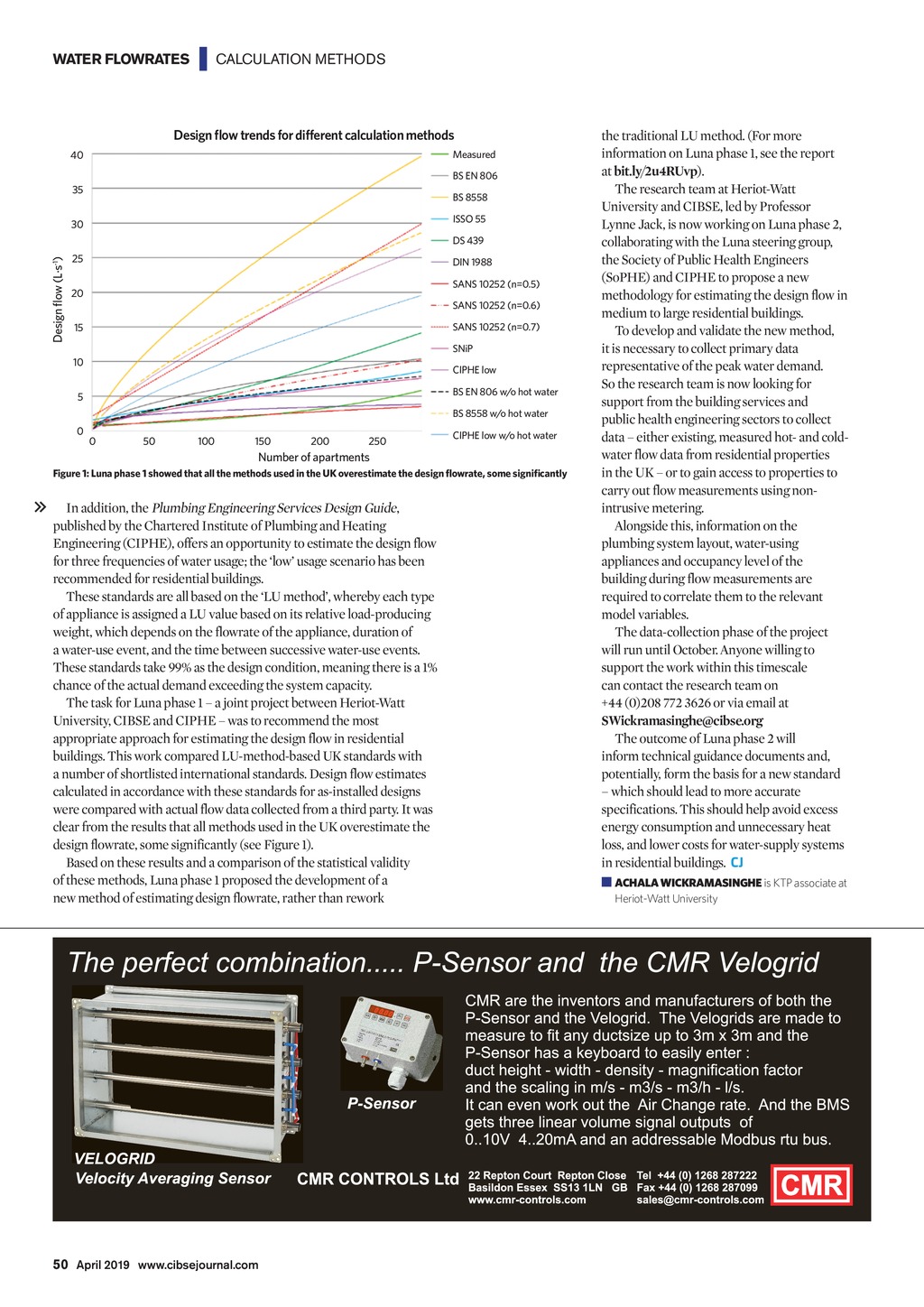


WATER FLOWRATES | CALCULATION METHODS Design flow trends for different calculation methods Measured 40 BS EN 806 35 BS 8558 ISSO 55 30 Design flow (L.s-1) DS 439 25 DIN 1988 SANS 10252 (n=0.5) 20 SANS 10252 (n=0.6) SANS 10252 (n=0.7) 15 SNiP 10 CIPHE low BS EN 806 w/o hot water 5 BS 8558 w/o hot water 0 0 50 100 150 200 250 CIPHE low w/o hot water Number of apartments Figure 1: Luna phase 1 showed that all the methods used in the UK overestimate the design flowrate, some significantly In addition, the Plumbing Engineering Services Design Guide, published by the Chartered Institute of Plumbing and Heating Engineering (CIPHE), offers an opportunity to estimate the design flow for three frequencies of water usage; the low usage scenario has been recommended for residential buildings. These standards are all based on the LU method, whereby each type of appliance is assigned a LU value based on its relative load-producing weight, which depends on the flowrate of the appliance, duration of a water-use event, and the time between successive water-use events. These standards take 99% as the design condition, meaning there is a 1% chance of the actual demand exceeding the system capacity. The task for Luna phase 1 a joint project between Heriot-Watt University, CIBSE and CIPHE was to recommend the most appropriate approach for estimating the design flow in residential buildings. This work compared LU-method-based UK standards with a number of shortlisted international standards. Design flow estimates calculated in accordance with these standards for as-installed designs were compared with actual flow data collected from a third party. It was clear from the results that all methods used in the UK overestimate the design flowrate, some significantly (see Figure 1). Based on these results and a comparison of the statistical validity of these methods, Luna phase 1 proposed the development of a new method of estimating design flowrate, rather than rework the traditional LU method. (For more informationon Luna phase 1, see the report atbit.ly/2u4RUvp). The research team at Heriot-Watt University and CIBSE, led by Professor Lynne Jack, is now working on Luna phase 2, collaborating with the Luna steering group, the Society of Public Health Engineers (SoPHE) and CIPHE to propose a new methodology for estimating the design flow in medium to large residential buildings. To develop and validate the new method, it is necessary to collect primary data representative of the peak water demand. Sothe research team is now looking for support from the building services and publichealth engineering sectors to collect data either existing, measured hot- and coldwater flow data from residential properties in the UK orto gain access to properties to carry out flow measurements using nonintrusive metering. Alongside this, information on the plumbing system layout, water-using appliances and occupancy level of the building during flow measurements are required to correlate them to the relevant model variables. The data-collection phase of the project will run until October. Anyone willing to support the work within this timescale cancontact the research team on +44 (0)208 772 3626 or via email at SWickramasinghe@cibse.org The outcome of Luna phase 2 will inform technical guidance documents and, potentially, form the basis for a new standard which should lead to more accurate specifications. This should help avoid excess energy consumption and unnecessary heat loss, and lower costs for water-supply systems in residential buildings. CJ ACHALA WICKRAMASINGHE is KTP associate at Heriot-Watt University 50 April 2019 www.cibsejournal.com CIBSE Apr19 pp49-50 Luna.indd 50 22/03/2019 16:59