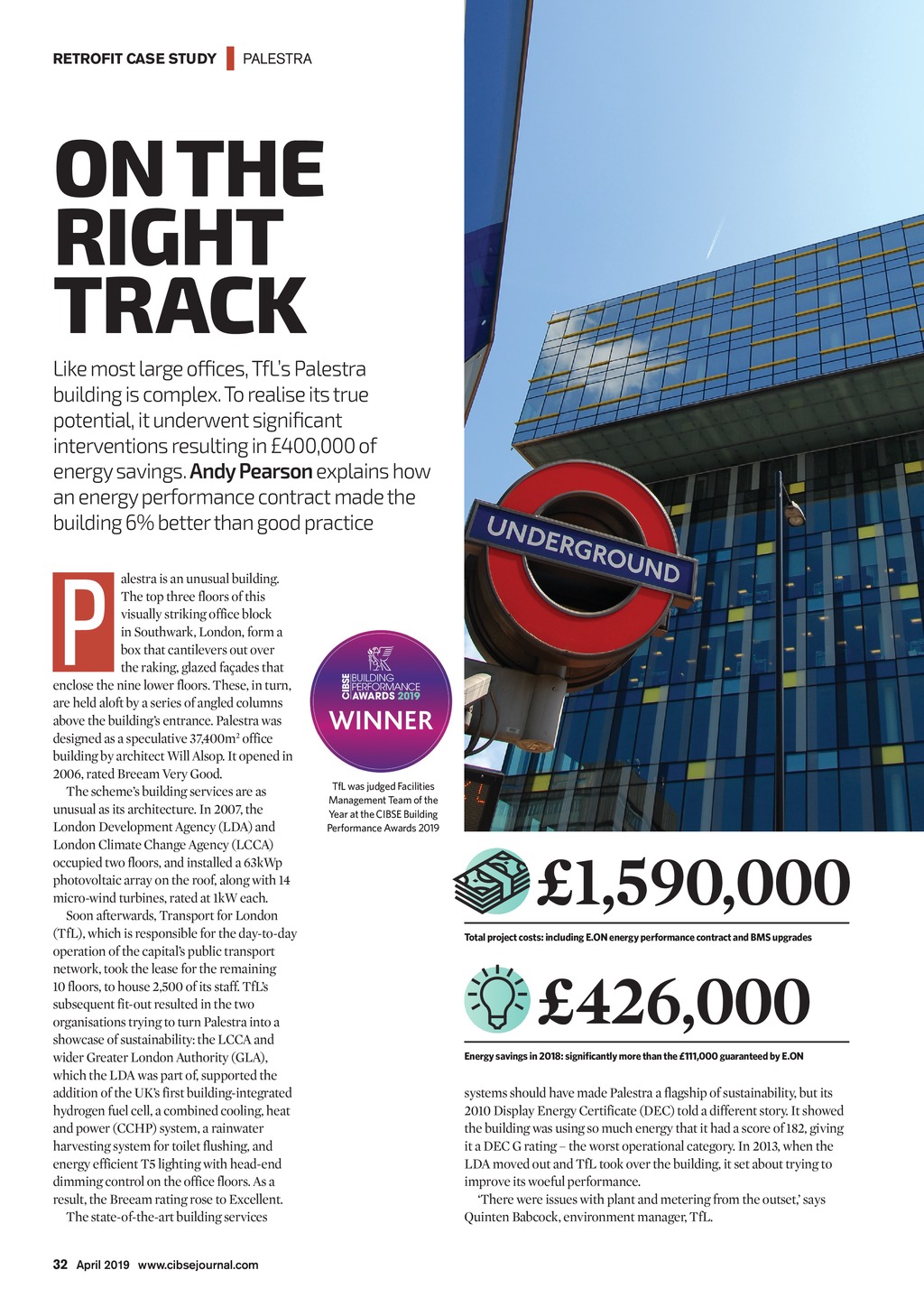


RETROFIT CASE STUDY | PALESTRA ON THE RIGHT TRACK Like most large offices, TfLs Palestra building is complex. To realise its true potential, it underwent significant interventions resulting in 400,000 of energy savings. Andy Pearson explains how an energy performance contract made the building 6% better than good practice P alestra is an unusual building. The top three floors of this visually striking office block in Southwark, London, form a box that cantilevers out over the raking, glazed faades that enclose the nine lower floors. These, in turn, are held aloft by a series of angled columns above the buildings entrance. Palestra was designed as a speculative 37,400m2 office building by architect Will Alsop. It opened in 2006, rated Breeam Very Good. The schemes building services are as unusual as its architecture. In 2007, the London Development Agency (LDA) and London Climate Change Agency (LCCA) occupied two floors, and installed a 63kWp photovoltaic array on the roof, along with 14 micro-wind turbines, rated at 1kW each. Soon afterwards, Transport for London (TfL), which is responsible for the day-to-day operation of the capitals public transport network, took the lease for the remaining 10 floors, to house 2,500 of its staff. TfLs subsequent fit-out resulted in the two organisations trying to turn Palestra into a showcase of sustainability: the LCCA and wider Greater London Authority (GLA), which the LDA was part of, supported the addition of the UKs first building-integrated hydrogen fuel cell, a combined cooling, heat and power (CCHP) system, a rainwater harvesting system for toilet flushing, and energy efficient T5 lighting with head-end dimming control on the office floors. As a result, the Breeam rating rose to Excellent. The state-of-the-art building services TfL was judged Facilities Management Team of the Year at the CIBSE Building Performance Awards 2019 1,590,000 Total project costs: including E.ON energy performance contract and BMS upgrades 426,000 Energy savings in 2018: signicantly more than the 111,000 guaranteed by E.ON systems should have made Palestra a flagship of sustainability, but its 2010 Display Energy Certificate (DEC) told a different story. It showed the building was using so much energy that it had a score of 182, giving it a DEC G rating the worst operational category. In 2013, when the LDA moved out and TfL took over the building, it set about trying to improve its woeful performance. There were issues with plant and metering from the outset, says Quinten Babcock, environment manager, TfL. 32 April 2019 www.cibsejournal.com CIBSE Apr19 pp32-36 Palestra.indd 32 22/03/2019 16:55