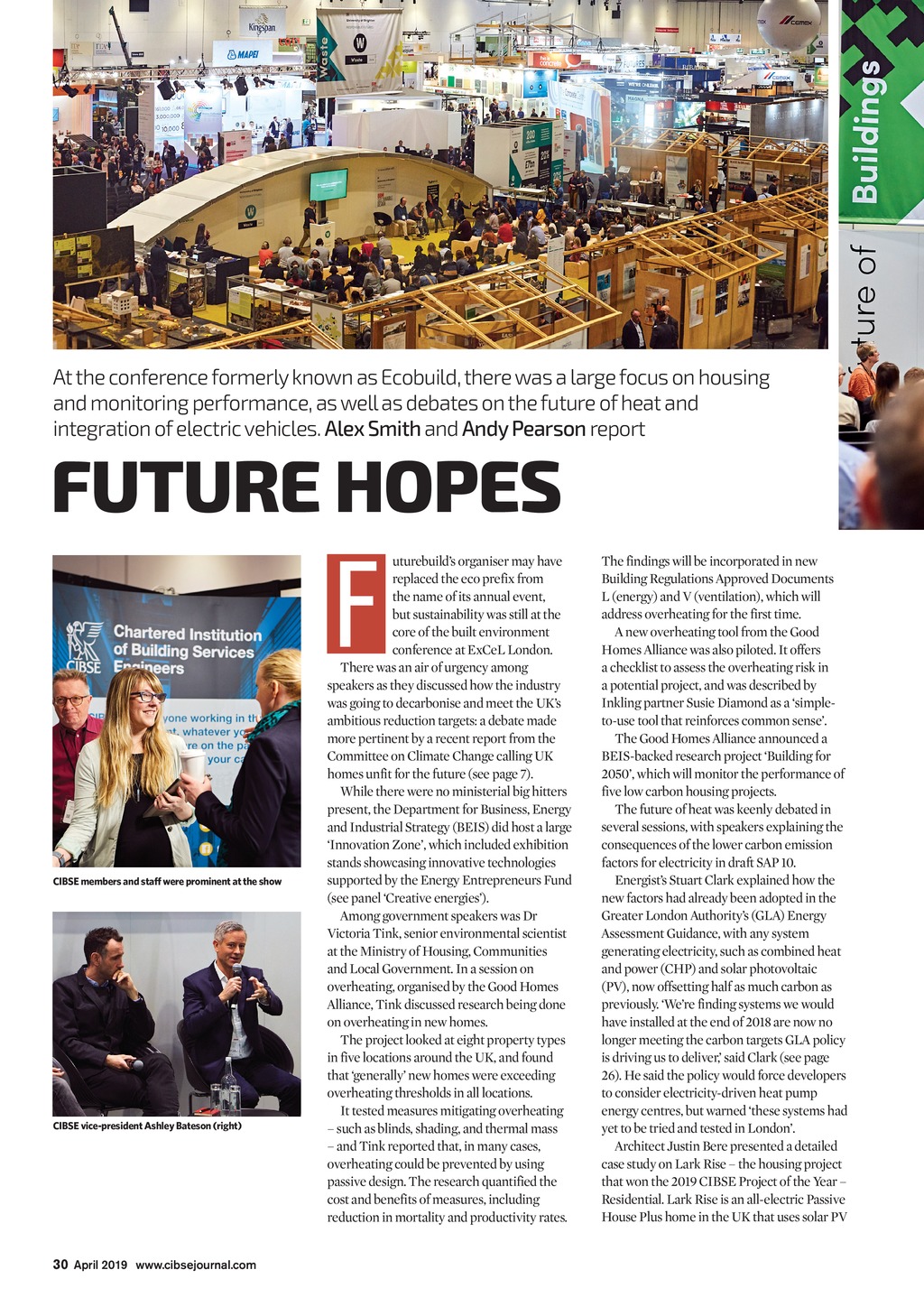


At the conference formerly known as Ecobuild, there was a large focus on housing and monitoring performance, as well as debates on the future of heat and integration of electric vehicles. Alex Smith and Andy Pearson report FUTURE HOPES F CIBSE members and staff were prominent at the show CIBSE vice-president Ashley Bateson (right) uturebuilds organiser may have replaced the eco prefix from the name of its annual event, but sustainability was still at the core of the built environment conference at ExCeL London. There was an air of urgency among speakers as they discussed how the industry was going to decarbonise and meet the UKs ambitious reduction targets: a debate made more pertinent by a recent report from the Committee on Climate Change calling UK homes unfit for the future (see page 7). While there were no ministerial big hitters present, the Department for Business, Energy and Industrial Strategy (BEIS) did host a large Innovation Zone, which included exhibition stands showcasing innovative technologies supported by the Energy Entrepreneurs Fund (see panel Creative energies). Among government speakers was Dr Victoria Tink, senior environmental scientist at the Ministry of Housing, Communities and Local Government. In a session on overheating, organised by the Good Homes Alliance, Tink discussed research being done on overheating in new homes. The project looked at eight property types in five locations around the UK, and found that generally new homes were exceeding overheating thresholds in all locations. It tested measures mitigating overheating such as blinds, shading, and thermal mass and Tink reported that, in many cases, overheating could be prevented by using passive design. The research quantified the cost and benefits of measures, including reduction in mortality and productivity rates. The findings will be incorporated in new Building Regulations Approved Documents L (energy) and V (ventilation), which will address overheating for the first time. A new overheating tool from the Good Homes Alliance was also piloted. It offers a checklist to assess the overheating risk in a potential project, and was described by Inkling partner Susie Diamond as a simpleto-use tool that reinforces common sense. The Good Homes Alliance announced a BEIS-backed research project Building for 2050, which will monitor the performance of five low carbon housing projects. The future of heat was keenly debated in several sessions, with speakers explaining the consequences of the lower carbon emission factors for electricity in draft SAP 10. Energists Stuart Clark explained how the new factors had already been adopted in the Greater London Authoritys (GLA) Energy Assessment Guidance, with any system generating electricity, such as combined heat and power (CHP) and solar photovoltaic (PV), now offsetting half as much carbon as previously. Were finding systems we would have installed at the end of 2018 are now no longer meeting the carbon targets GLA policy is driving us to deliver, said Clark (see page 26). He said the policy would force developers to consider electricity-driven heat pump energy centres, but warned these systems had yet to be tried and tested in London. Architect Justin Bere presented a detailed case study on Lark Rise the housing project that won the 2019 CIBSE Project of the Year Residential. Lark Rise is an all-electric Passive House Plus home in the UK that uses solar PV 30 April 2019 www.cibsejournal.com CIBSE Apr19 pp30-31 Futurebuild.indd 30 22/03/2019 18:13