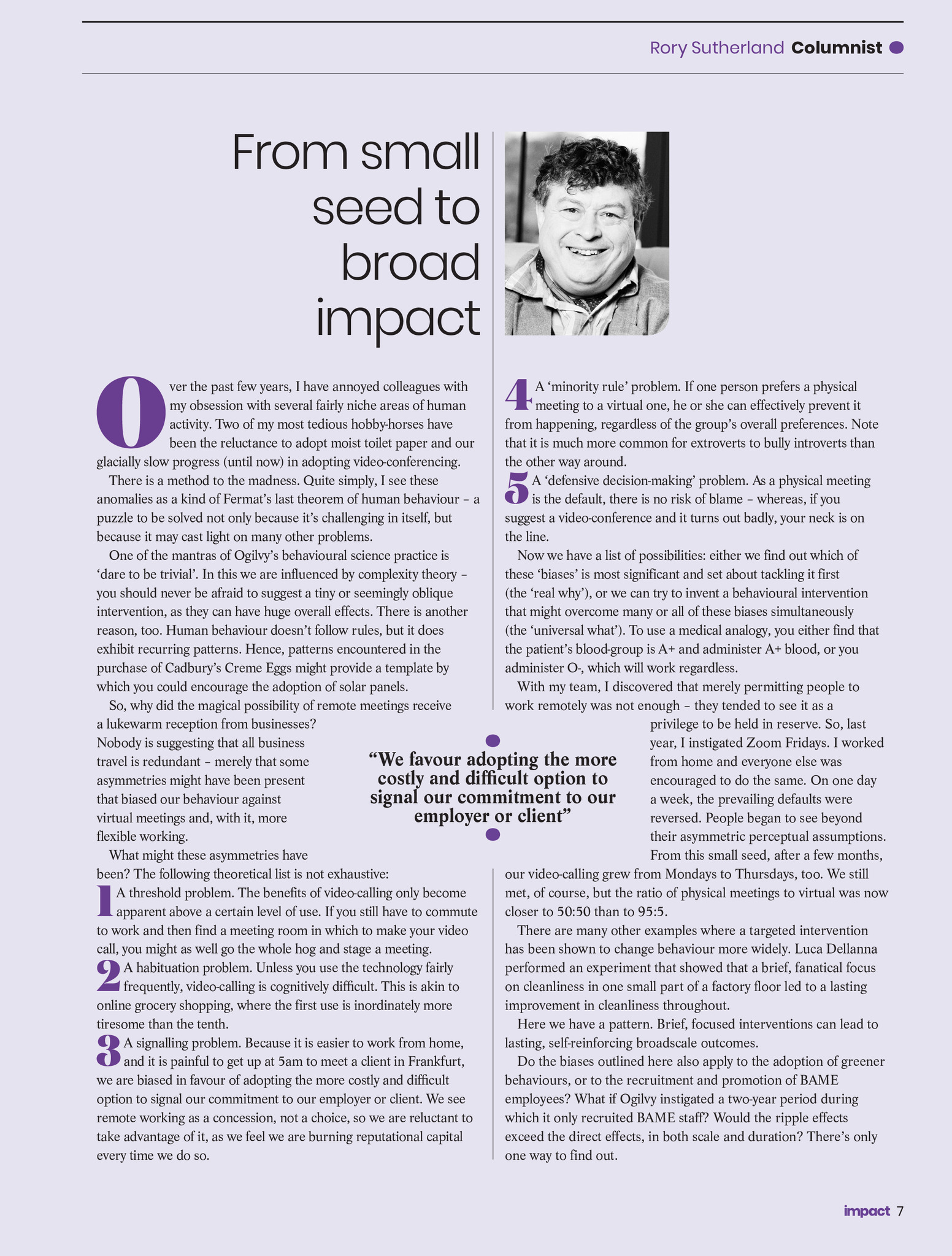
Rory Sutherland Columnist O From small seed to broad impact 4 ver the past few years, I have annoyed colleagues with A minority rule problem. If one person prefers a physical my obsession with several fairly niche areas of human meeting to a virtual one, he or she can effectively prevent it activity. Two of my most tedious hobby-horses have from happening, regardless of the groups overall preferences. Note been the reluctance to adopt moist toilet paper and our that it is much more common for extroverts to bully introverts than glacially slow progress (until now) in adopting video-conferencing. the other way around. There is a method to the madness. Quite simply, I see these A defensive decision-making problem. As a physical meeting anomalies as a kind of Fermats last theorem of human behaviour a is the default, there is no risk of blame whereas, if you puzzle to be solved not only because its challenging in itself, but suggest a video-conference and it turns out badly, your neck is on because it may cast light on many other problems. the line. One of the mantras of Ogilvys behavioural science practice is Now we have a list of possibilities: either we find out which of dare to be trivial. In this we are influenced by complexity theory these biases is most significant and set about tackling it first you should never be afraid to suggest a tiny or seemingly oblique (the real why), or we can try to invent a behavioural intervention intervention, as they can have huge overall effects. There is another that might overcome many or all of these biases simultaneously reason, too. Human behaviour doesnt follow rules, but it does (the universal what). To use a medical analogy, you either find that exhibit recurring patterns. Hence, patterns encountered in the the patients blood-group is A+ and administer A+ blood, or you purchase of Cadburys Creme Eggs might provide a template by administer O-, which will work regardless. which you could encourage the adoption of solar panels. With my team, I discovered that merely permitting people to So, why did the magical possibility of remote meetings receive work remotely was not enough they tended to see it as a a lukewarm reception from businesses? privilege to be held in reserve. So, last Nobody is suggesting that all business year, I instigated Zoom Fridays. I worked We favour adopting the more travel is redundant merely that some from home and everyone else was costly and difficult option to asymmetries might have been present encouraged to do the same. On one day signal our commitment to our that biased our behaviour against a week, the prevailing defaults were employer or client virtual meetings and, with it, more reversed. People began to see beyond flexible working. their asymmetric perceptual assumptions. What might these asymmetries have From this small seed, after a few months, been? The following theoretical list is not exhaustive: our video-calling grew from Mondays to Thursdays, too. We still A threshold problem. The benefits of video-calling only become met, of course, but the ratio of physical meetings to virtual was now apparent above a certain level of use. If you still have to commute closer to 50:50 than to 95:5. to work and then find a meeting room in which to make your video There are many other examples where a targeted intervention call, you might as well go the whole hog and stage a meeting. has been shown to change behaviour more widely. Luca Dellanna A habituation problem. Unless you use the technology fairly performed an experiment that showed that a brief, fanatical focus frequently, video-calling is cognitively difficult. This is akin to on cleanliness in one small part of a factory floor led to a lasting online grocery shopping, where the first use is inordinately more improvement in cleanliness throughout. tiresome than the tenth. Here we have a pattern. Brief, focused interventions can lead to A signalling problem. Because it is easier to work from home, lasting, self-reinforcing broadscale outcomes. and it is painful to get up at 5am to meet a client in Frankfurt, Do the biases outlined here also apply to the adoption of greener we are biased in favour of adopting the more costly and difficult behaviours, or to the recruitment and promotion of BAME option to signal our commitment to our employer or client. We see employees? What if Ogilvy instigated a two-year period during remote working as a concession, not a choice, so we are reluctant to which it only recruited BAME staff? Would the ripple effects take advantage of it, as we feel we are burning reputational capital exceed the direct effects, in both scale and duration? Theres only every time we do so. one way to find out. 5 1 2 3 7