
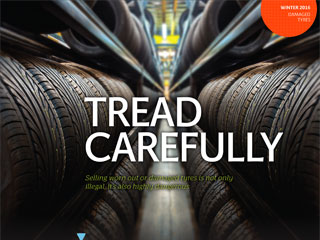
WInTer 2016 dAMAGEd TYRES treAd CAreFuLLy Selling worn out or damaged tyres is not only illegal, its also highly dangerous Businesses can minimise the likelihood of noncompliance by adopting good working practices When trading standards in the West Midlands carried out inspections at sellers of part-worn tyres in their area, they found major problems. More than 600 tyres were inspected, with a fifth of these being deemed unfit for sale. Some of the issues found included: l Incorrectly repaired punctures or penetrations l Embedded objects l Bead damage l Low tread depths The main cause of failure was found to be shortcomings in the ways individual businesses operated, such as: l Inadequate tyre inspection procedures l Inadequate repair techniques l Inappropriate repair materials l A lack of knowledge of the applicable requirements l Reliance on assurances from wholesale suppliers that tyres were compliant, without in-house checking The Motor Vehicle Tyres (Safety) Regulations 1994 set out safety standards for the sale of part-worn tyres. under the regulations, it is illegal to sell any part-worn tyre that is capable of being fitted to a motor vehicle or trailer, unless requirements about its markings and condition are met. It is also illegal to have unsafe tyres in possession for sale, so tyres held in storage but not intended for sale need to be clearly identified. Failure to comply with the above requirements is a criminal offence. The maximum penalty on conviction is an unlimited fine and up to two years imprisonment. Businesses can minimise the likelihood of non-compliance by adopting good working practices, including: Credit: Murray dewar Images: Tony Baggett / SantiPhotoSS / Shutterstock l effective stock inspection: each tyre should be thoroughly inspected by a competent person before being designated as safe to sell. Businesses should not rely on warranties provided by their supplier; they need to do their own checks. l Storage: all stock designated as being safe to sell must be placed in a clearly identified area of the premises. Rejected, defective or scrap tyres must be kept separate from tyres that are available for purchase by customers. l Training: all staff with responsibility for inspecting, fitting or repairing tyres should be properly trained; records should be kept demonstrating that this has taken place. Further guidance on the 1994 Regulations can be found here. doS And donTS for uSed cAr deAlerS In our spring edition, we looked at the rights consumers have under the consumer rights Act 2015, and the associated obligations for secondhand car dealers. However, dealers also need to ensure they do not fall foul of criminal legislation when advertising and selling used vehicles. l do get a structural/mechanical inspection of the vehicle carried out l do check for alterations made by previous owners; this may affect the way you advertise your vehicles l Many online advertisers now pre-populate the vehicle specification using the registration number. donT rely It is not always easy to know that you are doing the right on this being correct previous owners may have made things to comply with the legislation. alterations to the vehicle. vehicle specifications do vary The following simple dos and donts provide a non- a lot depending on what was ordered by the original exhaustive guide on the actions dealers can take to avoid purchaser and when it was ordered some of the pitfalls of selling used cars. l donT leave information that the consumer must know out of adverts such as whether the vehicle has l do check the MoT history of your vehicles here. This previously been an insurance write-off or a hire car can give an indication of whether the odometer reading l If you buy your stock from auction, do check terms and is correct, and the history also identifies advisory issues conditions before buying. This may save you money if from previous MoT tests that may have deteriorated and something goes wrong now require rectifying l do check any service history provided with your vehicles, l donT rely on warranted mileage descriptions when buying from auction. It is the seller that makes this and contact the garages that have carried out the services statement, not the auction; the mileage could still be to confirm they are genuine and accurate incorrect. do your own checks before selling the vehicle l do contact any known previous owners of your vehicles to confirm the history l do accurately declare the mileage of vehicles at the time of advertising l do carry out a vehicle history check to find out about a vehicles mileage, outstanding finance and whether If further advice is required, your local Trading Standards it has previously been recorded as an insurance write- Service should be able to help. off. numerous organisations offer this service online including mycarcheck, autocheck and HPI Credit: Ian Bell For further information please contact your local Trading Standards Service