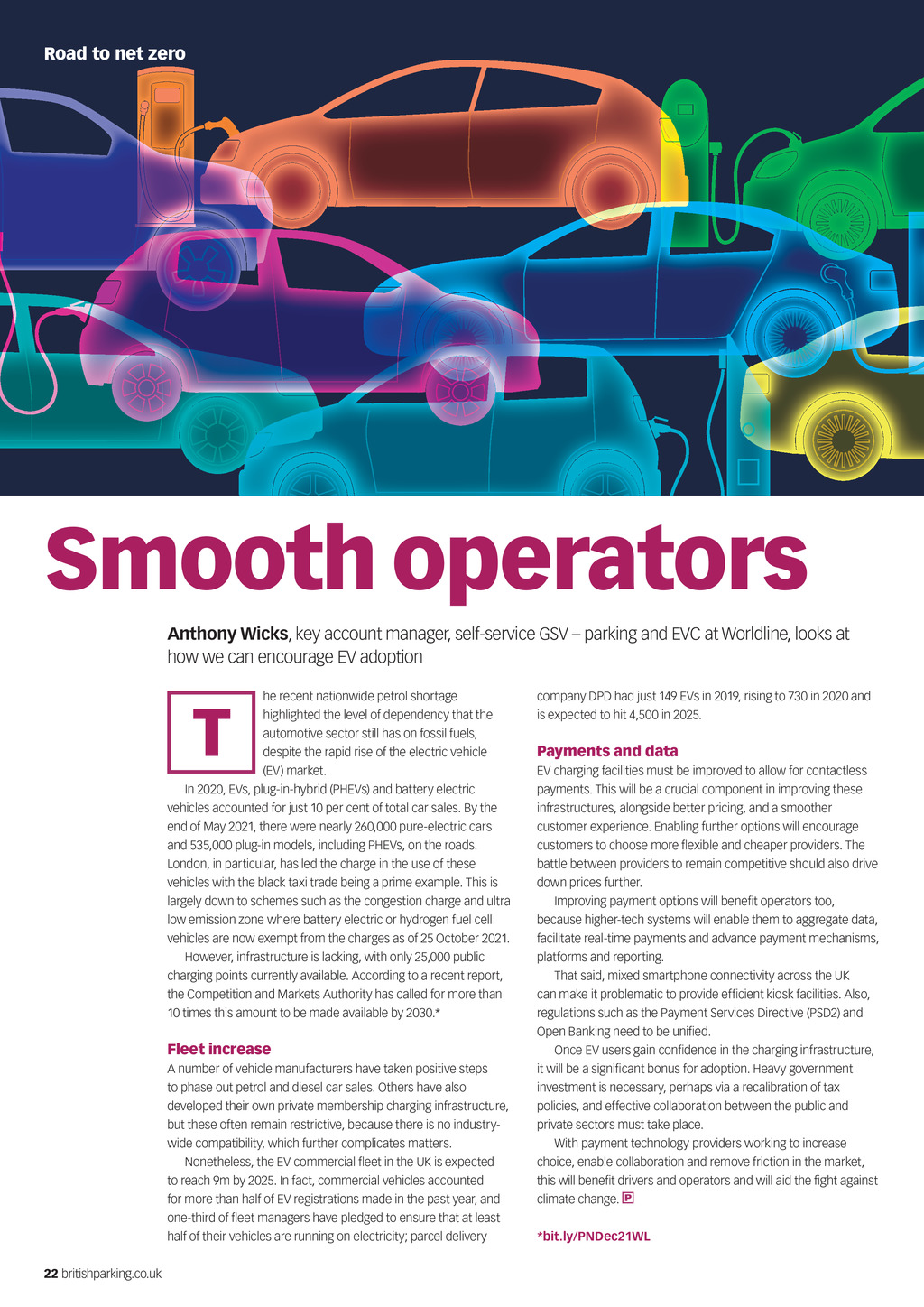



Road to net zero Smooth operators Anthony Wicks, key account manager, self-service GSV parking and EVC at Worldline, looks at how we can encourage EV adoption he recent nationwide petrol shortage highlighted the level of dependency that the automotive sector still has on fossil fuels, despite the rapid rise of the electric vehicle (EV) market. In 2020, EVs, plug-in-hybrid (PHEVs) and battery electric vehicles accounted for just 10 per cent of total car sales. By the end of May 2021, there were nearly 260,000 pure-electric cars and 535,000 plug-in models, including PHEVs, on the roads. London, in particular, has led the charge in the use of these vehicles with the black taxi trade being a prime example. This is largely down to schemes such as the congestion charge and ultra low emission zone where battery electric or hydrogen fuel cell vehicles are now exempt from the charges as of 25 October 2021. However, infrastructure is lacking, with only 25,000 public charging points currently available. According to a recent report, the Competition and Markets Authority has called for more than 10 times this amount to be made available by 2030.* T Fleet increase A number of vehicle manufacturers have taken positive steps to phase out petrol and diesel car sales. Others have also developed their own private membership charging infrastructure, but these often remain restrictive, because there is no industrywide compatibility, which further complicates matters. Nonetheless, the EV commercial fleet in the UK is expected to reach 9m by 2025. In fact, commercial vehicles accounted for more than half of EV registrations made in the past year, and one-third of fleet managers have pledged to ensure that at least half of their vehicles are running on electricity; parcel delivery company DPD had just 149 EVs in 2019, rising to 730 in 2020 and is expected to hit 4,500 in 2025. Payments and data EV charging facilities must be improved to allow for contactless payments. This will be a crucial component in improving these infrastructures, alongside better pricing, and a smoother customer experience. Enabling further options will encourage customers to choose more flexible and cheaper providers. The battle between providers to remain competitive should also drive down prices further. Improving payment options will benefit operators too, because higher-tech systems will enable them to aggregate data, facilitate real-time payments and advance payment mechanisms, platforms and reporting. That said, mixed smartphone connectivity across the UK can make it problematic to provide efficient kiosk facilities. Also, regulations such as the Payment Services Directive (PSD2) and Open Banking need to be unified. Once EV users gain confidence in the charging infrastructure, it will be a significant bonus for adoption. Heavy government investment is necessary, perhaps via a recalibration of tax policies, and effective collaboration between the public and private sectors must take place. With payment technology providers working to increase choice, enable collaboration and remove friction in the market, this will benefit drivers and operators and will aid the fight against climate change. *bit.ly/PNDec21WL 22 britishparking.co.uk PN Dec 2021 pp22-23 Worldline.indd 22 22/11/2021 13:28