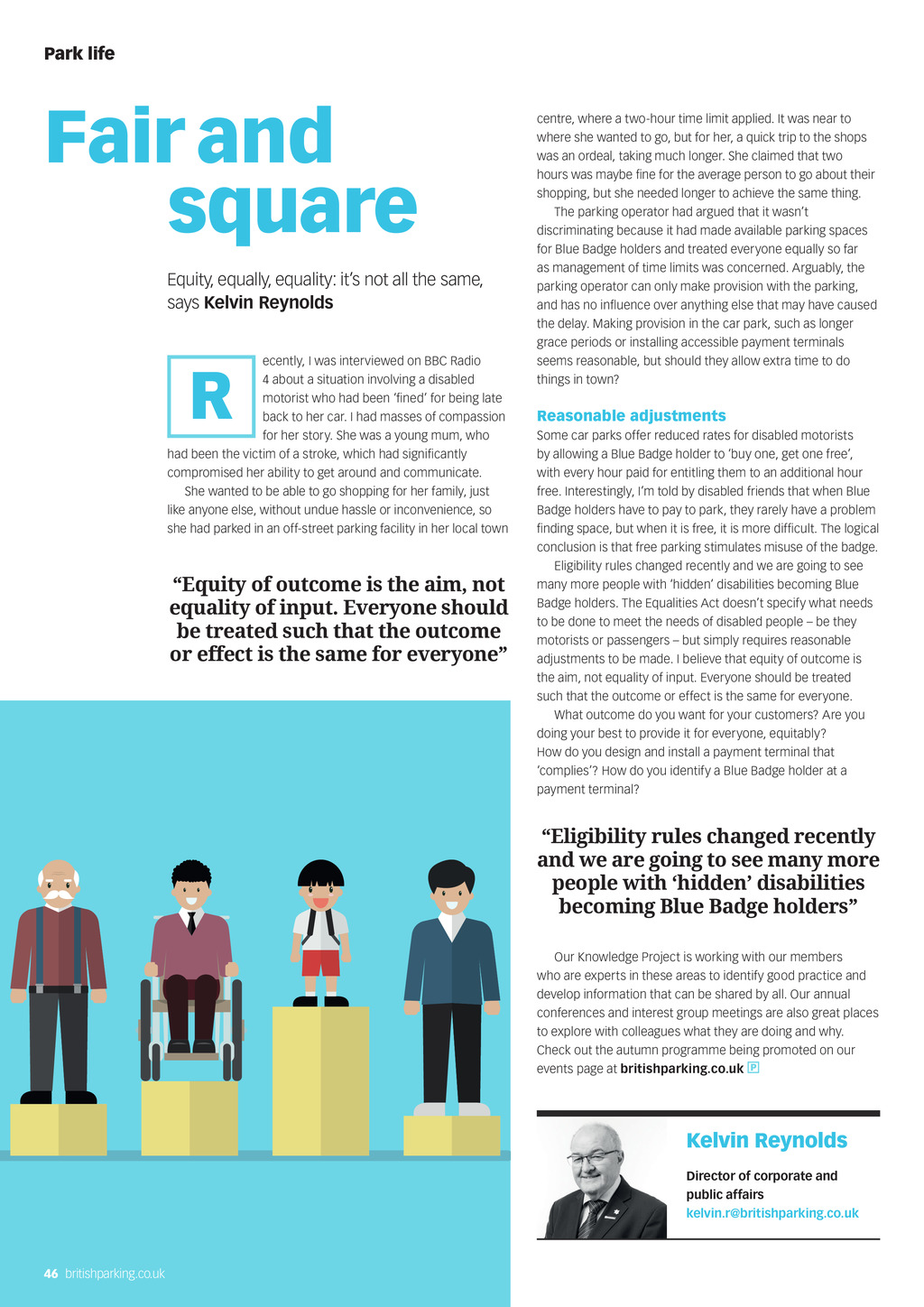


Park life Fair and square Equity, equally, equality: its not all the same, says Kelvin Reynolds ecently, I was interviewed on BBC Radio 4 about a situation involving a disabled motorist who had been fined for being late back to her car. I had masses of compassion for her story. She was a young mum, who had been the victim of a stroke, which had significantly compromised her ability to get around and communicate. She wanted to be able to go shopping for her family, just like anyone else, without undue hassle or inconvenience, so she had parked in an off-street parking facility in her local town R Equity of outcome is the aim, not equality of input. Everyone should be treated such that the outcome or effect is the same for everyone centre, where a two-hour time limit applied. It was near to where she wanted to go, but for her, a quick trip to the shops was an ordeal, taking much longer. She claimed that two hours was maybe fine for the average person to go about their shopping, but she needed longer to achieve the same thing. The parking operator had argued that it wasnt discriminating because it had made available parking spaces for Blue Badge holders and treated everyone equally so far as management of time limits was concerned. Arguably, the parking operator can only make provision with the parking, and has no influence over anything else that may have caused the delay. Making provision in the car park, such as longer grace periods or installing accessible payment terminals seems reasonable, but should they allow extra time to do things in town? Reasonable adjustments Some car parks offer reduced rates for disabled motorists by allowing a Blue Badge holder to buy one, get one free, with every hour paid for entitling them to an additional hour free. Interestingly, Im told by disabled friends that when Blue Badge holders have to pay to park, they rarely have a problem finding space, but when it is free, it is more difficult. The logical conclusion is that free parking stimulates misuse of the badge. Eligibility rules changed recently and we are going to see many more people with hidden disabilities becoming Blue Badge holders. The Equalities Act doesnt specify what needs to be done to meet the needs of disabled people be they motorists or passengers but simply requires reasonable adjustments to be made. I believe that equity of outcome is the aim, not equality of input. Everyone should be treated such that the outcome or effect is the same for everyone. What outcome do you want for your customers? Are you doing your best to provide it for everyone, equitably? How do you design and install a payment terminal that complies? How do you identify a Blue Badge holder at a payment terminal? Eligibility rules changed recently and we are going to see many more people with hidden disabilities becoming Blue Badge holders Our Knowledge Project is working with our members who are experts in these areas to identify good practice and develop information that can be shared by all. Our annual conferences and interest group meetings are also great places to explore with colleagues what they are doing and why. Check out the autumn programme being promoted on our events page at britishparking.co.uk Kelvin Reynolds Director of corporate and public affairs kelvin.r@britishparking.co.uk 46 britishparking.co.uk PN Sep19 pp46 Kelvin Parklife.indd 46 22/08/2019 12:21