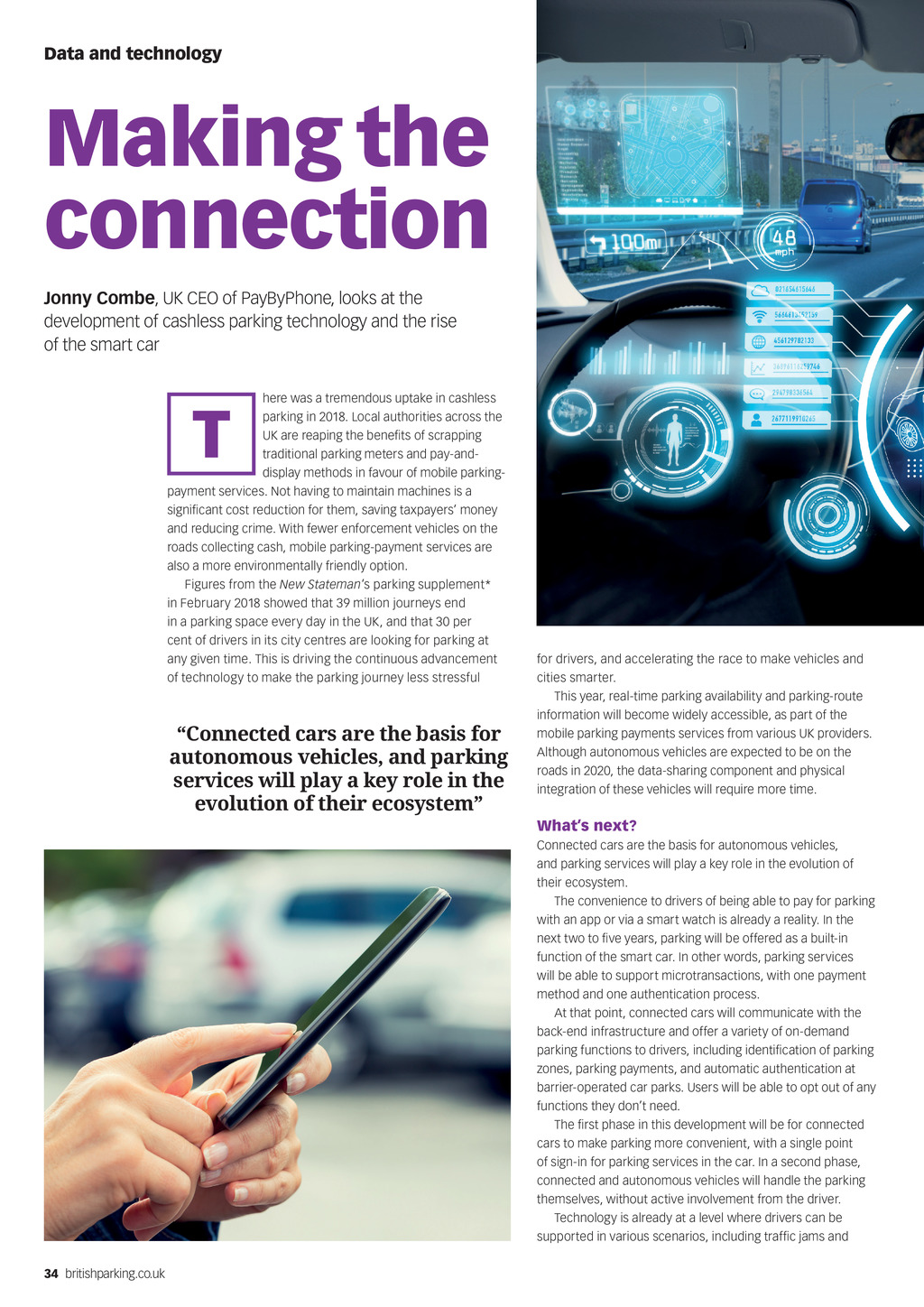
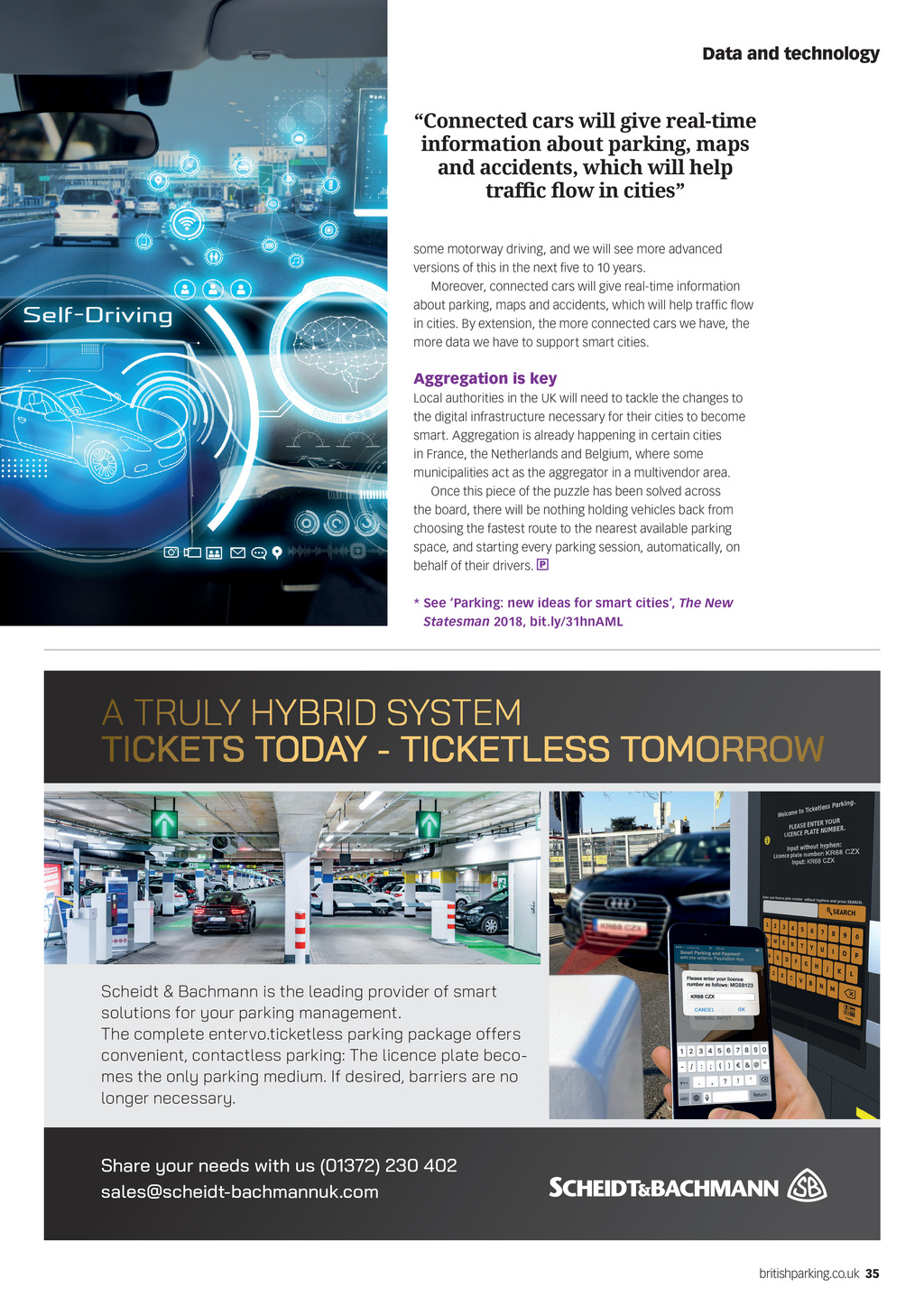

Data and technology Making the connection Jonny Combe, UK CEO of PayByPhone, looks at the development of cashless parking technology and the rise of the smart car here was a tremendous uptake in cashless parking in 2018. Local authorities across the UK are reaping the benefits of scrapping traditional parking meters and pay-anddisplay methods in favour of mobile parkingpayment services. Not having to maintain machines is a significant cost reduction for them, saving taxpayers money and reducing crime. With fewer enforcement vehicles on the roads collecting cash, mobile parking-payment services are also a more environmentally friendly option. Figures from the New Statemans parking supplement* in February 2018 showed that 39 million journeys end in a parking space every day in the UK, and that 30 per cent of drivers in its city centres are looking for parking at any given time. This is driving the continuous advancement of technology to make the parking journey less stressful T Connected cars are the basis for autonomous vehicles, and parking services will play a key role in the evolution of their ecosystem for drivers, and accelerating the race to make vehicles and cities smarter. This year, real-time parking availability and parking-route information will become widely accessible, as part of the mobile parking payments services from various UK providers. Although autonomous vehicles are expected to be on the roads in 2020, the data-sharing component and physical integration of these vehicles will require more time. Whats next? Connected cars are the basis for autonomous vehicles, and parking services will play a key role in the evolution of their ecosystem. The convenience to drivers of being able to pay for parking with an app or via a smart watch is already a reality. In the next two to five years, parking will be offered as a built-in function of the smart car. In other words, parking services will be able to support microtransactions, with one payment method and one authentication process. At that point, connected cars will communicate with the back-end infrastructure and offer a variety of on-demand parking functions to drivers, including identification of parking zones, parking payments, and automatic authentication at barrier-operated car parks. Users will be able to opt out of any functions they dont need. The first phase in this development will be for connected cars to make parking more convenient, with a single point of sign-in for parking services in the car. In a second phase, connected and autonomous vehicles will handle the parking themselves, without active involvement from the driver. Technology is already at a level where drivers can be supported in various scenarios, including traffic jams and 34 britishparking.co.uk PN Sep19 pp34-35 Paybyphone.indd 34 22/08/2019 11:59