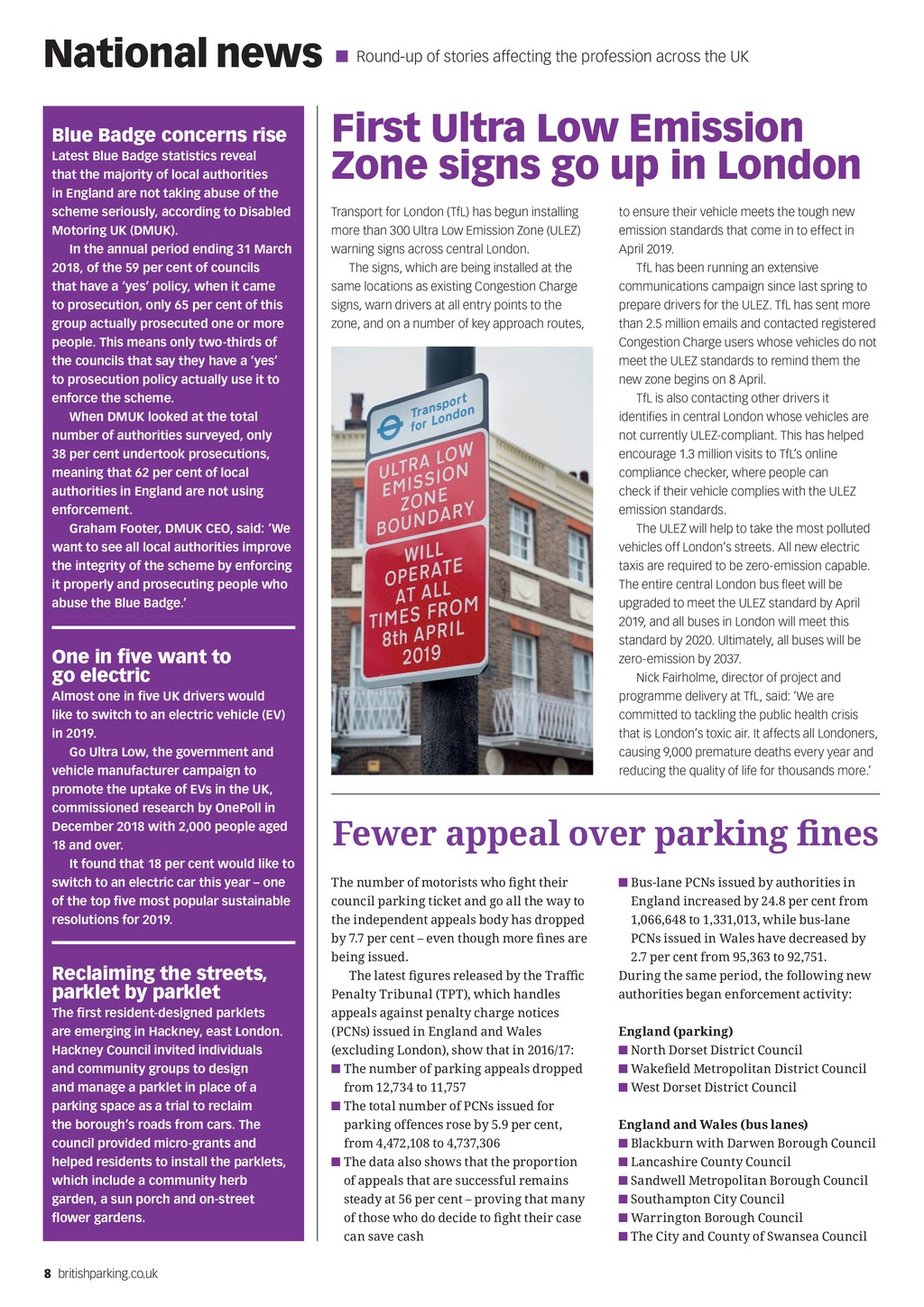

National news Blue Badge concerns rise Latest Blue Badge statistics reveal that the majority of local authorities in England are not taking abuse of the scheme seriously, according to Disabled Motoring UK (DMUK). In the annual period ending 31 March 2018, of the 59 per cent of councils that have a yes policy, when it came to prosecution, only 65 per cent of this group actually prosecuted one or more people. This means only two-thirds of the councils that say they have a yes to prosecution policy actually use it to enforce the scheme. When DMUK looked at the total number of authorities surveyed, only 38 per cent undertook prosecutions, meaning that 62 per cent of local authorities in England are not using enforcement. Graham Footer, DMUK CEO, said: We want to see all local authorities improve the integrity of the scheme by enforcing it properly and prosecuting people who abuse the Blue Badge. Round-up of stories affecting the profession across the UK First Ultra Low Emission Zone signs go up in London Transport for London (TfL) has begun installing more than 300 Ultra Low Emission Zone (ULEZ) warning signs across central London. The signs, which are being installed at the same locations as existing Congestion Charge signs, warn drivers at all entry points to the zone, and on a number of key approach routes, One in five want to go electric Almost one in five UK drivers would like to switch to an electric vehicle (EV) in 2019. Go Ultra Low, the government and vehicle manufacturer campaign to promote the uptake of EVs in the UK, commissioned research by OnePoll in December 2018 with 2,000 people aged 18 and over. It found that 18 per cent would like to switch to an electric car this year one of the top five most popular sustainable resolutions for 2019. Reclaiming the streets, parklet by parklet The first resident-designed parklets are emerging in Hackney, east London. Hackney Council invited individuals and community groups to design and manage a parklet in place of a parking space as a trial to reclaim the boroughs roads from cars. The council provided micro-grants and helped residents to install the parklets, which include a community herb garden, a sun porch and on-street flower gardens. to ensure their vehicle meets the tough new emission standards that come in to effect in April 2019. TfL has been running an extensive communications campaign since last spring to prepare drivers for the ULEZ. TfL has sent more than 2.5 million emails and contacted registered Congestion Charge users whose vehicles do not meet the ULEZ standards to remind them the new zone begins on 8 April. TfL is also contacting other drivers it identifies in central London whose vehicles are not currently ULEZ-compliant. This has helped encourage 1.3 million visits to TfLs online compliance checker, where people can check if their vehicle complies with the ULEZ emission standards. The ULEZ will help to take the most polluted vehicles off Londons streets. All new electric taxis are required to be zero-emission capable. The entire central London bus fleet will be upgraded to meet the ULEZ standard by April 2019, and all buses in London will meet this standard by 2020. Ultimately, all buses will be zero-emission by 2037. Nick Fairholme, director of project and programme delivery at TfL, said: We are committed to tackling the public health crisis that is Londons toxic air. It affects all Londoners, causing 9,000 premature deaths every year and reducing the quality of life for thousands more. Fewer appeal over parking fines The number of motorists who fight their council parking ticket and go all the way to the independent appeals body has dropped by 7.7 per cent even though more fines are being issued. The latest figures released by the Traffic Penalty Tribunal (TPT), which handles appeals against penalty charge notices (PCNs) issued in England and Wales (excluding London), show that in 2016/17: T he number of parking appeals dropped from 12,734 to 11,757 T he total number of PCNs issued for parking offences rose by 5.9 per cent, from 4,472,108 to 4,737,306 T he data also shows that the proportion of appeals that are successful remains steady at 56 per cent proving that many of those who do decide to fight their case can save cash B us-lane PCNs issued by authorities in England increased by 24.8 per cent from 1,066,648 to 1,331,013, while bus-lane PCNs issued in Wales have decreased by 2.7 per cent from 95,363 to 92,751. During the same period, the following new authorities began enforcement activity: England (parking) N orth Dorset District Council W akefield Metropolitan District Council W est Dorset District Council England and Wales (bus lanes) B lackburn with Darwen Borough Council L ancashire County Council S andwell Metropolitan Borough Council S outhampton City Council W arrington Borough Council T he City and County of Swansea Council 8 britishparking.co.uk PNFeb19 pp08-09 News.indd 8 23/01/2019 12:34