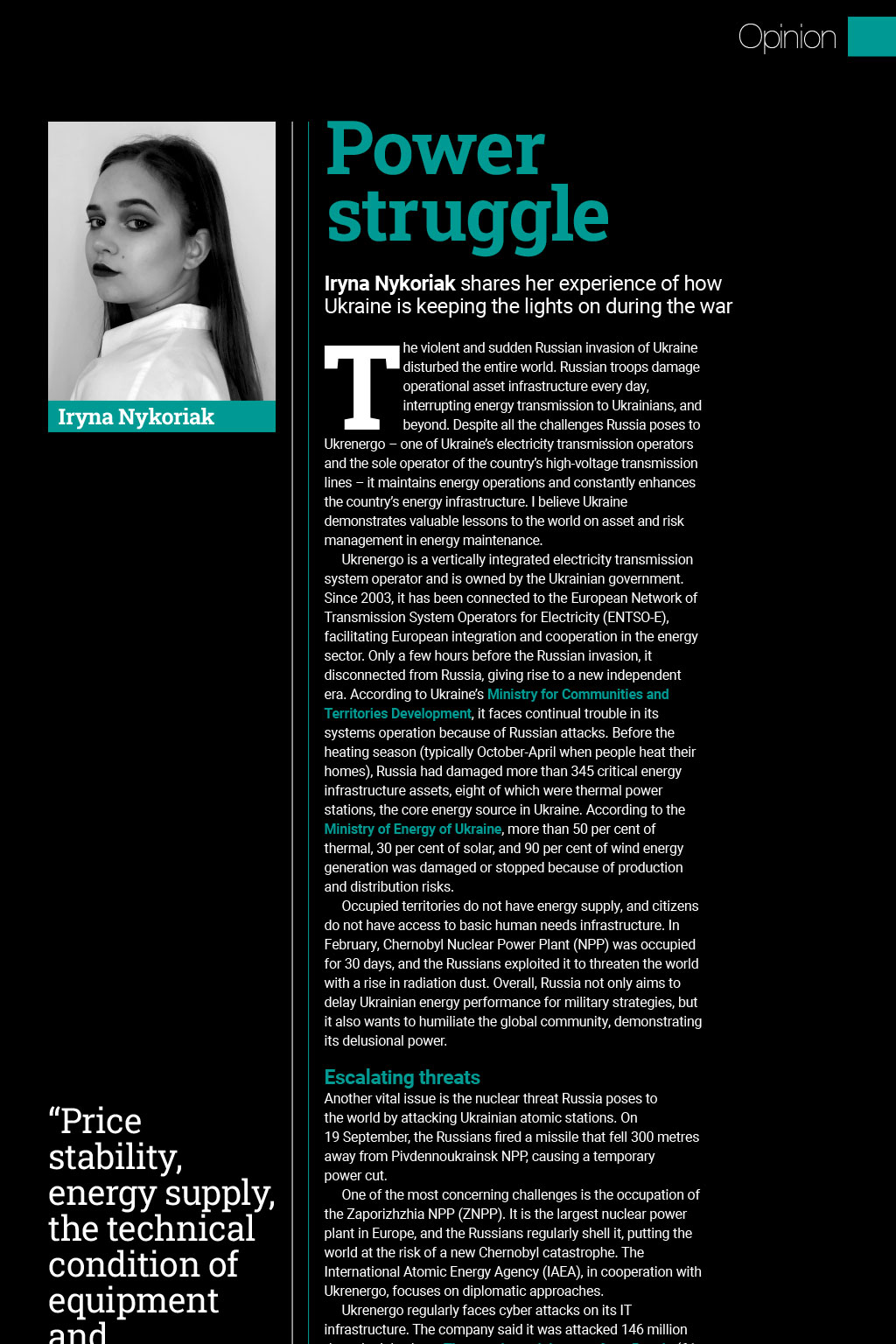


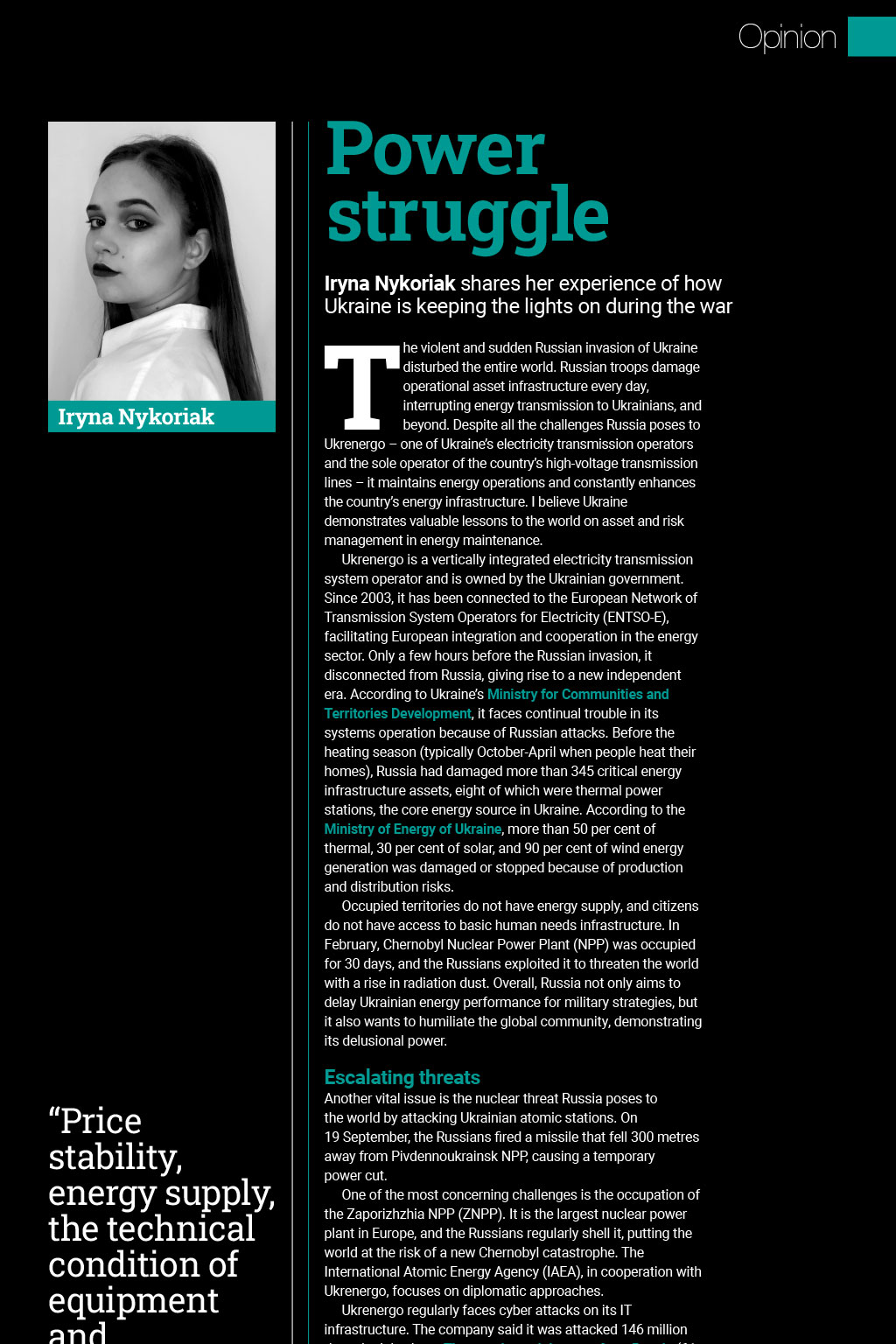
Opinion Power struggle Iryna Nykoriak shares her experience of how Ukraine is keeping the lights on during the war Iryna Nykoriak The violent and sudden Russian invasion of Ukraine disturbed the entire world. Russian troops damage operational asset infrastructure every day, interrupting energy transmission to Ukrainians, and beyond. Despite all the challenges Russia poses to Ukrenergo one of Ukraines electricity transmission operators and the sole operator of the countrys high-voltage transmission lines it maintains energy operations and constantly enhances the countrys energy infrastructure. I believe Ukraine demonstrates valuable lessons to the world on asset and risk management in energy maintenance. Ukrenergo is a vertically integrated electricity transmission system operator and is owned by the Ukrainian government. Since 2003, it has been connected to the European Network of Transmission System Operators for Electricity (ENTSO-E), facilitating European integration and cooperation in the energy sector. Only a few hours before the Russian invasion, it disconnected from Russia, giving rise to a new independent era. According to Ukraines Ministry for Communities and Territories Development, it faces continual trouble in its systems operation because of Russian attacks. Before the heating season (typically October-April when people heat their homes), Russia had damaged more than 345 critical energy infrastructure assets, eight of which were thermal power stations, the core energy source in Ukraine. According to the Ministry of Energy of Ukraine, more than 50 per cent of thermal, 30 per cent of solar, and 90 per cent of wind energy generation was damaged or stopped because of production and distribution risks. Occupied territories do not have energy supply, and citizens do not have access to basic human needs infrastructure. In February, Chernobyl Nuclear Power Plant (NPP) was occupied for 30 days, and the Russians exploited it to threaten the world with a rise in radiation dust. Overall, Russia not only aims to delay Ukrainian energy performance for military strategies, but it also wants to humiliate the global community, demonstrating its delusional power. Escalating threats Price stability, energy supply, the technical condition of equipment and availability of backup equipment, and foreign investments, along with an emphasis on staff and clients, define the asset management approach in wartime Another vital issue is the nuclear threat Russia poses to the world by attacking Ukrainian atomic stations. On 19 September, the Russians fired a missile that fell 300 metres away from Pivdennoukrainsk NPP, causing a temporary power cut. One of the most concerning challenges is the occupation of the Zaporizhzhia NPP (ZNPP). It is the largest nuclear power plant in Europe, and the Russians regularly shell it, putting the world at the risk of a new Chernobyl catastrophe. The International Atomic Energy Agency (IAEA), in cooperation with Ukrenergo, focuses on diplomatic approaches. Ukrenergo regularly faces cyber attacks on its IT infrastructure. The company said it was attacked 146 million times in July alone. The attacks mainly came from Russia (61 per cent) and from the temporarily occupied territories of Luhansk and Donetsk (26 per cent). The remaining 13 per cent of attacks were from elsewhere. Even though they did not significantly harm Ukrenergos performance, these attacks sabotaged and interfered with the companys focus on infrastructure maintenance and international cooperation. Such an ability to diversify to resolve challenges is an inspiration for others. If the Ukrainian government sincerely strives to accomplish a target, it will work towards it, in spite of the circumstances. Response and resilience Despite these enormous threats and infrastructure destruction, Ukrenergo and the Ukrainian government have successfully recovered from Russian aggression and stabilised cooperation with Europe. Oleksiy Chernyshov, the Ukrainian Minister of Communities and Territories, determined price stability, energy supply, the technical condition of equipment and availability of backup equipment, and foreign investments as critical assets in war and post-war infrastructure advancement. These priorities, along with an emphasis on staff and clients, define the asset management approach in wartime. Such an approach significantly benefits Ukraine in overcoming challenges and improving energy assets in the short and long term. Ukrenergos regular #EnergyFront posts on Facebook and Twitter keep people updated about the companys performance during the war. Mostly, it reports grid frequency stability and energy consumption levels. It also includes reports on what infrastructure has been renovated and other achievements, such as ZNPP maintenance. One of the most recent achievements was an increase in trade to 300MW (previously 250MW) capacity between ENTSO-E and Ukrainian power plants. Moreover, Ukraine sets personal records in energy export. It achieved US$131m on 17 September, demonstrating that it fulfilled all the technical requirements and now can synchronise to the continental Europe power system. Ukrenergo performs highly, not only in the technical operation of the company but also in maintaining faith and certainty in its capacity. One of Russias military strategies is to destabilise Ukrainian trust in its government and its agents. However, Ukrenergo, as the core service provider, successfully demonstrates its sustainability. It requires enormous courage and strength to share such information and emphasise achievements. War is cruel and demotivating, so it is vital to embrace positive events. Update: 19 October 2022 Iryna Nykoriak is a student in the Educational and Scientific Institute of Journalism at Taras Shevchencko Kyiv National University. She has worked in asset management since April 2022 as a social media marketer for German energy infrastructure consulting company meliorate GmbH. The main section of the copy was written in September 2022. Since then, Russian attacks on Ukraines energy sector have increased. Nykoriak adds: Mid-October was a tough time for Ukraine in terms of energy infrastructure and distribution. Russia regularly shelled critical infrastructure with bombs and what are believed to be Iranian-built kamikaze drones. Ukrenergos CEO, Volodymyr Kudritskyi, called these events the biggest attack on energy infrastructure in war history, as more than 30 per cent of energy infrastructure was damaged or destroyed. Despite these attacks, Ukrenergo fixed the major issues in two to three days, applying a comprehensive asset management approach and involving cooperation from the Ukrainian people. Details are not reported in an effort to conceal strategic data from Russia. Still, the company reported a reduction in energy consumption during peak hours (because of citizens cooperation with Ukrenergo), the development of preventative plans, and quick-reaction training.