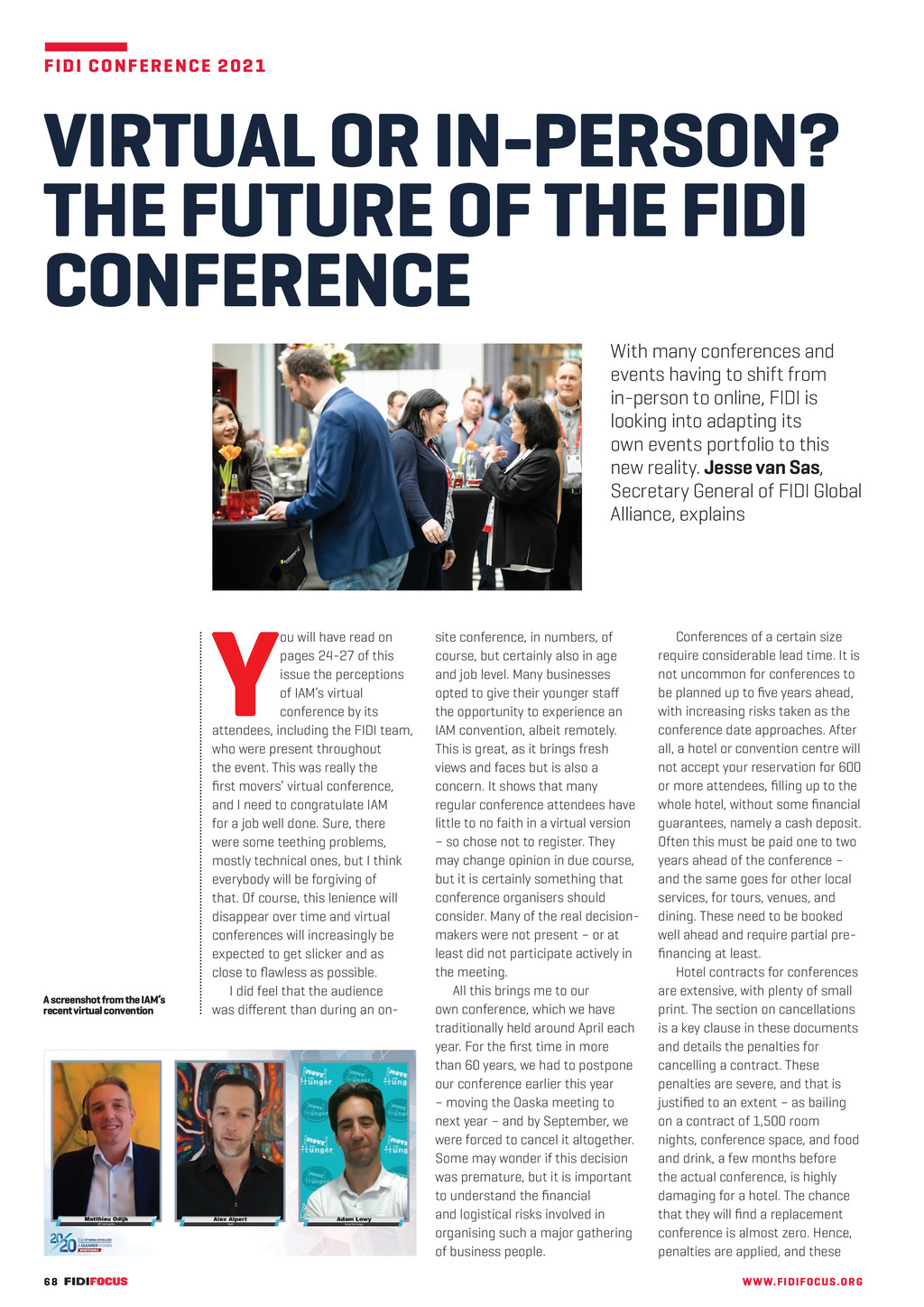
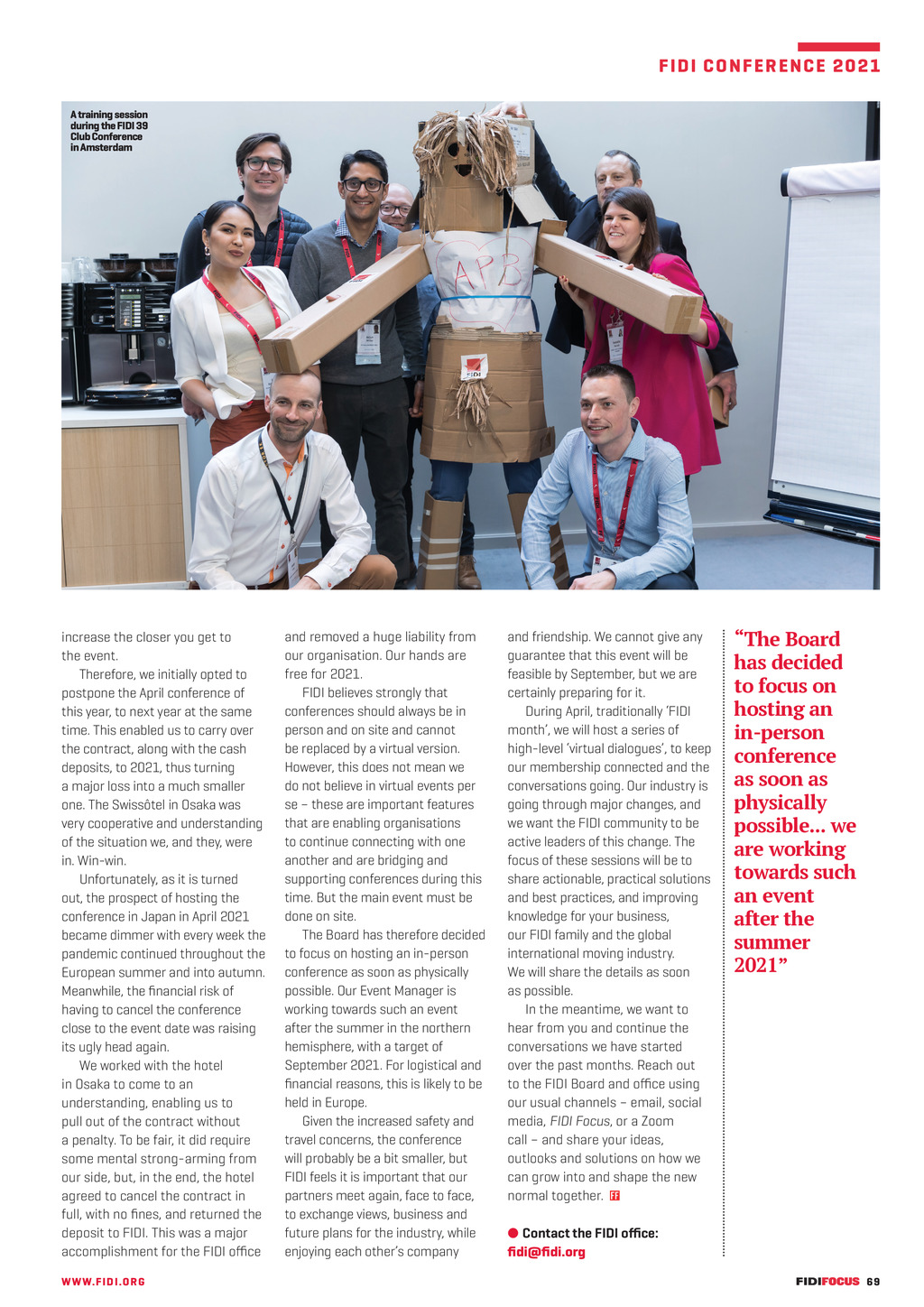

F ID I C O N FE R ENCE 2021 VIRTUAL OR IN-PERSON? THE FUTURE OF THE FIDI CONFERENCE With many conferences and events having to shift from in-person to online, FIDI is looking into adapting its own events portfolio to this new reality. Jesse van Sas, Secretary General of FIDI Global Alliance, explains Y A screenshot from the IAMs recent virtual convention ou will have read on pages 24-27 of this issue the perceptions of IAMs virtual conference by its attendees, including the FIDI team, who were present throughout the event. This was really the first movers virtual conference, and I need to congratulate IAM for a job well done. Sure, there were some teething problems, mostly technical ones, but I think everybody will be forgiving of that. Of course, this lenience will disappear over time and virtual conferences will increasingly be expected to get slicker and as close to flawless as possible. I did feel that the audience was dierent than during an on- 68 FF300 DecJan21 pp68-69 FIDI Conference.indd 68 site conference, in numbers, of course, but certainly also in age and job level. Many businesses opted to give their younger sta the opportunity to experience an IAM convention, albeit remotely. This is great, as it brings fresh views and faces but is also a concern. It shows that many regular conference attendees have little to no faith in a virtual version so chose not to register. They may change opinion in due course, but it is certainly something that conference organisers should consider. Many of the real decisionmakers were not present or at least did not participate actively in the meeting. All this brings me to our own conference, which we have traditionally held around April each year. For the first time in more than 60 years, we had to postpone our conference earlier this year moving the Oaska meeting to next year and by September, we were forced to cancel it altogether. Some may wonder if this decision was premature, but it is important to understand the financial and logistical risks involved in organising such a major gathering of business people. Conferences of a certain size require considerable lead time. It is not uncommon for conferences to be planned up to five years ahead, with increasing risks taken as the conference date approaches. After all, a hotel or convention centre will not accept your reservation for 600 or more attendees, filling up to the whole hotel, without some financial guarantees, namely a cash deposit. Often this must be paid one to two years ahead of the conference and the same goes for other local services, for tours, venues, and dining. These need to be booked well ahead and require partial prefinancing at least. Hotel contracts for conferences are extensive, with plenty of small print. The section on cancellations is a key clause in these documents and details the penalties for cancelling a contract. These penalties are severe, and that is justified to an extent as bailing on a contract of 1,500 room nights, conference space, and food and drink, a few months before the actual conference, is highly damaging for a hotel. The chance that they will find a replacement conference is almost zero. Hence, penalties are applied, and these WW W. F I D I FOC U S . OR G 24/11/2020 15:33