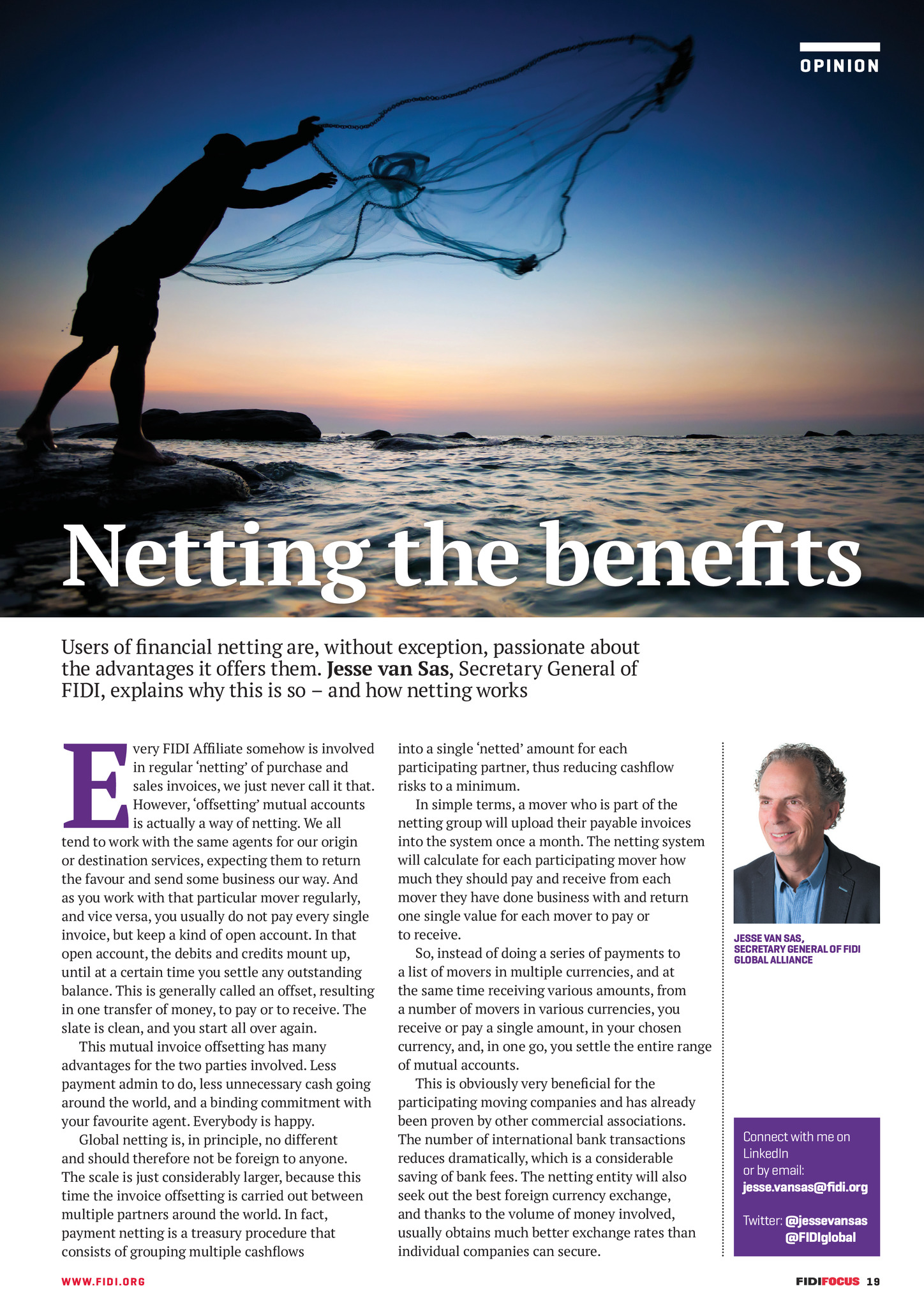

O PI N I O N Netting the benets Users of financial netting are, without exception, passionate about the advantages it offers them. Jesse van Sas, Secretary General of FIDI, explains why this is so and how netting works E very FIDI Affiliate somehow is involved in regular netting of purchase and sales invoices, we just never call it that. However, offsetting mutual accounts is actually a way of netting. We all tend to work with the same agents for our origin or destination services, expecting them to return the favour and send some business our way. And as you work with that particular mover regularly, and vice versa, you usually do not pay every single invoice, but keep a kind of open account. In that open account, the debits and credits mount up, until at a certain time you settle any outstanding balance. This is generally called an offset, resulting in one transfer of money, to pay or to receive. The slate is clean, and you start all over again. This mutual invoice offsetting has many advantages for the two parties involved. Less payment admin to do, less unnecessary cash going around the world, and a binding commitment with your favourite agent. Everybody is happy. Global netting is, in principle, no different and should therefore not be foreign to anyone. The scale is just considerably larger, because this time the invoice offsetting is carried out between multiple partners around the world. In fact, payment netting is a treasury procedure that consists of grouping multiple cashows W W W. F ID I. O R G FF300 DecJan21 pp18-21 Jesse Opinion.indd 19 into a single netted amount for each participating partner, thus reducing cashow risks to a minimum. In simple terms, a mover who is part of the netting group will upload their payable invoices into the system once a month. The netting system will calculate for each participating mover how much they should pay and receive from each mover they have done business with and return one single value for each mover to pay or to receive. So, instead of doing a series of payments to a list of movers in multiple currencies, and at the same time receiving various amounts, from a number of movers in various currencies, you receive or pay a single amount, in your chosen currency, and, in one go, you settle the entire range of mutual accounts. This is obviously very beneficial for the participating moving companies and has already been proven by other commercial associations. The number of international bank transactions reduces dramatically, which is a considerable saving of bank fees. The netting entity will also seek out the best foreign currency exchange, and thanks to the volume of money involved, usually obtains much better exchange rates than individual companies can secure. JESSE VAN SAS, SECRETARY GENERAL OF FIDI GLOBAL ALLIANCE Connect with me on LinkedIn or by email: jesse.vansas@fidi.org Twitter: @jessevansas @FIDIglobal 19 24/11/2020 10:56