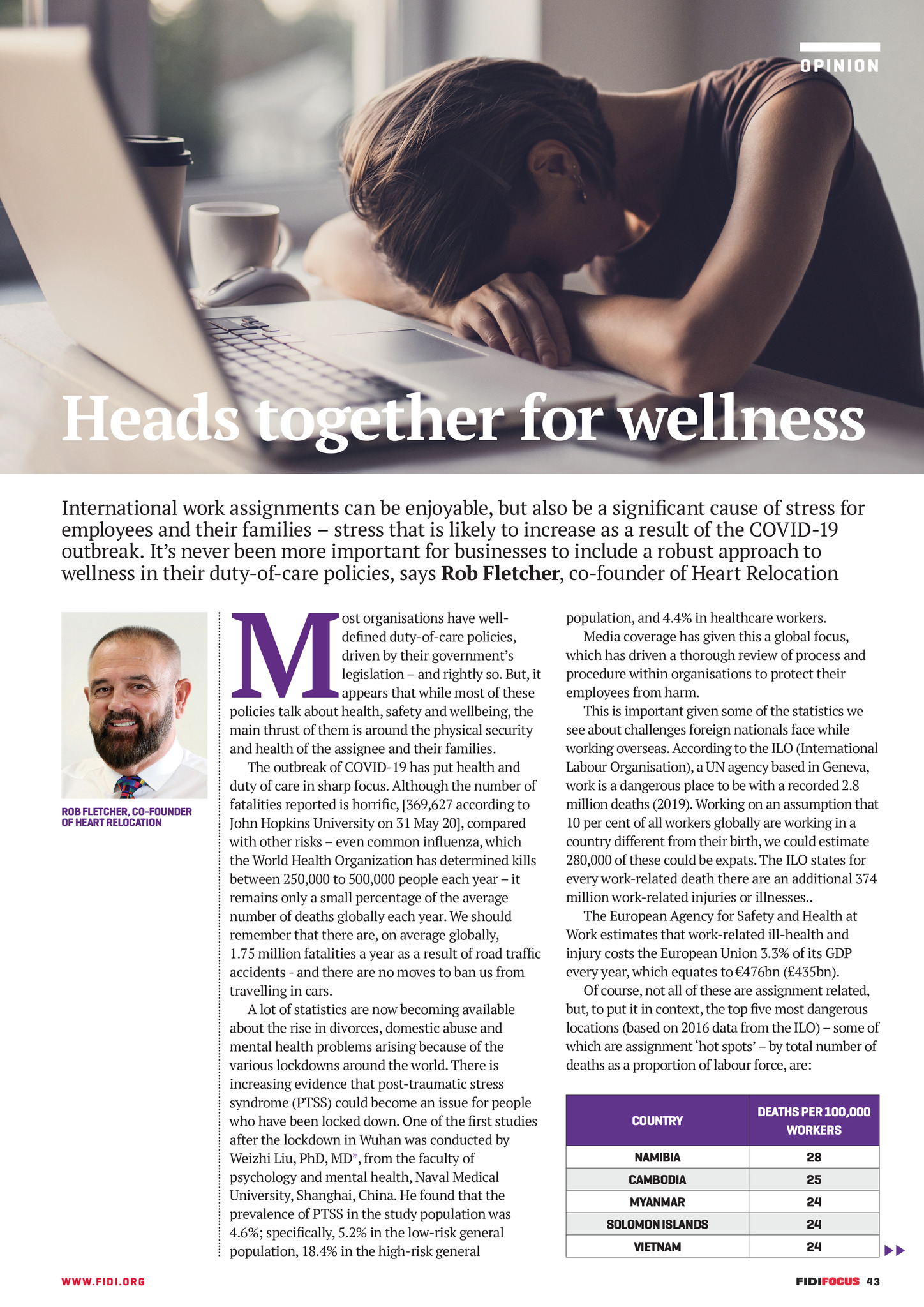
O PI N I O N Heads together for wellness International work assignments can be enjoyable, but also be a significant cause of stress for employees and their families stress that is likely to increase as a result of the COVID-19 outbreak. Its never been more important for businesses to include a robust approach to wellness in their duty-of-care policies, says Rob Fletcher, co-founder of Heart Relocation M ROB FLETCHER, CO-FOUNDER OF HEART RELOCATION W W W. F ID I. O R G FF297 JunJul20 pp42-45 Fletcher Opinion.indd 43 ost organisations have welldefined duty-of-care policies, driven by their governments legislation and rightly so. But, it appears that while most of these policies talk about health, safety and wellbeing, the main thrust of them is around the physical security and health of the assignee and their families. The outbreak of COVID-19 has put health and duty of care in sharp focus. Although the number of fatalities reported is horrific, [369,627 according to John Hopkins University on 31 May 20], compared with other risks even common inuenza, which the World Health Organization has determined kills between 250,000 to 500,000 people each year it remains only a small percentage of the average number of deaths globally each year. We should remember that there are, on average globally, 1.75 million fatalities a year as a result of road traffic accidents - and there are no moves to ban us from travelling in cars. A lot of statistics are now becoming available about the rise in divorces, domestic abuse and mental health problems arising because of the various lockdowns around the world. There is increasing evidence that post-traumatic stress syndrome (PTSS) could become an issue for people who have been locked down. One of the first studies after the lockdown in Wuhan was conducted by Weizhi Liu, PhD, MD*, from the faculty of psychology and mental health, Naval Medical University, Shanghai, China. He found that the prevalence of PTSS in the study population was 4.6%; specifically, 5.2% in the low-risk general population, 18.4% in the high-risk general population, and 4.4% in healthcare workers. Media coverage has given this a global focus, which has driven a thorough review of process and procedure within organisations to protect their employees from harm. This is important given some of the statistics we see about challenges foreign nationals face while working overseas. According to the ILO (International Labour Organisation), a UN agency based in Geneva, work is a dangerous place to be with a recorded 2.8 million deaths (2019). Working on an assumption that 10 per cent of all workers globally are working in a country different from their birth, we could estimate 280,000 of these could be expats. The ILO states for every work-related death there are an additional 374 million work-related injuries or illnesses.. The European Agency for Safety and Health at Work estimates that work-related ill-health and injury costs the European Union 3.3% of its GDP every year, which equates to 476bn (435bn). Of course, not all of these are assignment related, but, to put it in context, the top five most dangerous locations (based on 2016 data from the ILO) some of which are assignment hot spots by total number of deaths as a proportion of labour force, are: COUNTRY DEATHS PER 100,000 WORKERS NAMIBIA 28 CAMBODIA 25 MYANMAR 24 SOLOMON ISLANDS 24 VIETNAM 24 43 01/06/2020 15:06