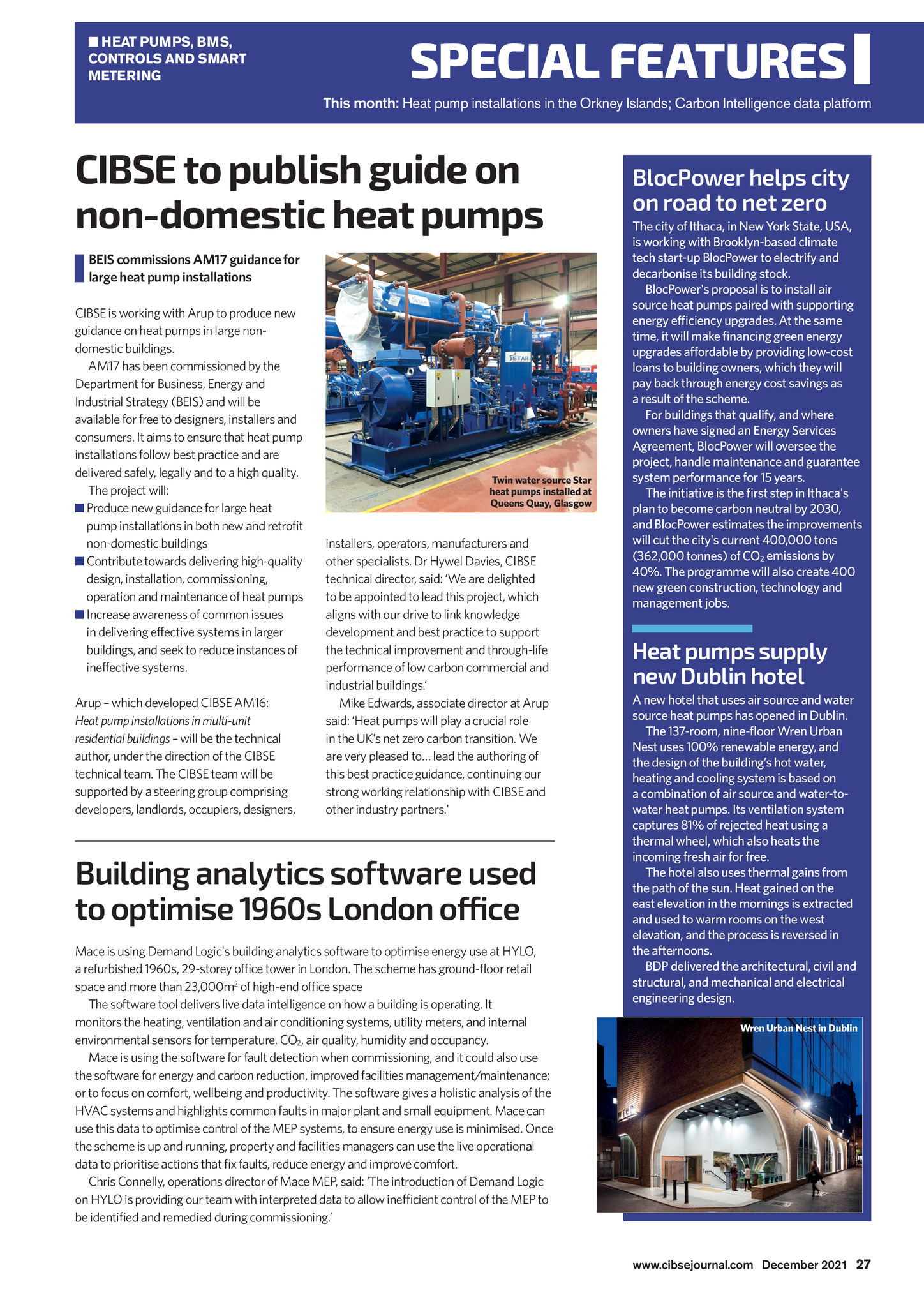

HEAT PUMPS, BMS, CONTROLS AND SMART METERING SPECIAL FEATURES This month: Heat pump installations in the Orkney Islands; Carbon Intelligence data platform CIBSE to publish guide on non-domestic heat pumps BEIS commissions AM17 guidance for large heat pump installations CIBSE is working with Arup to produce new guidance on heat pumps in large nondomestic buildings. AM17 has been commissioned by the Department for Business, Energy and Industrial Strategy (BEIS) and will be available for free to designers, installers and consumers. It aims to ensure that heat pump installations follow best practice and are delivered safely, legally and to a high quality. The project will: Produce new guidance for large heat non-domestic buildings Contribute towards delivering high-quality design, installation, commissioning, operation and maintenance of heat pumps Increase awareness of common issues in delivering effective systems in larger buildings, and seek to reduce instances of ineffective systems. Arup which developed CIBSE AM16: Heat pump installations in multi-unit residential buildings will be the technical author, under the direction of the CIBSE technical team. The CIBSE team will be supported by a steering group comprising developers, landlords, occupiers, designers, Twin water source Star heat pumps installed at Queens Quay, Glasgow installers, operators, manufacturers and other specialists. Dr Hywel Davies, CIBSE technical director, said: We are delighted to be appointed to lead this project, which aligns with our drive to link knowledge development and best practice to support the technical improvement and through-life performance of low carbon commercial and Mike Edwards, associate director at Arup said: Heat pumps will play a crucial role are very pleased to lead the authoring of this best practice guidance, continuing our strong working relationship with CIBSE and other industry partners. Building analytics software used to optimise 1960s London office Mace is using Demand Logic s building analytics software to optimise energy use at HYLO, space and more than 23,000m2 The software tool delivers live data intelligence on how a building is operating. It monitors the heating, ventilation and air conditioning systems, utility meters, and internal environmental sensors for temperature, CO2, air quality, humidity and occupancy. Mace is using the software for fault detection when commissioning, and it could also use the software for energy and carbon reduction, improved facilities management/maintenance; or to focus on comfort, wellbeing and productivity. The software gives a holistic analysis of the HVAC systems and highlights common faults in major plant and small equipment. Mace can use this data to optimise control of the MEP systems, to ensure energy use is minimised. Once the scheme is up and running, property and facilities managers can use the live operational BlocPower helps city on road to net zero The city of Ithaca, in New York State, USA, is working with Brooklyn-based climate tech start-up BlocPower to electrify and decarbonise its building stock. BlocPower s proposal is to install air source heat pumps paired with supporting upgrades affordable by providing low-cost loans to building owners, which they will pay back through energy cost savings as a result of the scheme. For buildings that qualify, and where owners have signed an Energy Services Agreement, BlocPower will oversee the project, handle maintenance and guarantee system performance for 15 years. plan to become carbon neutral by 2030, and BlocPower estimates the improvements will cut the city s current 400,000 tons (362,000 tonnes) of CO2 emissions by 40%. The programme will also create 400 new green construction, technology and management jobs. Heat pumps supply new Dublin hotel A new hotel that uses air source and water source heat pumps has opened in Dublin. Nest uses 100% renewable energy, and the design of the buildings hot water, heating and cooling system is based on a combination of air source and water-towater heat pumps. Its ventilation system captures 81% of rejected heat using a thermal wheel, which also heats the incoming fresh air for free. The hotel also uses thermal gains from the path of the sun. Heat gained on the east elevation in the mornings is extracted and used to warm rooms on the west elevation, and the process is reversed in the afternoons. BDP delivered the architectural, civil and structural, and mechanical and electrical engineering design. Wren Urban Nest in Dublin Chris Connelly, operations director of Mace MEP, said: The introduction of Demand Logic www.cibsejournal.com December 2021 27 CIBSE Dec21 pp27 Specials News.indd 27 26/11/2021 14:41