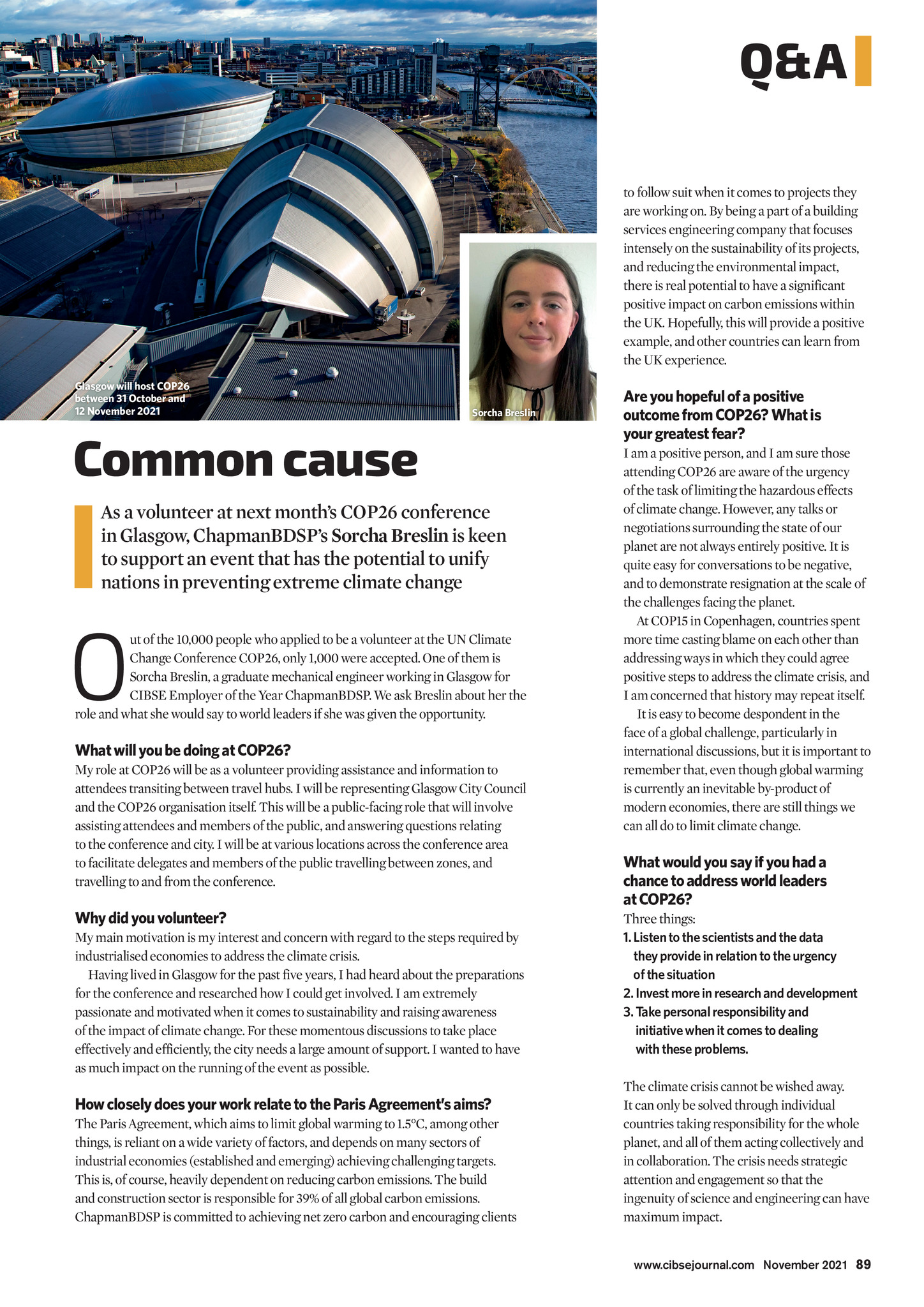
Q&A to follow suit when it comes to projects they are working on. By being a part of a building services engineering company that focuses intensely on the sustainability of its projects, and reducing the environmental impact, there is real potential to have a significant positive impact on carbon emissions within the UK. Hopefully, this will provide a positive example, and other countries can learn from the UK experience. Glasgow will host COP26 between 31 October and 12 November 2021 Sorcha Breslin Common cause As a volunteer at next months COP26 conference in Glasgow, ChapmanBDSPs Sorcha Breslin is keen to support an event that has the potential to unify nations in preventing extreme climate change O ut of the 10,000 people who applied to be a volunteer at the UN Climate Change Conference COP26, only 1,000 were accepted. One of them is Sorcha Breslin, a graduate mechanical engineer working in Glasgow for CIBSE Employer of the Year ChapmanBDSP. We ask Breslin about her the role and what she would say to world leaders if she was given the opportunity. What will you be doing at COP26? My role at COP26 will be as a volunteer providing assistance and information to attendees transiting between travel hubs. I will be representing Glasgow City Council and the COP26 organisation itself. This will be a public-facing role that will involve assisting attendees and members of the public, and answering questions relating to the conference and city. I will be at various locations across the conference area to facilitate delegates and members of the public travelling between zones, and travelling to and from the conference. Why did you volunteer? My main motivation is my interest and concern with regard to the steps required by industrialised economies to address the climate crisis. Having lived in Glasgow for the past five years, I had heard about the preparations for the conference and researched how I could get involved. I am extremely passionate and motivated when it comes to sustainability and raising awareness of the impact of climate change. For these momentous discussions to take place effectively and efficiently, the city needs a large amount of support. I wanted to have as much impact on the running of the event as possible. How closely does your work relate to the Paris Agreements aims? The Paris Agreement, which aims to limit global warming to 1.5C, among other things, is reliant on a wide variety of factors, and depends on many sectors of industrial economies (established and emerging) achieving challenging targets. This is, of course, heavily dependent on reducing carbon emissions. The build and construction sector is responsible for 39% of all global carbon emissions. ChapmanBDSP is committed to achieving net zero carbon and encouraging clients Are you hopeful of a positive outcome from COP26? What is your greatest fear? I am a positive person, and I am sure those attending COP26 are aware of the urgency of the task of limiting the hazardous effects of climate change. However, any talks or negotiations surrounding the state of our planet are not always entirely positive. It is quite easy for conversations to be negative, and to demonstrate resignation at the scale of the challenges facing the planet. At COP15 in Copenhagen, countries spent more time casting blame on each other than addressing ways in which they could agree positive steps to address the climate crisis, and I am concerned that history may repeat itself. It is easy to become despondent in the face of a global challenge, particularly in international discussions, but it is important to remember that, even though global warming is currently an inevitable by-product of modern economies, there are still things we can all do to limit climate change. What would you say if you had a chance to address world leaders at COP26? Three things: 1. Listen to the scientists and the data they provide in relation to the urgency of the situation 2. Invest more in research and development 3. Take personal responsibility and initiative when it comes to dealing with these problems. The climate crisis cannot be wished away. It can only be solved through individual countries taking responsibility for the whole planet, and all of them acting collectively and in collaboration. The crisis needs strategic attention and engagement so that the ingenuity of science and engineering can have maximum impact. www.cibsejournal.com November 2021 89 CIBSE Nov21 pp89 Q&A.indd 89 22/10/2021 15:23