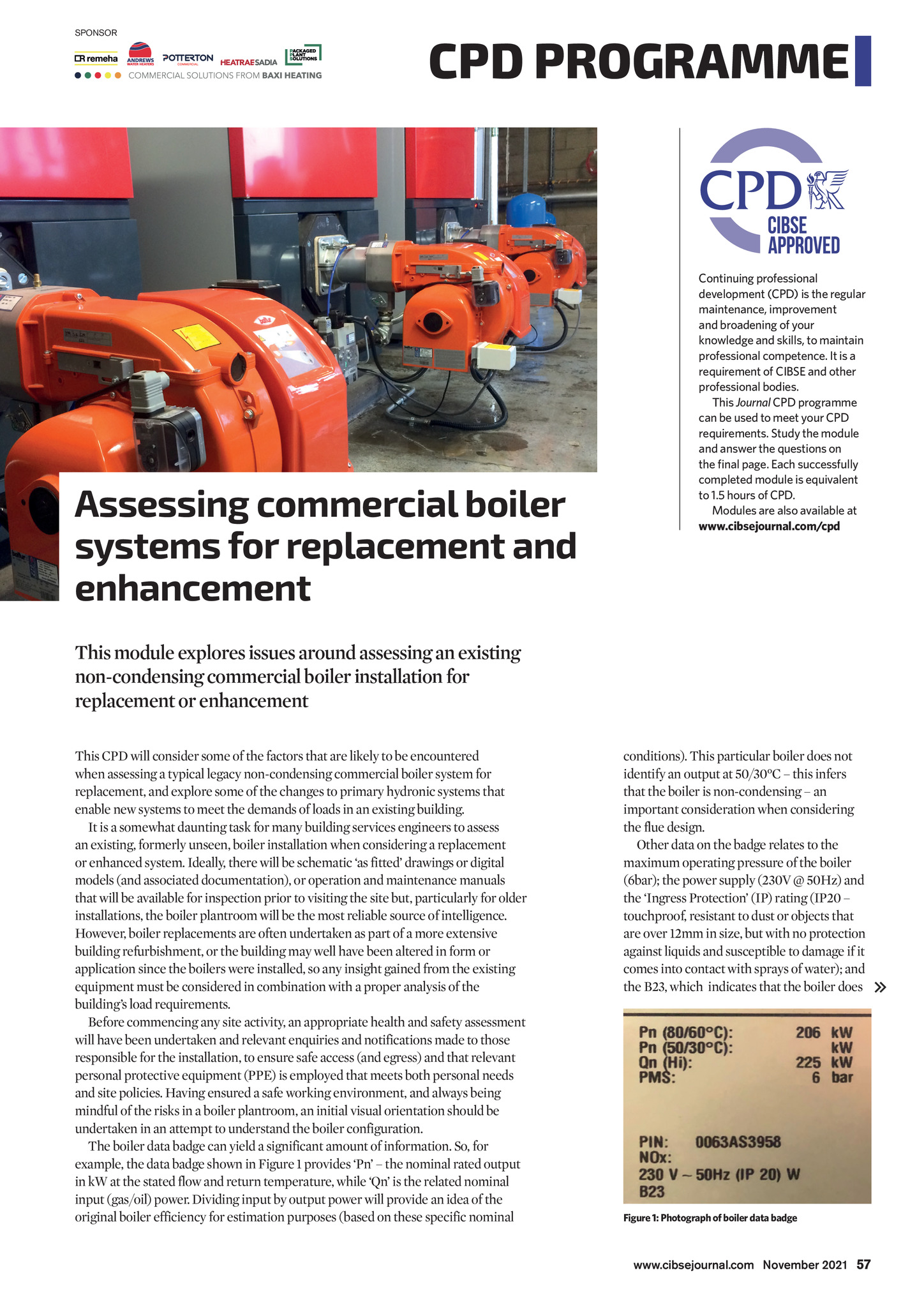

SPONSOR CPD PROGRAMME Continuing professional development (CPD) is the regular maintenance, improvement and broadening of your knowledge and skills, to maintain professional competence. It is a requirement of CIBSE and other professional bodies. This Journal CPD programme can be used to meet your CPD requirements. Study the module and answer the questions on Assessing commercial boiler systems for replacement and enhancement completed module is equivalent to 1.5 hours of CPD. Modules are also available at www.cibsejournal.com/cpd This module explores issues around assessing an existing non-condensing commercial boiler installation for replacement or enhancement This CPD will consider some of the factors that are likely to be encountered when assessing a typical legacy non-condensing commercial boiler system for replacement, and explore some of the changes to primary hydronic systems that enable new systems to meet the demands of loads in an existing building. It is a somewhat daunting task for many building services engineers to assess an existing, formerly unseen, boiler installation when considering a replacement or enhanced system. Ideally, there will be schematic as fitted drawings or digital models (and associated documentation), or operation and maintenance manuals that will be available for inspection prior to visiting the site but, particularly for older installations, the boiler plantroom will be the most reliable source of intelligence. However, boiler replacements are often undertaken as part of a more extensive building refurbishment, or the building may well have been altered in form or application since the boilers were installed, so any insight gained from the existing equipment must be considered in combination with a proper analysis of the buildings load requirements. Before commencing any site activity, an appropriate health and safety assessment will have been undertaken and relevant enquiries and notifications made to those responsible for the installation, to ensure safe access (and egress) and that relevant personal protective equipment (PPE) is employed that meets both personal needs and site policies. Having ensured a safe working environment, and always being mindful of the risks in a boiler plantroom, an initial visual orientation should be undertaken in an attempt to understand the boiler configuration. The boiler data badge can yield a significant amount of information. So, for example, the data badge shown in Figure 1 provides Pn the nominal rated output in kW at the stated flow and return temperature, while Qn is the related nominal input (gas/oil) power. Dividing input by output power will provide an idea of the original boiler efficiency for estimation purposes (based on these specific nominal conditions). This particular boiler does not identify an output at 50/30C this infers that the boiler is non-condensing an important consideration when considering the flue design. Other data on the badge relates to the maximum operating pressure of the boiler (6bar); the power supply (230V @ 50Hz) and the Ingress Protection (IP) rating (IP20 touchproof, resistant to dust or objects that are over 12mm in size, but with no protection against liquids and susceptible to damage if it comes into contact with sprays of water); and the B23, which indicates that the boiler does Figure 1: Photograph of boiler data badge www.cibsejournal.com November 2021 57 CIBSE Nov21 pp57-60 CPD 187.indd 57 22/10/2021 16:36