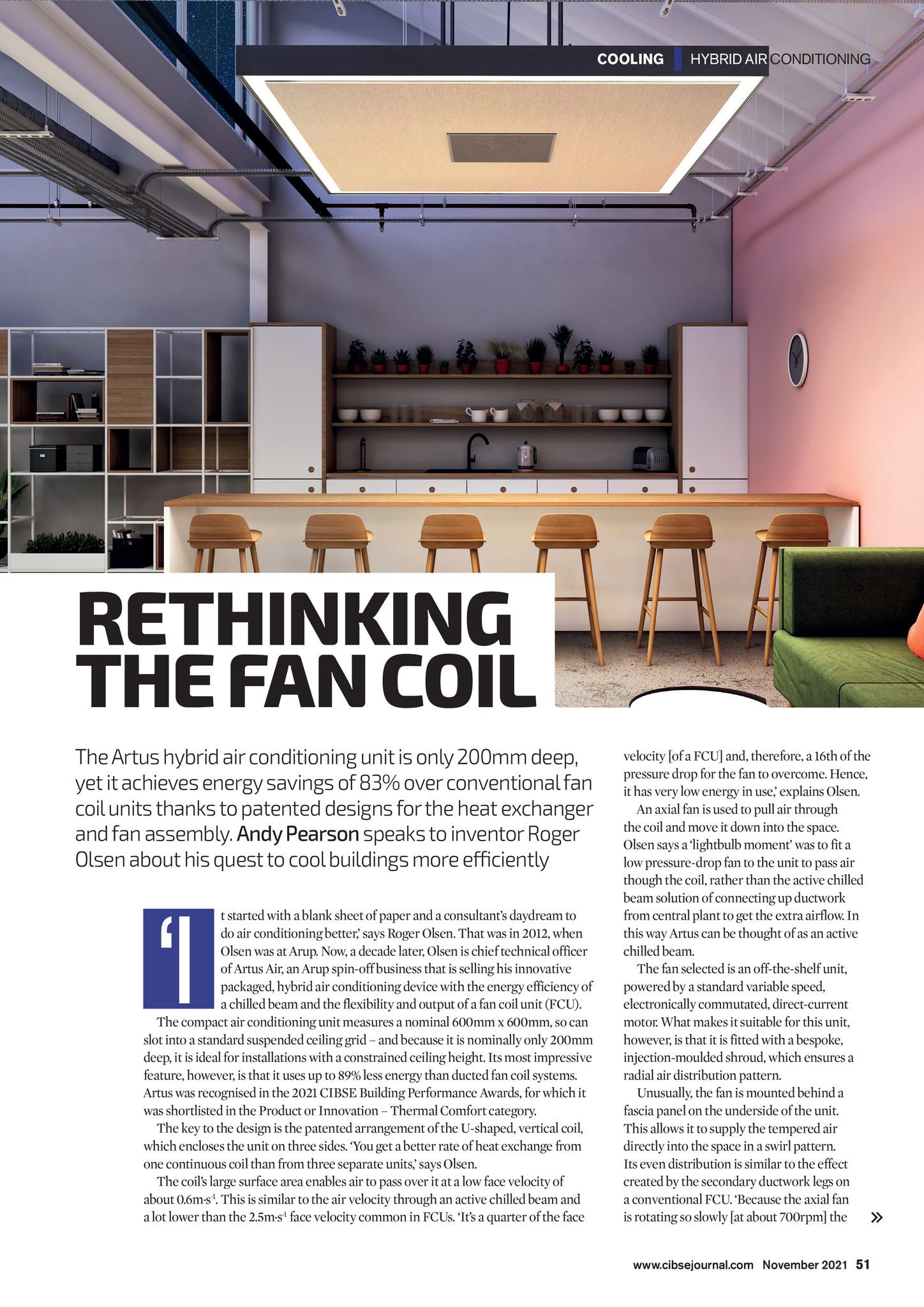
COOLING | HYBRID AIR CONDITIONING RETHINKING THE FAN COIL The Artus hybrid air conditioning unit is only 200mm deep, yet it achieves energy savings of 83% over conventional fan coil units thanks to patented designs for the heat exchanger and fan assembly. Andy Pearson speaks to inventor Roger Olsen about his quest to cool buildings more efficiently I t started with a blank sheet of paper and a consultants daydream to do air conditioning better, says Roger Olsen. That was in 2012, when Olsen was at Arup. Now, a decade later, Olsen is chief technical officer of Artus Air, an Arup spin-off business that is selling his innovative packaged, hybrid air conditioning device with the energy efficiency of a chilled beam and the flexibility and output of a fan coil unit (FCU). The compact air conditioning unit measures a nominal 600mm x 600mm, so can slot into a standard suspended ceiling grid and because it is nominally only 200mm deep, it is ideal for installations with a constrained ceiling height. Its most impressive feature, however, is that it uses up to 89% less energy than ducted fan coil systems. Artus was recognised in the 2021 CIBSE Building Performance Awards, for which it was shortlisted in the Product or Innovation Thermal Comfort category. The key to the design is the patented arrangement of the U-shaped, vertical coil, which encloses the unit on three sides. You get a better rate of heat exchange from one continuous coil than from three separate units, says Olsen. The coils large surface area enables air to pass over it at a low face velocity of about 0.6m.s-1. This is similar to the air velocity through an active chilled beam and a lot lower than the 2.5m.s-1 face velocity common in FCUs. Its a quarter of the face velocity [of a FCU] and, therefore, a 16th of the pressure drop for the fan to overcome. Hence, it has very low energy in use, explains Olsen. An axial fan is used to pull air through the coil and move it down into the space. Olsen says a lightbulb moment was to fit a low pressure-drop fan to the unit to pass air though the coil, rather than the active chilled beam solution of connecting up ductwork from central plant to get the extra airflow. In this way Artus can be thought of as an active chilled beam. The fan selected is an off-the-shelf unit, powered by a standard variable speed, electronically commutated, direct-current motor. What makes it suitable for this unit, however, is that it is fitted with a bespoke, injection-moulded shroud, which ensures a radial air distribution pattern. Unusually, the fan is mounted behind a fascia panel on the underside of the unit. This allows it to supply the tempered air directly into the space in a swirl pattern. Its even distribution is similar to the effect created by the secondary ductwork legs on a conventional FCU. Because the axial fan is rotating so slowly [at about 700rpm] the www.cibsejournal.com November 2021 51 CIBSE Nov21 pp51-52, 54 Artus.indd 51 22/10/2021 18:14