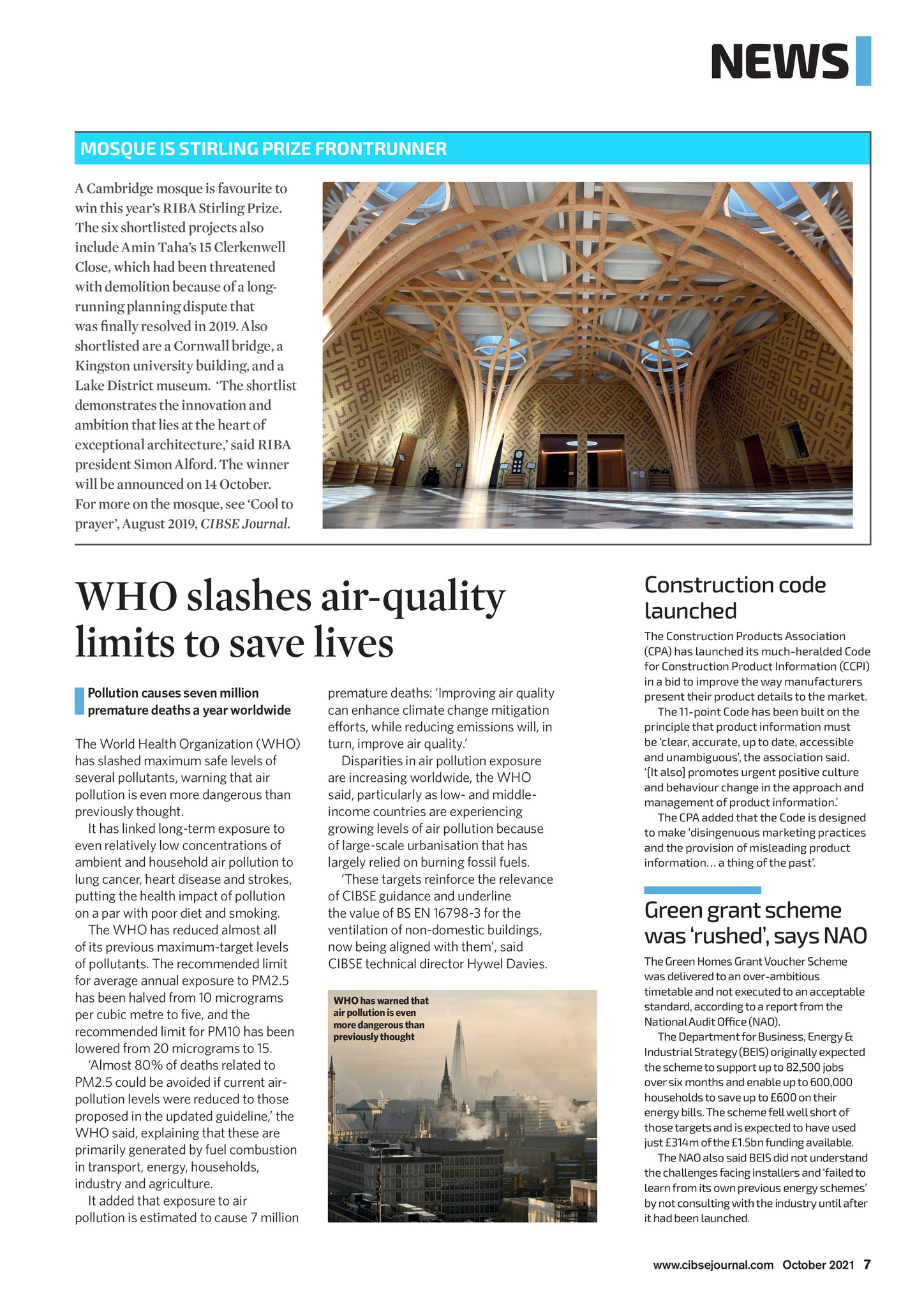
EWS MOSQUE IS STIRLING PRIZE FRONTRUNNER A Cambridge mosque is favourite to win this years RIBA Stirling Prize. The six shortlisted projects also include Amin Tahas 15 Clerkenwell Close, which had been threatened with demolition because of a longrunning planning dispute that shortlisted are a Cornwall bridge, a Kingston university building, and a Lake District museum. The shortlist demonstrates the innovation and ambition that lies at the heart of exceptional architecture, said RIBA president Simon Alford. The winner will be announced on 14 October. For more on the mosque, see Cool to CIBSE Journal. WHO slashes air-quality limits to save lives Pollution causes seven million premature deaths a year worldwide The World Health Organization (WHO) has slashed maximum safe levels of several pollutants, warning that air pollution is even more dangerous than previously thought. It has linked long-term exposure to even relatively low concentrations of ambient and household air pollution to lung cancer, heart disease and strokes, putting the health impact of pollution on a par with poor diet and smoking. The WHO has reduced almost all of its previous maximum-target levels of pollutants. The recommended limit for average annual exposure to PM2.5 has been halved from 10 micrograms recommended limit for PM10 has been lowered from 20 micrograms to 15. Almost 80% of deaths related to PM2.5 could be avoided if current airpollution levels were reduced to those proposed in the updated guideline, the WHO said, explaining that these are primarily generated by fuel combustion in transport, energy, households, industry and agriculture. It added that exposure to air pollution is estimated to cause 7 million premature deaths: Improving air quality can enhance climate change mitigation efforts, while reducing emissions will, in turn, improve air quality. Disparities in air pollution exposure are increasing worldwide, the WHO said, particularly as low- and middleincome countries are experiencing growing levels of air pollution because of large-scale urbanisation that has largely relied on burning fossil fuels. These targets reinforce the relevance of CIBSE guidance and underline the value of BS EN 16798-3 for the ventilation of non-domestic buildings, now being aligned with them, said CIBSE technical director Hywel Davies. WHO has warned that air pollution is even more dangerous than previously thought Construction code launched The Construction Products Association (CPA) has launched its much-heralded Code for Construction Product Information (CCPI) in a bid to improve the way manufacturers present their product details to the market. The 11-point Code has been built on the principle that product information must be clear, accurate, up to date, accessible and unambiguous, the association said. [It also] promotes urgent positive culture and behaviour change in the approach and management of product information. The CPA added that the Code is designed to make disingenuous marketing practices and the provision of misleading product information a thing of the past. Green grant scheme was rushed, says NAO The Green Homes Grant Voucher Scheme was delivered to an over-ambitious timetable and not executed to an acceptable standard, according to a report from the National Audit Office (NAO). The Department for Business, Energy & Industrial Strategy (BEIS) originally expected the scheme to support up to 82,500 jobs over six months and enable up to 600,000 households to save up to 600 on their energy bills. The scheme fell well short of those targets and is expected to have used just 314m of the 1.5bn funding available. The NAO also said BEIS did not understand the challenges facing installers and failed to learn from its own previous energy schemes by not consulting with the industry until after it had been launched. www.cibsejournal.com October 2021 7 CIBSE Oct21 pp07 News.indd 7 24/09/2021 15:55