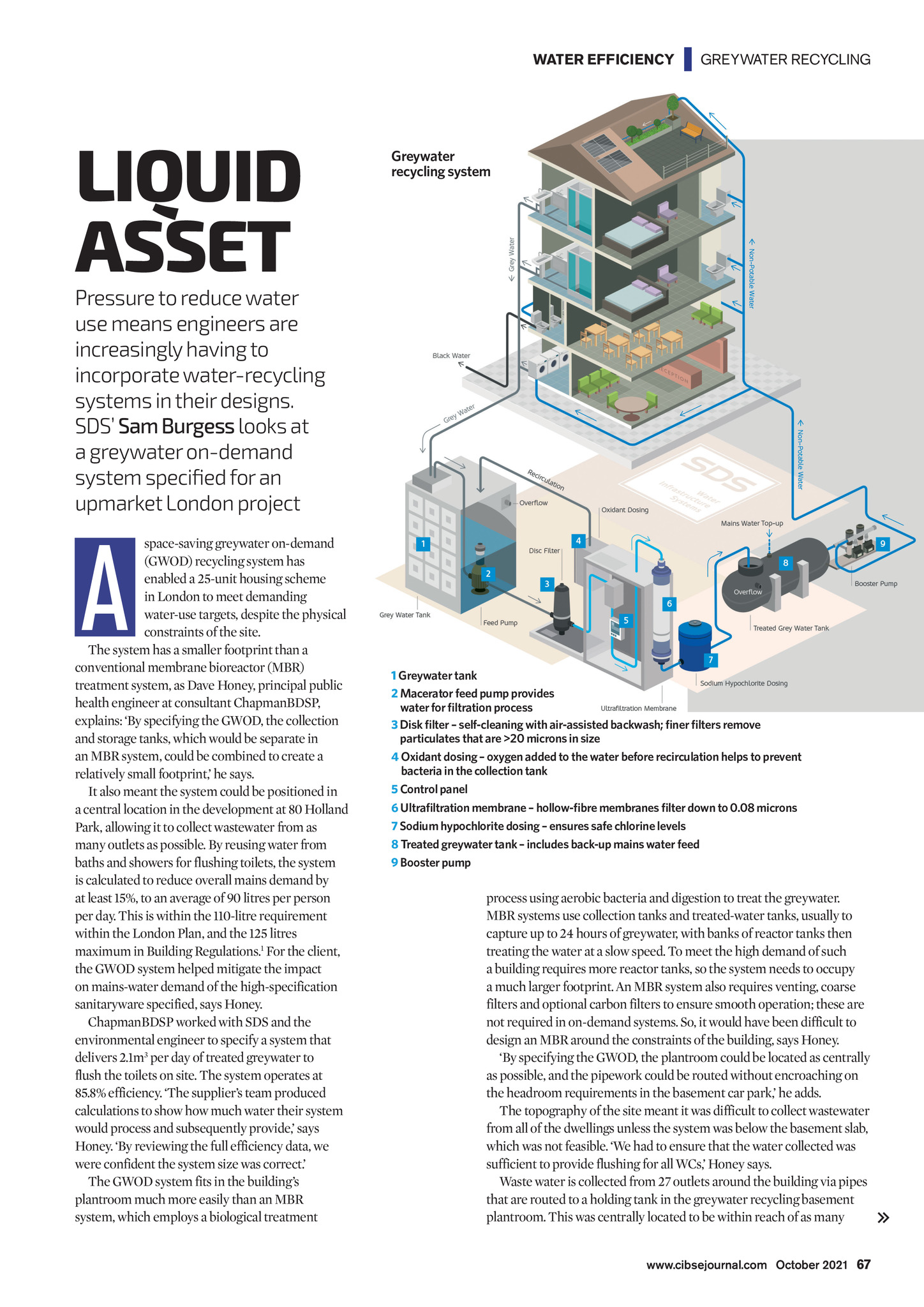
WATER EFFICIENCY LIQUID ASSET | GREYWATER RECYCLING Greywater recycling system Pressure to reduce water use means engineers are increasingly having to incorporate water-recycling systems in their designs. SDS Sam Burgess looks at a greywater on-demand system specified for an upmarket London project A space-saving greywater on-demand (GWOD) recycling system has enabled a 25-unit housing scheme in London to meet demanding water-use targets, despite the physical constraints of the site. The system has a smaller footprint than a conventional membrane bioreactor (MBR) treatment system, as Dave Honey, principal public health engineer at consultant ChapmanBDSP, explains: By specifying the GWOD, the collection and storage tanks, which would be separate in an MBR system, could be combined to create a relatively small footprint, he says. It also meant the system could be positioned in a central location in the development at 80 Holland Park, allowing it to collect wastewater from as many outlets as possible. By reusing water from baths and showers for flushing toilets, the system is calculated to reduce overall mains demand by at least 15%, to an average of 90 litres per person per day. This is within the 110-litre requirement within the London Plan, and the 125 litres maximum in Building Regulations.1 For the client, the GWOD system helped mitigate the impact on mains-water demand of the high-specification sanitaryware specified, says Honey. ChapmanBDSP worked with SDS and the environmental engineer to specify a system that delivers 2.1m3 per day of treated greywater to flush the toilets on site. The system operates at 85.8% efficiency. The suppliers team produced calculations to show how much water their system would process and subsequently provide, says Honey. By reviewing the full efficiency data, we were confident the system size was correct. The GWOD system fits in the buildings plantroom much more easily than an MBR system, which employs a biological treatment 1 Greywater tank 2 Macerator feed pump provides 3 4 5 Control panel 6 7 8 9 Booster pump process using aerobic bacteria and digestion to treat the greywater. MBR systems use collection tanks and treated-water tanks, usually to capture up to 24 hours of greywater, with banks of reactor tanks then treating the water at a slow speed. To meet the high demand of such a building requires more reactor tanks, so the system needs to occupy a much larger footprint. An MBR system also requires venting, coarse filters and optional carbon filters to ensure smooth operation; these are not required in on-demand systems. So, it would have been difficult to design an MBR around the constraints of the building, says Honey. By specifying the GWOD, the plantroom could be located as centrally as possible, and the pipework could be routed without encroaching on the headroom requirements in the basement car park, he adds. The topography of the site meant it was difficult to collect wastewater from all of the dwellings unless the system was below the basement slab, which was not feasible. We had to ensure that the water collected was sufficient to provide flushing for all WCs, Honey says. Waste water is collected from 27 outlets around the building via pipes that are routed to a holding tank in the greywater recycling basement plantroom. This was centrally located to be within reach of as many www.cibsejournal.com October 2021 67 CIBSE Oct21 pp67-68 Greywater recycling.indd 67 24/09/2021 15:51