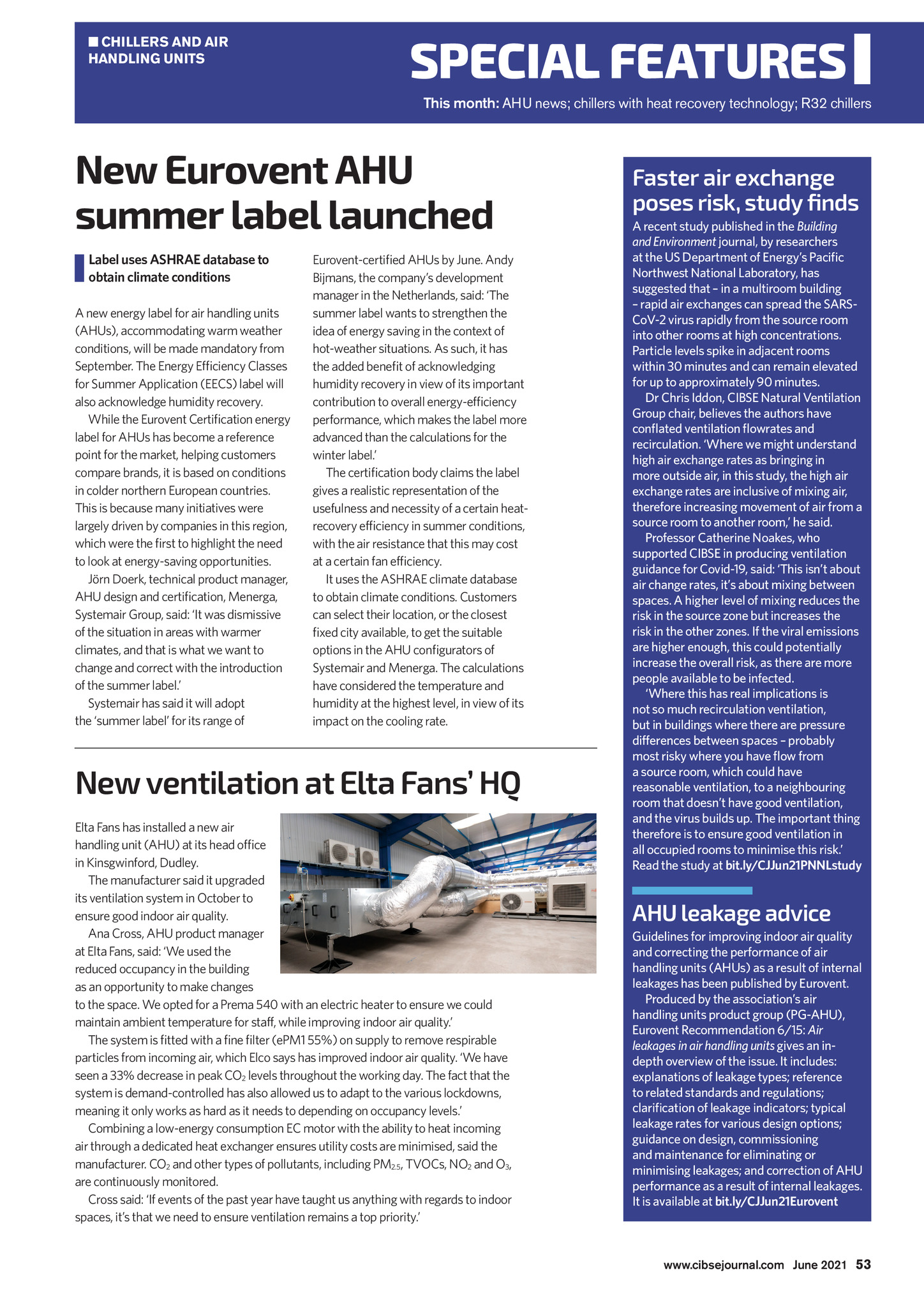
CHILLERS AND AIR HANDLING UNITS SPECIAL FEATURES This month: AHU news; chillers with heat recovery technology; R32 chillers New Eurovent AHU summer label launched Label uses ASHRAE database to obtain climate conditions A new energy label for air handling units (AHUs), accommodating warm weather conditions, will be made mandatory from Bijmans, the companys development manager in the Netherlands, said: The summer label wants to strengthen the idea of energy saving in the context of hot-weather situations. As such, it has humidity recovery in view of its important also acknowledge humidity recovery. label for AHUs has become a reference point for the market, helping customers compare brands, it is based on conditions in colder northern European countries. This is because many initiatives were largely driven by companies in this region, performance, which makes the label more advanced than the calculations for the winter label. gives a realistic representation of the usefulness and necessity of a certain heatwith the air resistance that this may cost to look at energy-saving opportunities. Jrn Doerk, technical product manager, Systemair Group, said: It was dismissive of the situation in areas with warmer climates, and that is what we want to change and correct with the introduction of the summer label. Systemair has said it will adopt the summer label for its range of It uses the ASHRAE climate database can select their location, or the closest have considered the temperature and humidity at the highest level, in view of its impact on the cooling rate. New ventilation at Elta Fans HQ Elta Fans has installed a new air in Kinsgwinford, Dudley. The manufacturer said it upgraded its ventilation system in October to ensure good indoor air quality. at Elta Fans, said: We used the reduced occupancy in the building as an opportunity to make changes to the space. We opted for a Prema 540 with an electric heater to ensure we could maintain ambient temperature for staff, while improving indoor air quality. particles from incoming air, which Elco says has improved indoor air quality. We have 2 levels throughout the working day. The fact that the system is demand-controlled has also allowed us to adapt to the various lockdowns, meaning it only works as hard as it needs to depending on occupancy levels. air through a dedicated heat exchanger ensures utility costs are minimised, said the 2 2.5 2 and O3, are continuously monitored. spaces, its that we need to ensure ventilation remains a top priority. Faster air exchange poses risk, study finds A recent study published in the Building and Environment journal, by researchers Northwest National Laboratory, has suggested that in a multiroom building rapid air exchanges can spread the SARSCoV-2 virus rapidly from the source room into other rooms at high concentrations. Particle levels spike in adjacent rooms within 30 minutes and can remain elevated for up to approximately 90 minutes. Dr Chris Iddon, CIBSE Natural Ventilation Group chair, believes the authors have recirculation. Where we might understand high air exchange rates as bringing in more outside air, in this study, the high air exchange rates are inclusive of mixing air, therefore increasing movement of air from a source room to another room, he said. Professor Catherine Noakes, who supported CIBSE in producing ventilation guidance for Covid-19, said: This isnt about air change rates, its about mixing between spaces. A higher level of mixing reduces the risk in the source zone but increases the risk in the other zones. If the viral emissions are higher enough, this could potentially increase the overall risk, as there are more people available to be infected. Where this has real implications is not so much recirculation ventilation, but in buildings where there are pressure differences between spaces probably a source room, which could have reasonable ventilation, to a neighbouring room that doesnt have good ventilation, and the virus builds up. The important thing therefore is to ensure good ventilation in all occupied rooms to minimise this risk. Read the study at bit.ly/CJJun21PNNLstudy AHU leakage advice Guidelines for improving indoor air quality and correcting the performance of air handling units (AHUs) as a result of internal leakages has been published by Eurovent. Produced by the associations air handling units product group (PG-AHU), Eurovent Recommendation 6/15: Air leakages in air handling units gives an indepth overview of the issue. It includes: explanations of leakage types; reference to related standards and regulations; leakage rates for various design options; guidance on design, commissioning and maintenance for eliminating or minimising leakages; and correction of AHU performance as a result of internal leakages. It is available at bit.ly/CJJun21Eurovent www.cibsejournal.com June 2021 53 CIBSE June 21 pp53-54 Chiller and AHU News.indd 53 21/05/2021 16:28