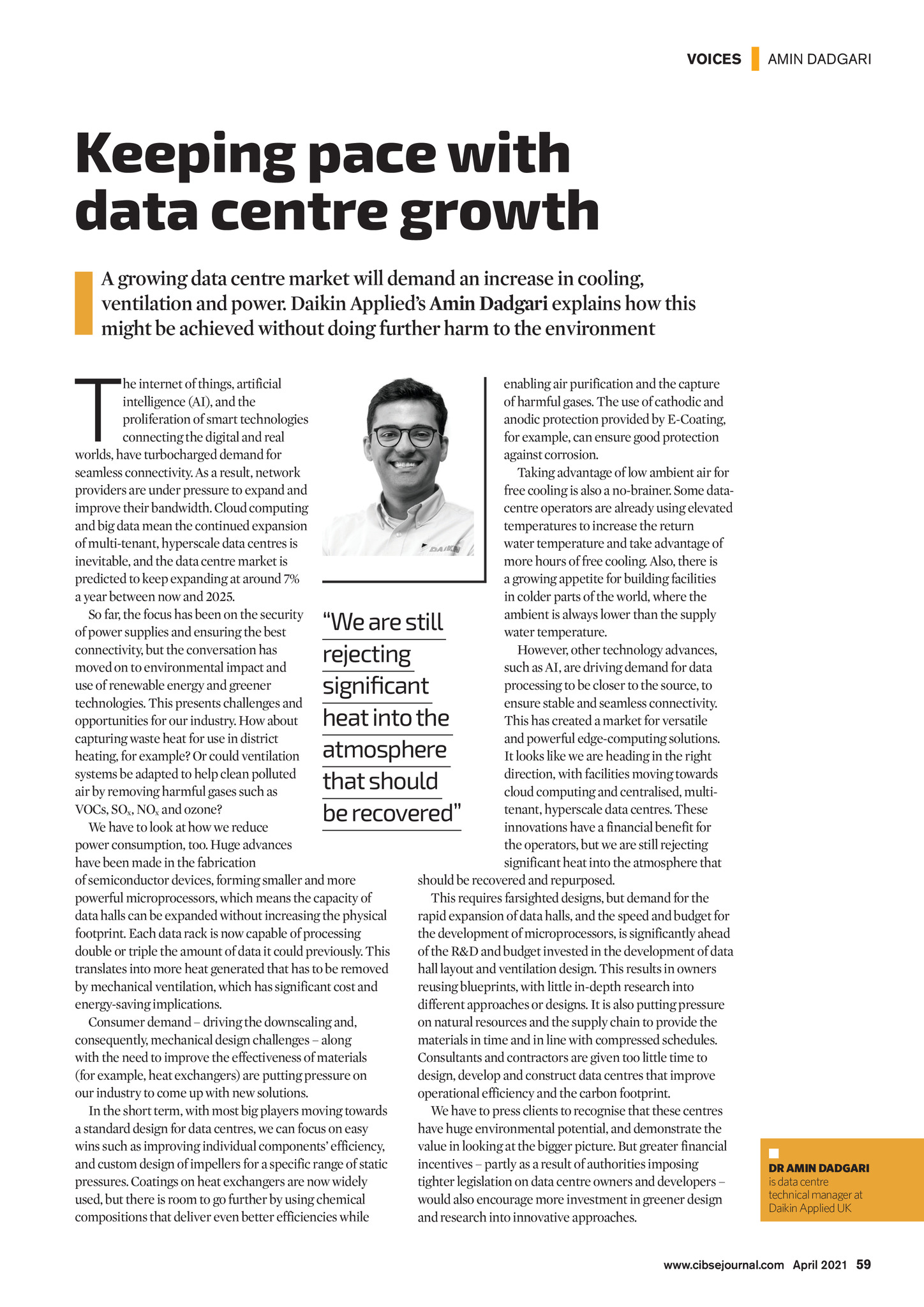
VOICES | AMIN DADGARI Keeping pace with data centre growth A growing data centre market will demand an increase in cooling, ventilation and power. Daikin Applieds Amin Dadgari explains how this might be achieved without doing further harm to the environment T he internet of things, artificial intelligence (AI), and the proliferation of smart technologies connecting the digital and real worlds, have turbocharged demand for seamless connectivity. As a result, network providers are under pressure to expand and improve their bandwidth. Cloud computing and big data mean the continued expansion of multi-tenant, hyperscale data centres is inevitable, and the data centre market is predicted to keep expanding at around 7% a year between now and 2025. So far, the focus has been on the security of power supplies and ensuring the best connectivity, but the conversation has moved on to environmental impact and use of renewable energy and greener technologies. This presents challenges and opportunities for our industry. How about capturing waste heat for use in district heating, for example? Or could ventilation systems be adapted to help clean polluted air by removing harmful gases such as VOCs, SOx, NOx and ozone? We have to look at how we reduce power consumption, too. Huge advances have been made in the fabrication of semiconductor devices, forming smaller and more powerful microprocessors, which means the capacity of data halls can be expanded without increasing the physical footprint. Each data rack is now capable of processing double or triple the amount of data it could previously. This translates into more heat generated that has to be removed by mechanical ventilation, which has significant cost and energy-saving implications. Consumer demand driving the downscaling and, consequently, mechanical design challenges along with the need to improve the effectiveness of materials (for example, heat exchangers) are putting pressure on our industry to come up with new solutions. In the short term, with most big players moving towards a standard design for data centres, we can focus on easy wins such as improving individual components efficiency, and custom design of impellers for a specific range of static pressures. Coatings on heat exchangers are now widely used, but there is room to go further by using chemical compositions that deliver even better efficiencies while enabling air purification and the capture of harmful gases. The use of cathodic and anodic protection provided by E-Coating, for example, can ensure good protection against corrosion. Taking advantage of low ambient air for free cooling is also a no-brainer. Some datacentre operators are already using elevated temperatures to increase the return water temperature and take advantage of more hours of free cooling. Also, there is a growing appetite for building facilities in colder parts of the world, where the ambient is always lower than the supply water temperature. However, other technology advances, such as AI, are driving demand for data processing to be closer to the source, to ensure stable and seamless connectivity. This has created a market for versatile and powerful edge-computing solutions. It looks like we are heading in the right direction, with facilities moving towards cloud computing and centralised, multitenant, hyperscale data centres. These innovations have a financial benefit for the operators, but we are still rejecting significant heat into the atmosphere that should be recovered and repurposed. This requires farsighted designs, but demand for the rapid expansion of data halls, and the speed and budget for the development of microprocessors, is significantly ahead of the R&D and budget invested in the development of data hall layout and ventilation design. This results in owners reusing blueprints, with little in-depth research into different approaches or designs. It is also putting pressure on natural resources and the supply chain to provide the materials in time and in line with compressed schedules. Consultants and contractors are given too little time to design, develop and construct data centres that improve operational efficiency and the carbon footprint. We have to press clients to recognise that these centres have huge environmental potential, and demonstrate the value in looking at the bigger picture. But greater financial incentives partly as a result of authorities imposing tighter legislation on data centre owners and developers would also encourage more investment in greener design and research into innovative approaches. We are still rejecting significant heat into the atmosphere that should be recovered DR AMIN DADGARI is data centre technical manager at Daikin Applied UK www.cibsejournal.com April 2021 59 CIBSE April 21 pp59 Daikin opinion.indd 59 26/03/2021 14:45