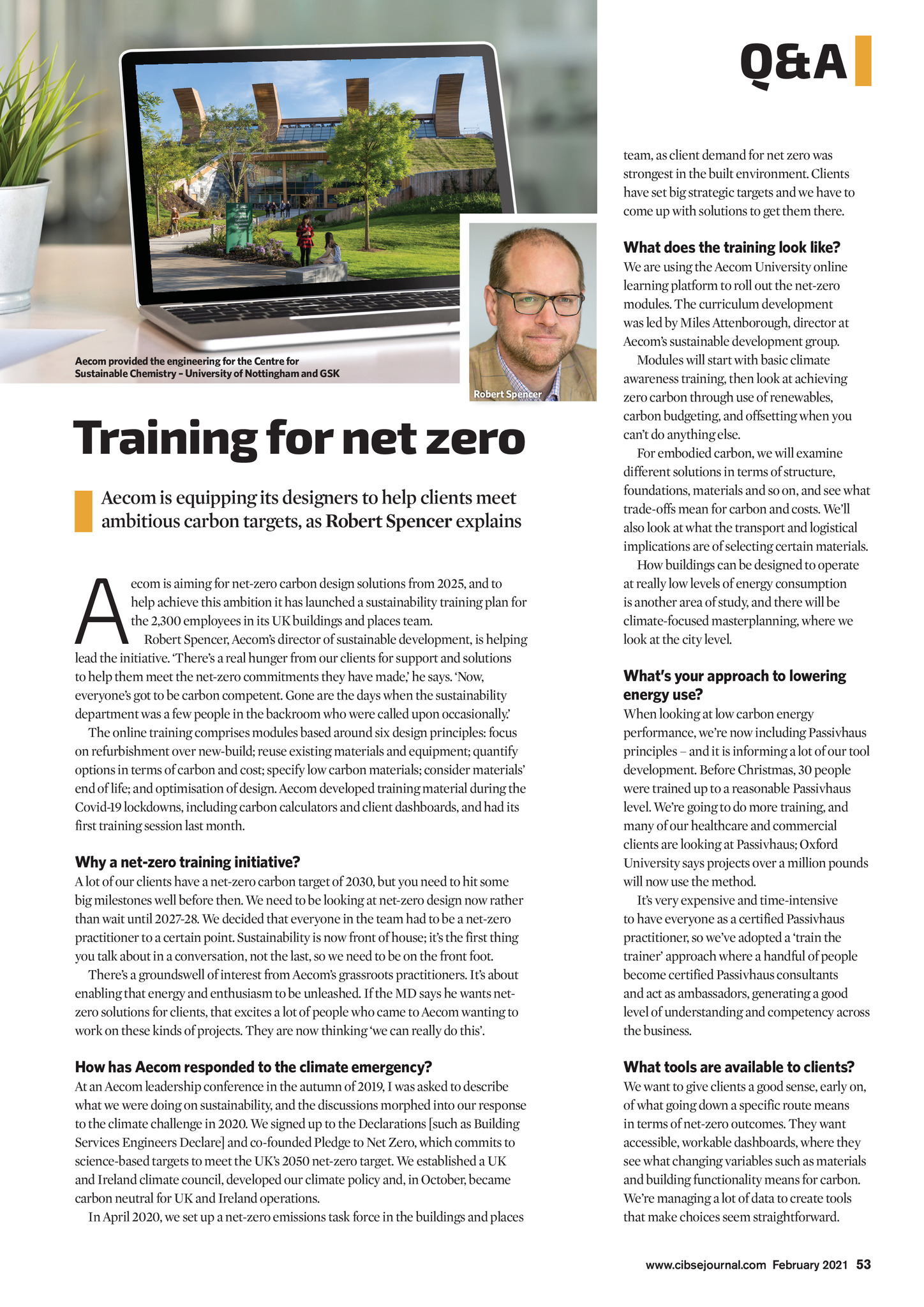
Q&A team, as client demand for net zero was strongest in the built environment. Clients have set big strategic targets and we have to come up with solutions to get them there. What does the training look like? Aecom provided the engineering for the Centre for Sustainable Chemistry University of Nottingham and GSK Robert Spencer Training for net zero Aecom is equipping its designers to help clients meet ambitious carbon targets, as Robert Spencer explains A ecom is aiming for net-zero carbon design solutions from 2025, and to help achieve this ambition it has launched a sustainability training plan for the 2,300 employees in its UK buildings and places team. Robert Spencer, Aecoms director of sustainable development, is helping lead the initiative. Theres a real hunger from our clients for support and solutions to help them meet the net-zero commitments they have made, he says. Now, everyones got to be carbon competent. Gone are the days when the sustainability department was a few people in the backroom who were called upon occasionally. The online training comprises modules based around six design principles: focus on refurbishment over new-build; reuse existing materials and equipment; quantify options in terms of carbon and cost; specify low carbon materials; consider materials end of life; and optimisation of design. Aecom developed training material during the Covid-19 lockdowns, including carbon calculators and client dashboards, and had its first training session last month. We are using the Aecom University online learning platform to roll out the net-zero modules. The curriculum development was led by Miles Attenborough, director at Aecoms sustainable development group. Modules will start with basic climate awareness training, then look at achieving zero carbon through use of renewables, carbon budgeting, and offsetting when you cant do anything else. For embodied carbon, we will examine different solutions in terms of structure, foundations, materials and so on, and see what trade-offs mean for carbon and costs. Well also look at what the transport and logistical implications are of selecting certain materials. How buildings can be designed to operate at really low levels of energy consumption is another area of study, and there will be climate-focused masterplanning, where we look at the city level. Whats your approach to lowering energy use? A lot of our clients have a net-zero carbon target of 2030, but you need to hit some big milestones well before then. We need to be looking at net-zero design now rather than wait until 2027-28. We decided that everyone in the team had to be a net-zero practitioner to a certain point. Sustainability is now front of house; its the first thing you talk about in a conversation, not the last, so we need to be on the front foot. Theres a groundswell of interest from Aecoms grassroots practitioners. Its about enabling that energy and enthusiasm to be unleashed. If the MD says he wants netzero solutions for clients, that excites a lot of people who came to Aecom wanting to work on these kinds of projects. They are now thinking we can really do this. When looking at low carbon energy performance, were now including Passivhaus principles and it is informing a lot of our tool development. Before Christmas, 30 people were trained up to a reasonable Passivhaus level. Were going to do more training, and many of our healthcare and commercial clients are looking at Passivhaus; Oxford University says projects over a million pounds will now use the method. Its very expensive and time-intensive to have everyone as a certified Passivhaus practitioner, so weve adopted a train the trainer approach where a handful of people become certified Passivhaus consultants and act as ambassadors, generating a good level of understanding and competency across the business. How has Aecom responded to the climate emergency? What tools are available to clients? At an Aecom leadership conference in the autumn of 2019, I was asked to describe what we were doing on sustainability, and the discussions morphed into our response to the climate challenge in 2020. We signed up to the Declarations [such as Building Services Engineers Declare] and co-founded Pledge to Net Zero, which commits to science-based targets to meet the UKs 2050 net-zero target. We established a UK and Ireland climate council, developed our climate policy and, in October, became carbon neutral for UK and Ireland operations. In April 2020, we set up a net-zero emissions task force in the buildings and places We want to give clients a good sense, early on, of what going down a specific route means in terms of net-zero outcomes. They want accessible, workable dashboards, where they see what changing variables such as materials and building functionality means for carbon. Were managing a lot of data to create tools that make choices seem straightforward. Why a net-zero training initiative? www.cibsejournal.com February 2021 53 CIBSE Feb21 pp53 Q&A.indd 53 22/01/2021 17:56