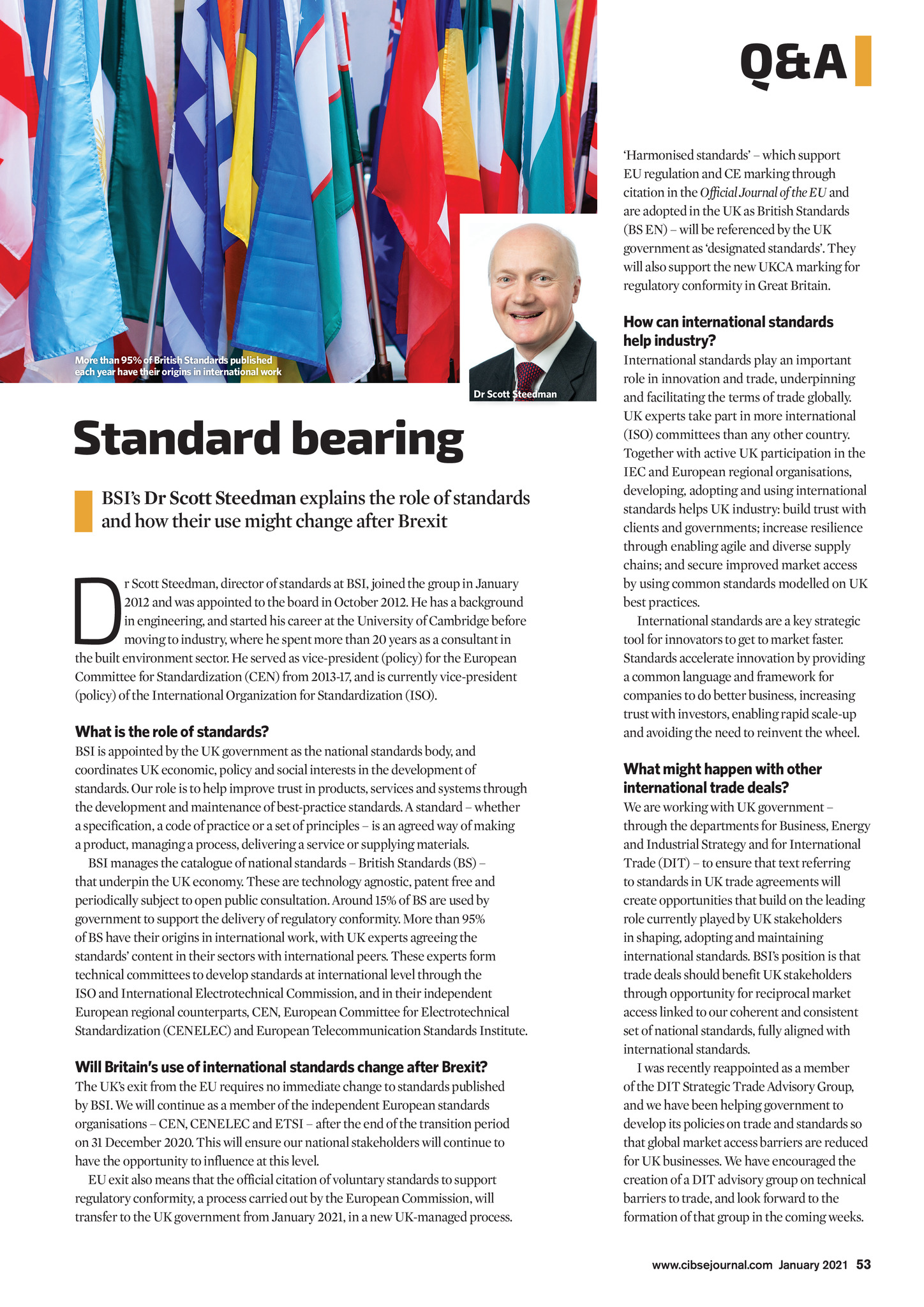
Q&A Harmonised standards which support EU regulation and CE marking through citation in the Ofcial Journal of the EU and are adopted in the UK as British Standards (BS EN) will be referenced by the UK government as designated standards. They will also support the new UKCA marking for regulatory conformity in Great Britain. How can international standards help industry? More than 95% of British Standards published each year have their origins in international work Dr Scott Steedman Standard bearing BSIs Dr Scott Steedman explains the role of standards and how their use might change after Brexit D r Scott Steedman, director of standards at BSI, joined the group in January 2012 and was appointed to the board in October 2012. He has a background in engineering, and started his career at the University of Cambridge before moving to industry, where he spent more than 20 years as a consultant in the built environment sector. He served as vice-president (policy) for the European Committee for Standardization (CEN) from 2013-17, and is currently vice-president (policy) of the International Organization for Standardization (ISO). What is the role of standards? BSI is appointed by the UK government as the national standards body, and coordinates UK economic, policy and social interests in the development of standards. Our role is to help improve trust in products, services and systems through the development and maintenance of best-practice standards. A standard whether a specification, a code of practice or a set of principles is an agreed way of making a product, managing a process, delivering a service or supplying materials. BSI manages the catalogue of national standards British Standards (BS) that underpin the UK economy. These are technology agnostic, patent free and periodically subject to open public consultation. Around 15% of BS are used by government to support the delivery of regulatory conformity. More than 95% of BS have their origins in international work, with UK experts agreeing the standards content in their sectors with international peers. These experts form technical committees to develop standards at international level through the ISO and International Electrotechnical Commission, and in their independent European regional counterparts, CEN, European Committee for Electrotechnical Standardization (CENELEC) and European Telecommunication Standards Institute. Will Britains use of international standards change after Brexit? The UKs exit from the EU requires no immediate change to standards published by BSI. We will continue as a member of the independent European standards organisations CEN, CENELEC and ETSI after the end of the transition period on 31 December 2020. This will ensure our national stakeholders will continue to have the opportunity to influence at this level. EU exit also means that the official citation of voluntary standards to support regulatory conformity, a process carried out by the European Commission, will transfer to the UK government from January 2021, in a new UK-managed process. International standards play an important role in innovation and trade, underpinning and facilitating the terms of trade globally. UK experts take part in more international (ISO) committees than any other country. Together with active UK participation in the IEC and European regional organisations, developing, adopting and using international standards helps UK industry: build trust with clients and governments; increase resilience through enabling agile and diverse supply chains; and secure improved market access by using common standards modelled on UK best practices. International standards are a key strategic tool for innovators to get to market faster. Standards accelerate innovation by providing a common language and framework for companies to do better business, increasing trust with investors, enabling rapid scale-up and avoiding the need to reinvent the wheel. What might happen with other international trade deals? We are working with UK government through the departments for Business, Energy and Industrial Strategy and for International Trade (DIT) to ensure that text referring to standards in UK trade agreements will create opportunities that build on the leading role currently played by UK stakeholders in shaping, adopting and maintaining international standards. BSIs position is that trade deals should benefit UK stakeholders through opportunity for reciprocal market access linked to our coherent and consistent set of national standards, fully aligned with international standards. I was recently reappointed as a member of the DIT Strategic Trade Advisory Group, and we have been helping government to develop its policies on trade and standards so that global market access barriers are reduced for UK businesses. We have encouraged the creation of a DIT advisory group on technical barriers to trade, and look forward to the formation of that group in the coming weeks. www.cibsejournal.com January 2021 53 CIBSE Jan21 pp53 Q&A.indd 53 18/12/2020 15:33