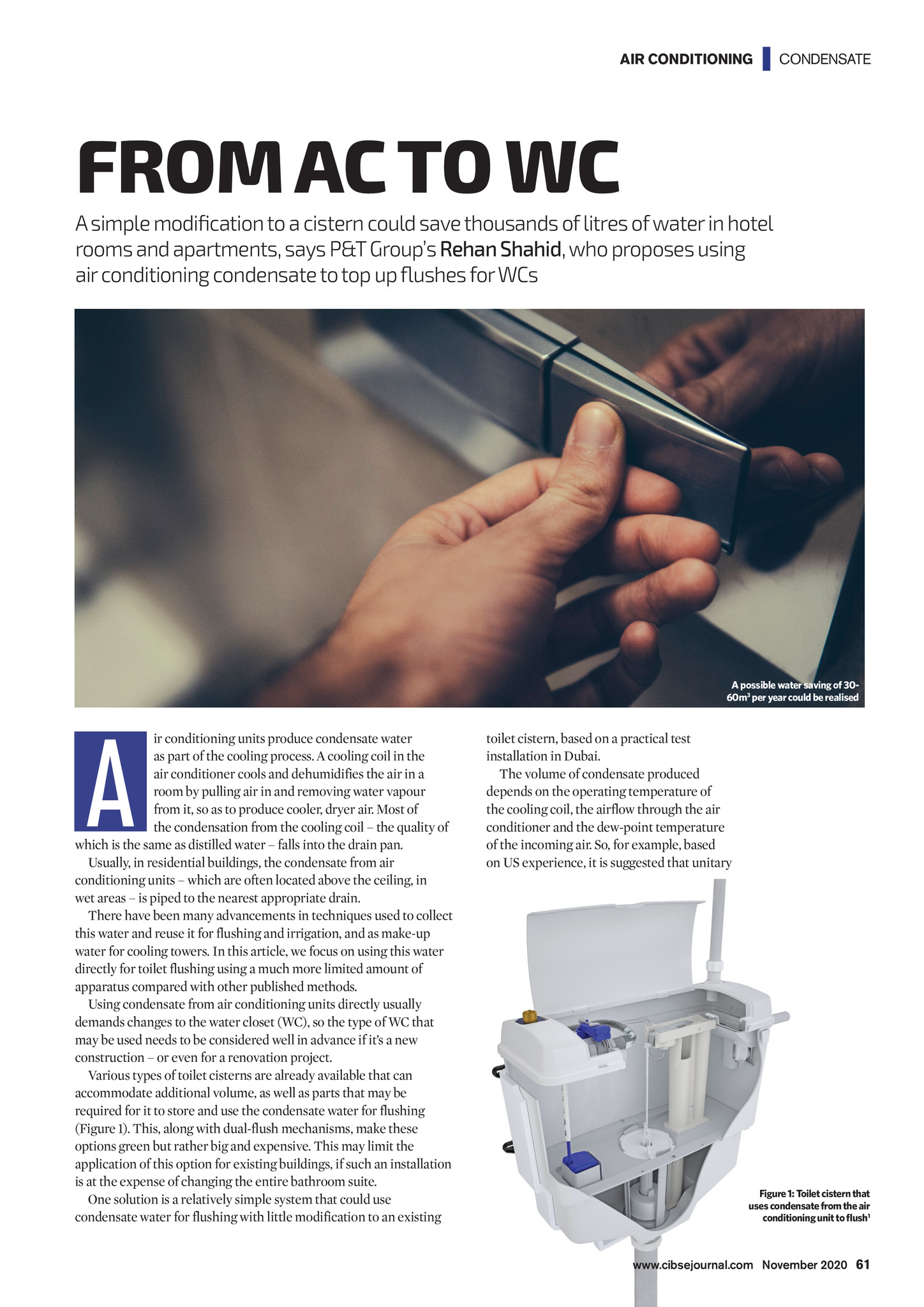
AIR CONDITIONING | CONDENSATE FROM AC TO WC A simple modification to a cistern could save thousands of litres of water in hotel rooms and apartments, says P&T Groups Rehan Shahid, who proposes using air conditioning condensate to top up flushes for WCs A possible water saving of 3060m3 per year could be realised A ir conditioning units produce condensate water as part of the cooling process. A cooling coil in the air conditioner cools and dehumidifies the air in a room by pulling air in and removing water vapour from it, so as to produce cooler, dryer air. Most of the condensation from the cooling coil the quality of which is the same as distilled water falls into the drain pan. Usually, in residential buildings, the condensate from air conditioning units which are often located above the ceiling, in wet areas is piped to the nearest appropriate drain. There have been many advancements in techniques used to collect this water and reuse it for flushing and irrigation, and as make-up water for cooling towers. In this article, we focus on using this water directly for toilet flushing using a much more limited amount of apparatus compared with other published methods. Using condensate from air conditioning units directly usually demands changes to the water closet (WC), so the type of WC that may be used needs to be considered well in advance if its a new construction or even for a renovation project. Various types of toilet cisterns are already available that can accommodate additional volume, as well as parts that may be required for it to store and use the condensate water for flushing (Figure 1). This, along with dual-flush mechanisms, make these options green but rather big and expensive. This may limit the application of this option for existing buildings, if such an installation is at the expense of changing the entire bathroom suite. One solution is a relatively simple system that could use condensate water for flushing with little modification to an existing toilet cistern, based on a practical test installation in Dubai. The volume of condensate produced depends on the operating temperature of the cooling coil, the airflow through the air conditioner and the dew-point temperature of the incoming air. So, for example, based on US experience, it is suggested that unitary Figure 1: Toilet cistern that uses condensate from the air conditioning unit to flush1 www.cibsejournal.com November 2020 61 CIBSE Nov20 pp61-62 AC condensate.indd 61 23/10/2020 16:41