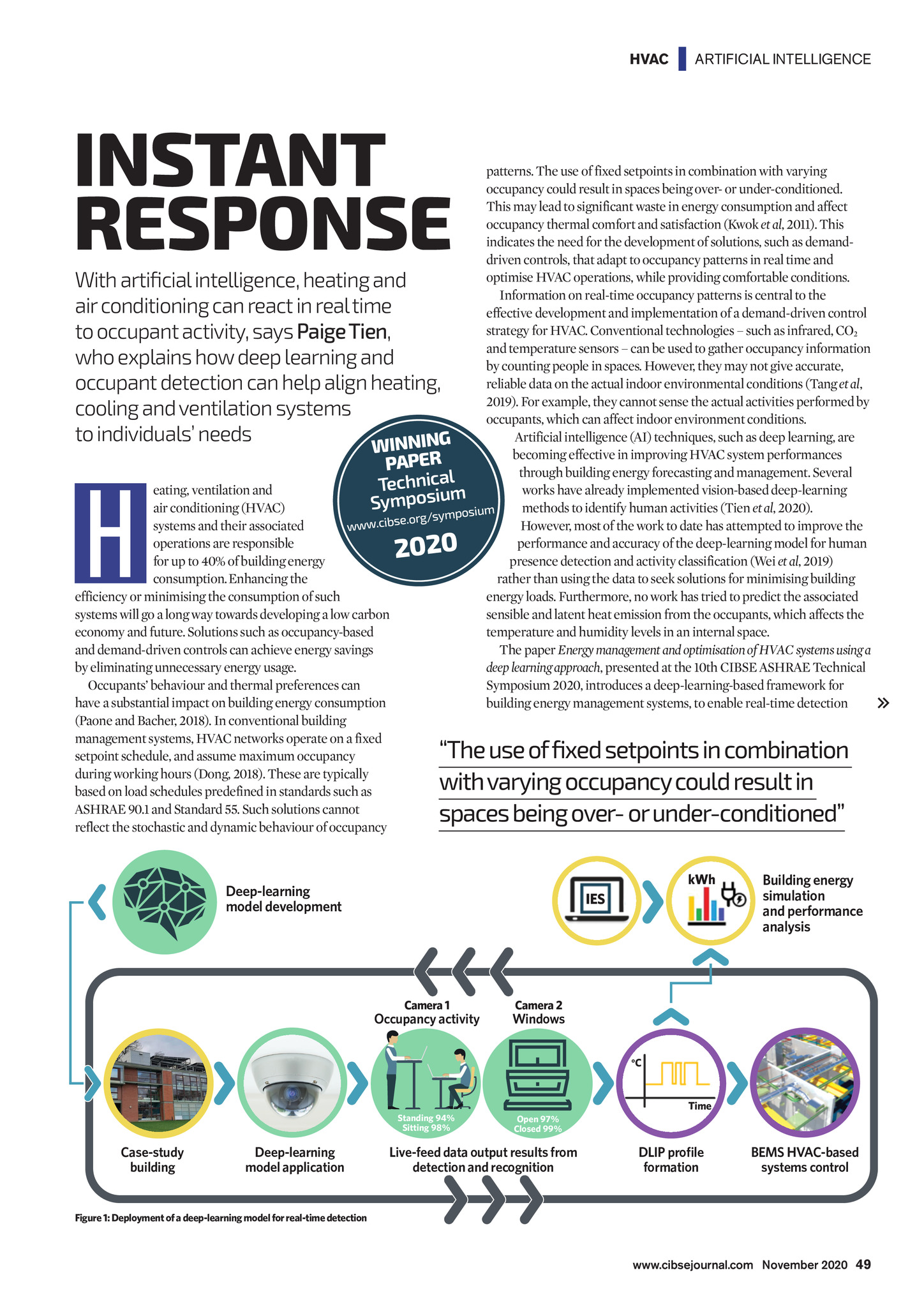
HVAC | ARTIFICIAL INTELLIGENCE INSTANT RESPONSE patterns. The use of fixed setpoints in combination with varying occupancy could result in spaces being over- or under-conditioned. This may lead to significant waste in energy consumption and affect occupancy thermal comfort and satisfaction (Kwok et al, 2011). This indicates the need for the development of solutions, such as demanddriven controls, that adapt to occupancy patterns in real time and optimise HVAC operations, while providing comfortable conditions. With artificial intelligence, heating and Information on real-time occupancy patterns is central to the air conditioning can react in real time effective development and implementation of a demand-driven control strategy for HVAC. Conventional technologies such as infrared, CO2 to occupant activity, says Paige Tien, and temperature sensors can be used to gather occupancy information who explains how deep learning and by counting people in spaces. However, they may not give accurate, reliable data on the actual indoor environmental conditions (Tang et al, occupant detection can help align heating, 2019). For example, they cannot sense the actual activities performed by cooling and ventilation systems occupants, which can affect indoor environment conditions. to individuals needs Artificial intelligence (AI) techniques, such as deep learning, are G IN WINN becoming effective in improving HVAC system performances PAPER through building energy forecasting and management. Several Technicalm eating, ventilation and works have already implemented vision-based deep-learning Symposiu posium methods to identify human activities (Tien et al, 2020). air conditioning (HVAC) .org/sym systems and their associated However, most of the work to date has attempted to improve the www.cibse operations are responsible performance and accuracy of the deep-learning model for human for up to 40% of building energy presence detection and activity classification (Wei et al, 2019) consumption. Enhancing the rather than using the data to seek solutions for minimising building efficiency or minimising the consumption of such energy loads. Furthermore, no work has tried to predict the associated systems will go a long way towards developing a low carbon sensible and latent heat emission from the occupants, which affects the economy and future. Solutions such as occupancy-based temperature and humidity levels in an internal space. and demand-driven controls can achieve energy savings The paper Energy management and optimisation of HVAC systems using a by eliminating unnecessary energy usage. deep learning approach, presented at the 10th CIBSE ASHRAE Technical Occupants behaviour and thermal preferences can Symposium 2020, introduces a deep-learning-based framework for have a substantial impact on building energy consumption building energy management systems, to enable real-time detection (Paone and Bacher, 2018). In conventional building management systems, HVAC networks operate on a fixed setpoint schedule, and assume maximum occupancy during working hours (Dong, 2018). These are typically based on load schedules predefined in standards such as ASHRAE 90.1 and Standard 55. Such solutions cannot reflect the stochastic and dynamic behaviour of occupancy H 2020 The use of fixed setpoints in combination with varying occupancy could result in spaces being over- or under-conditioned kWh Deep-learning model development IES Camera 1 Occupancy activity Camera 2 Windows o Standing 94% Sitting 98% Case-study building Deep-learning model application Building energy simulation and performance analysis C Time Open 97% Closed 99% Live-feed data output results from detection and recognition DLIP profile formation BEMS HVAC-based systems control Figure 1: Deployment of a deep-learning model for real-time detection www.cibsejournal.com November 2020 49 CIBSE Nov 2020 pp49-50 HVAC deep learning.indd 49 23/10/2020 16:32