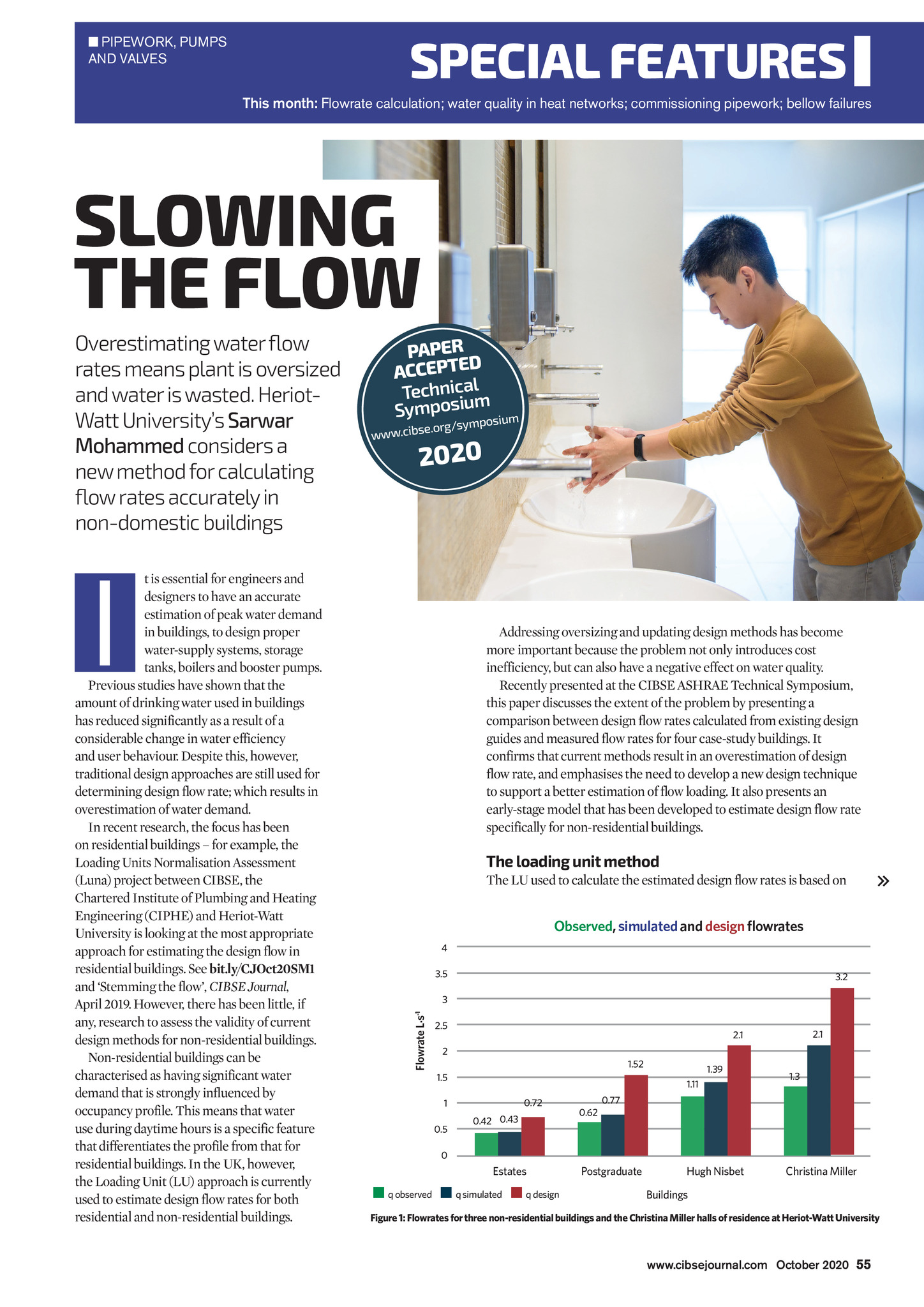
SPECIAL FEATURES PIPEWORK, PUMPS AND VALVES This month: Flowrate calculation; water quality in heat networks; commissioning pipework; bellow failures SLOWING THE FLOW Overestimating water flow rates means plant is oversized and water is wasted. HeriotWatt Universitys Sarwar Mohammed considers a new method for calculating flow rates accurately in non-domestic buildings PAPER ACCEPTED Technicalm Symposiu posium .org/sym www.cibse 2020 I Addressing oversizing and updating design methods has become more important because the problem not only introduces cost inefficiency, but can also have a negative effect on water quality. Recently presented at the CIBSE ASHRAE Technical Symposium, this paper discusses the extent of the problem by presenting a comparison between design flow rates calculated from existing design guides and measured flow rates for four case-study buildings. It confirms that current methods result in an overestimation of design flow rate, and emphasises the need to develop a new design technique to support a better estimation of flow loading. It also presents an early-stage model that has been developed to estimate design flow rate specifically for non-residential buildings. The loading unit method The LU used to calculate the estimated design flow rates is based on Observed, simulated and design flowrates 4 3.5 3.2 3 Flowrate L.s-1 t is essential for engineers and designers to have an accurate estimation of peak water demand in buildings, to design proper water-supply systems, storage tanks, boilers and booster pumps. Previous studies have shown that the amount of drinking water used in buildings has reduced significantly as a result of a considerable change in water efficiency and user behaviour. Despite this, however, traditional design approaches are still used for determining design flow rate; which results in overestimation of water demand. In recent research, the focus has been on residential buildings for example, the Loading Units Normalisation Assessment (Luna) project between CIBSE, the Chartered Institute of Plumbing and Heating Engineering (CIPHE) and Heriot-Watt University is looking at the most appropriate approach for estimating the design flow in residential buildings. See bit.ly/CJOct20SM1 and Stemming the flow, CIBSE Journal, April 2019. However, there has been little, if any, research to assess the validity of current design methods for non-residential buildings. Non-residential buildings can be characterised as having significant water demand that is strongly influenced by occupancy profile. This means that water use during daytime hours is a specific feature that differentiates the profile from that for residential buildings. In the UK, however, the Loading Unit (LU) approach is currently used to estimate design flow rates for both residential and non-residential buildings. 2.5 2.1 2.1 2 1.52 1.5 0.72 1 0.5 1.39 1.11 0.42 0.43 1.3 0.77 0.62 0 Estates q observed q simulated q design Postgraduate Hugh Nisbet Christina Miller Buildings Figure 1: Flowrates for three non-residential buildings and the Christina Miller halls of residence at Heriot-Watt University www.cibsejournal.com October 2020 55 CIBSE Oct20 pp55-56 Flow rate method.indd 55 25/09/2020 16:47